
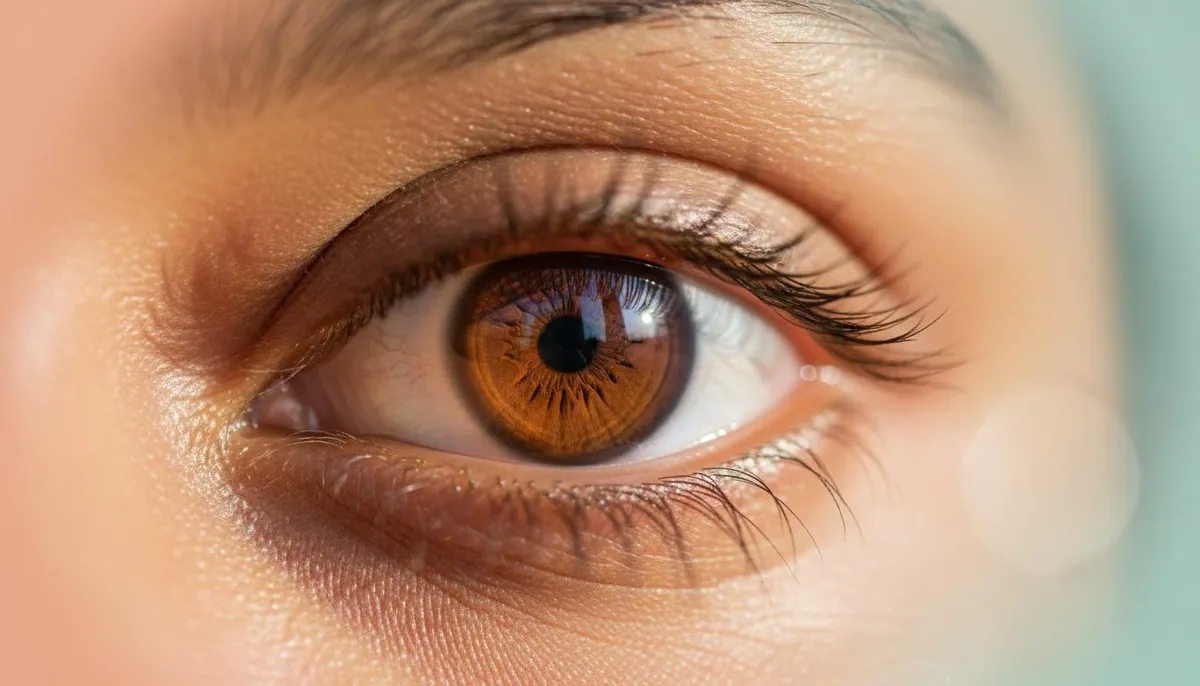
Have you ever looked in the mirror and noticed a small spot inside your eye, or on the white part of your eye? Maybe you've seen one on the eye of a friend or family member. Seeing these can make you a little curious, and maybe even a little scared. So today we're going to talk about these spots that appear on the eye, or in medical terms, (Nevus).
What exactly is an eye freckle/nevus?
Simply put, a mole is a small, colored growth that occurs on the surface of our eye or inside our eye. Just like spots form on our skin. We call a single mole a (Nevus). Sometimes these can be present at birth. Or they can develop new ones during life.
The important thing is that most of these eye spots are harmless. However, there are some types of spots that, although rare, can turn into a cancerous condition called Melanoma''. That's why your eye doctor will pay special attention to these types of spots when examining your eyes. Usually, this type of spot is only seen in one eye.
These spots are formed when cells called Melanocytes'', a type of cell that gives color to our skin, eyes, and hair, clump together and produce a pigment called Melanin''.
Are there any types of these spots? Where do they form inside the eye?
Yes, these eye spots can be divided into several types depending on where they are located. Let's see what they are.
Conjunctival Nevus
These types of spots form on the thin, transparent membrane that covers the front of our eyes and is also on the inside of the eyelids. This is called the Conjunctiva. These spots can come in a variety of colors, from yellow to gray to brown. They are often easily visible because they appear on the Sclera, the white part of the eye. These are the most common spots that can be seen on the surface of the eye.
Iris Nevus / Iris Freckle
Both types of spots form in the part of our eyes that gives them color, the (Iris). Think about it, some people have blue eyes, some have brown eyes, and that's where these spots form. The main difference between an (Iris Nevus) and an (Iris Freckle) is the size and depth.
An (Iris Nevus) is larger than an (Iris Freckle). Also, an (Iris Nevus) can go deep into the layers of the iris, and sometimes the pupil of the eye can be pulled to one side.
Spots at the back of the eye (Choroidal Nevus)
This is a type of mole that forms inside the eye, at the back. They form in a layer called the (Choroid). This (Choroid) part, together with the iris, is part of the system that gives the eye its color. Sometimes this (Choroidal Nevus) can be very light in color, and is also called (Amelanotic Choroidal Nevus). Since these are not visible from the outside, they can only be found when an ophthalmologist examines the inside of the eye with special equipment.
Remember, both (Iris Nevi) and (Choroidal Nevi) belong to the larger category (Uveal Nevi).
How common is it to get eye spots?
Having a nevus is actually not that rare. According to statistics, approximately one in ten people may have a nevus. Although this condition is said to be more common among white people, this may be because these nevi are more easily visible on light-colored eyes.
What are the symptoms of this eye spot? When should we be concerned?
You can often see a mole on your eye. It's especially easy to see if it's on the white of your eye. Moles on the iris can also be seen, especially in people with light-colored eyes. Benign moles that are not cancerous usually don't cause you any problems.
However, if you have a mole on your eye and also have the following symptoms, you should be concerned:
- Changes in vision: For example, feeling like your vision is blurry.
- Seeing things floating in front of your eyes: This is also called Eye floaters.'' It can feel like small black dots or threads are moving around in front of your eyes.
- Eye pain or discomfort: This may also feel like a headache.
- Changes in the size, color, or shape of the mole: The mole becomes larger than it was before, darker in color, or changes in shape.
In particular, floaters and changes in vision (e.g., blurred vision in one side) may be signs of a retinal detachment. Choroidal nevi can sometimes leak fluid or develop new, abnormal blood vessels, which can lead to a retinal detachment.
Why do these spots appear on the eye?
As we mentioned earlier, freckles are caused by the clumping together of pigment cells called Melanocytes. These cells produce the pigment Melanin, which gives our eyes, hair, and skin their color.
Some eye spots can be hereditary, meaning they are caused by genetics. Others, like sun spots on our skin, can also be caused by sun exposure.
How does a doctor recognize this?
Your eye doctor can see some types of eye spots without a special eye exam. However, to find a spot that is deep inside the eye, such as a choroidal nevus, a complete eye exam is essential. The doctor may use special cameras and imaging techniques to take pictures of these spots and note their size and shape.
Is there a treatment for this? Does it have to be removed?
Most eye moles (nevi) are harmless and do not require any special treatment. Your doctor will do this at regular intervals.(intervals) It is advised to come and have your eyes checked. Then you can observe if there is any change in the mole. If you try to remove such a mole unnecessarily, it can also damage the eye.
However, if the doctor suspects that a mole may be malignant (cancerous), then treatment may be considered. In such cases, the doctor may recommend removing the mole through surgery, radiation therapy, or laser surgery. Sometimes, the doctor may also recommend observing the mole for a while.
Are there ways to reduce the appearance of eye spots?
There is no way to prevent a congenital freckle. However, to reduce the risk of developing new freckles as you get older, it is very important to protect your eyes from the sun. It is a good habit to wear good quality sunglasses that protect against ultraviolet rays.
What happens if you have a mole on your eye? Should you be afraid?
If you have a freckle on your eye, it's probably nothing to worry about. Most freckles are harmless, and they won't affect your vision. However, the most important thing is to see an eye doctor regularly and have your eyes checked.
If I have a mole on my eye, what should I pay attention to?
If you know you have a mole on your eye, be aware of these things:
- Get eye exams at regular intervals: Get your eyes checked as recommended by your doctor, perhaps once a year or every six months.
- Wear sunglasses: When going outside, especially in strong sunlight, wear sunglasses with (UV) protection.
- Wear safety glasses: If you are doing any work that could pose a risk to your eyes (e.g., woodworking, gardening), wear safety glasses.
- Tell your doctor if you notice any changes: If you notice any changes in your vision, eye discomfort, or changes in the appearance of your mole, see a doctor right away.
What is the difference between a normal mole and eye cancer (melanoma)?
Simply put, Melanoma is cancer. Nevus is a mole that is usually not cancerous. A Uveal Nevus, a mole on the iris or choroid, has a very low risk of becoming cancerous – approximately one in 8,000. Most moles are always benign.
If you have a mole on your eye, you may have wondered, "Is this dangerous?" or "Should I be worried about this?" You may have asked your doctor, or you may have thought about asking. In most cases, the answer is that a mole on your eye (nevus) is not dangerous. However, since some types of moles can become cancerous, it is important to see an eye doctor regularly for eye exams.
So, what are the things we need to remember from this?
Okay, so, from what we've talked about eye spots, these are the most important things you need to remember:
- Most eye spots are harmless: so don't be unnecessarily scared.
- Regular eye exams are essential: See if there are any changes in the vision and seek medical advice on time.
- Protect your eyes from the sun: Use good sunglasses.
- Report any changes to your doctor: If you notice any changes in vision, changes in vision, or eye pain, seek medical advice immediately.
- Rarely, it can lead to cancer: that's why medical supervision is important.
So, if you also have a mole on your eye, I hope this information will help you become aware of it, take the necessary steps, and maintain healthy eyes.





Janiw kuna arsuwinakas jichhakamax uñt’ayatäkiti. Aka chiqanx amuyt’awim jan ukax jiskt’awim yapxatañamawa.