
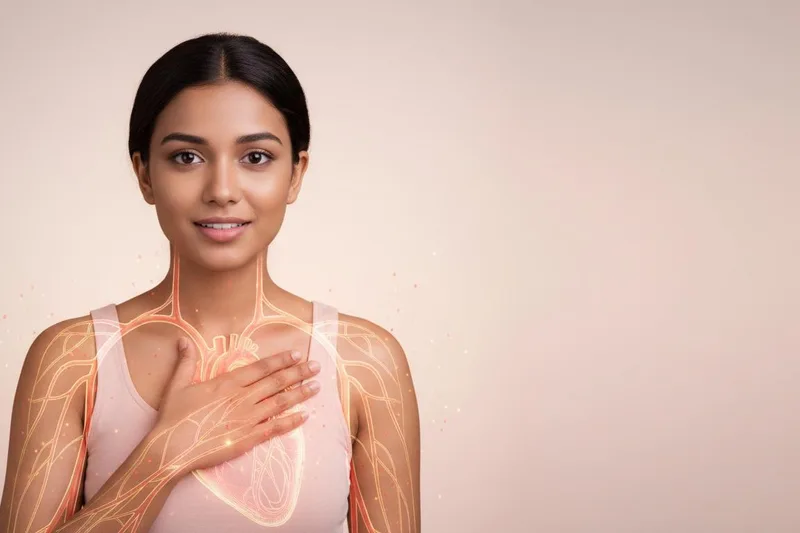
Have you ever wondered what the amazing story behind the sound of your heart beating, the pulsation you feel when you put your hand on your chest? Actually, inside our bodies, there is a system of blood vessels, just like a network of roads in a small city. This is what brings life to our entire body. Okay, let's see how this amazing thing called blood circulation, or blood circulation , works.
How valuable is blood?
We all know how valuable blood is to us. But what exactly does blood do to our bodies? Think about it, blood is like the most advanced delivery service in our bodies.
The services that blood provides to our bodies are truly amazing. Simply put:
- When we breathe, the oxygen that enters the lungs is carried by the blood to every tiny part of the body, to every cell.
- The nutrients we get from the food we eat, that is, the energy and vitamins our body needs, are distributed throughout the body by the blood.
- Also, blood helps to collect waste products, such as carbon dioxide , that are produced by the work of our cells and carry them to places where they are eliminated from the body (such as the lungs and kidneys).
- Not only this, but blood also carries immune cells that fight disease in our bodies and sends important chemicals like hormones to where they are needed.
So, blood is essential to sustaining our lives and maintaining the health of every tissue in our body.
Our heart - an amazing pump that works non-stop!
To send this blood throughout the body, it needs power, right? Well, that's what our heart, or cardiomyocyte, does. It's like a super pump that works non-stop all day long, even when we're sleeping. Every time the heart beats, a little blood is pumped throughout the body. This is so amazing that on average, our heart beats about a hundred thousand times a day!
The Vascular System - The Body's Highway Network
The blood that the heart pumps doesn't just spread throughout the body. It has a special system of roads. We call this the circulatory system . In this system, blood is carried through three types of tubes of different sizes called blood vessels . Just like a city has main roads, small roads, and byways.
These three types of blood vessels are:
1. Arteries
2. Veins
3. Capillaries
Let's now talk about each of these types separately.
Arteries - pathways that carry messages from the heart to the body
Arteries are large blood vessels that carry clean, oxygenated blood from the heart to all other tissues . They are usually shown in red on diagrams because they contain more oxygen (but in reality, all blood is red!).
- The largest and main artery that carries blood out of the heart is the aorta . It is like the largest pipe coming out of a water tank.
- Starting from this large artery, like the branches of a tree, it branches out into smaller arteries and travels throughout the body. These arteries supply blood to the arms, legs, head, and every organ in the body.
- The walls of the arteries are thick and strong, and they are elastic because they need to withstand the pressure and control the flow of blood when the heart pumps blood at high pressure.
Think of these arteries as the main water supply system for a city. They are the ones that carry clean water to every home and every place.
Capillaries - the smallest exchange centers
The blood that comes from the arteries does not go directly to the veins. In between, there is a network of very fine blood vessels, no thicker than a strand of hair, that reach every tiny part of the body, every cell. These are what we call capillaries. These are like little bridges that connect the arteries and veins.
- The walls of these capillaries are very thin - to be precise, only one cell layer thick.
- These thin walls allow oxygen and nutrients to be easily delivered from the blood to the tissues, and carbon dioxide and other waste products to be easily returned to the blood from the tissues.
- Simply put, these capillaries are where the real exchange happens . It's like a little shop, where goods are exchanged back and forth.
This capillary network is so fine that it is said that not a single cell in our body is more than a millimeter away from one of these capillaries. They are so widespread throughout the body.
Veins - Pathways that carry waste-laden blood back to the heart
Now, after supplying oxygen and nutrients to the tissues and collecting carbon dioxide and waste products from them, the blood must be brought back to the heart. That important job is done by a type of blood vessel called a vein. These are usually shown in blue on diagrams because this blood has less oxygen.
- Small veins, starting from capillaries, gradually join together to form larger veins, which eventually bring blood to the heart. Just like small streams join together to form a large river.
- Normally, blood with less oxygen and more carbon dioxide goes through this. (But there is one exception to this, and that is the veins that bring clean blood from the lungs to the heart - they are called pulmonary veins. It's a little complicated, we'll talk about that later).
- You've probably noticed that sometimes, on your arms or legs, veins appear blue above the skin. Those are veins. Veins are located a little more superficially than arteries.
- The large vein that carries blood from our head and arms to the heart is called the Superior Vena Cava . The inferior Vena Cava carries blood from the abdomen and legs . These two large veins collect impure blood from the heart.
- The walls of veins are slightly thinner and less elastic than those of arteries because blood flows through veins at lower pressure.
- There is another very important thing in veins. And that is valves.. These are like doors that open only one way. These valves help blood flow in only one direction, toward the heart, and prevent it from flowing backward. These valves are especially helpful in bringing blood up against gravity, especially from places like the legs.
Do you know how long this blood vessel system is?
You wouldn't believe it, but if you stretched out all the arteries, veins, and capillaries we've talked about, they would be over 60,000 miles (96,500 kilometers) long ! That's enough to go around the world more than twice! Isn't it amazing that we actually have such a long network of roads inside our bodies?
Constant blood flow and the role of the heart
In this way, the blood in our body does not stop flowing for a single second. This process continues while we are awake, sleeping, running, and eating. The root of all this is the non-stop pumping of our heart. The heart acts as the engine of this entire circulatory system.
Why is this blood journey so important to us?
Now you probably understand how important this blood flow, or blood circulation, is to our bodies.
Simply put:
- For every tiny cell in our body to live and function, this blood flow must occur precisely .
- Our cells cannot function without oxygen and nutrients, just like a car cannot run without fuel.
- Also, if waste products are not removed, cells can be damaged and even die.
- Sometimes, when problems arise in these blood vessels, for example, if they become blocked (with deposits of things like cholesterol) or if their elasticity decreases, blood flow can be impaired and various diseases can occur. These can even lead to serious conditions like heart attacks and strokes.
That is why maintaining healthy blood circulation is so important for our overall health.
The most important things we need to remember
So, now you understand what a complex, amazing, and essential process this blood circulation inside our bodies is.
Our heart, a small organ, constantly pumps blood through this vast network of blood vessels, giving life to every cell in our body. As long as this system is working properly, we are healthy and well.
Therefore, it is very important to take care of our heart and this circulatory system, which means following good habits like eating healthy, exercising, and avoiding smoking. Because this amazing system is what keeps us alive!
` Blood, blood, heart, blood circulation, arteries, veins, capillaries, oxygen, nutrition




💬 Comments (0)
No comments have been posted yet. Add your comment here for the first time.
Add your comment