
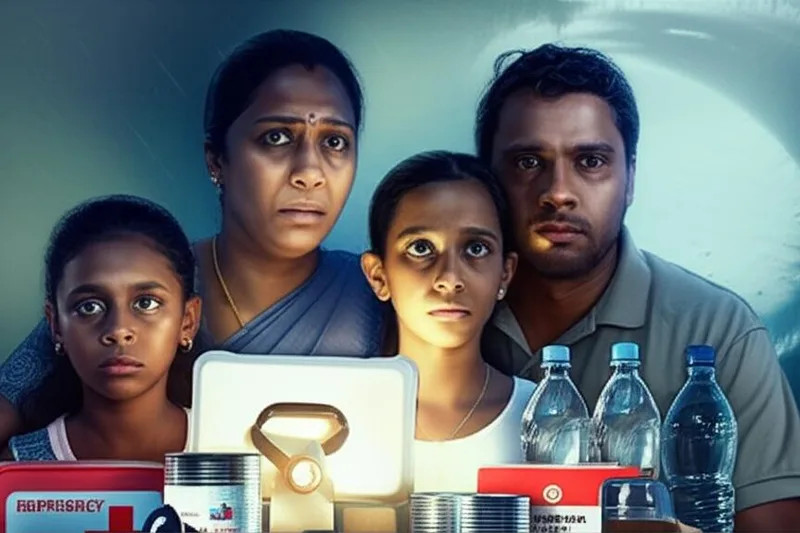
You can't really say anything about the weather in our country, can you? Suddenly, heavy rains come and cause floods , strong winds blow and sweep everything away. When living with such natural disasters, the best thing we can all do is to be prepared in advance. Because if we do, we can save ourselves and our loved ones from great danger. So today, let's talk about how we can prepare for severe weather conditions like a hurricane.
What is a hurricane?
Simply put, a hurricane is a very large, violent storm system that forms over the ocean. It is when these systems move inland that they become most dangerous. The main dangers associated with such a storm are:
- Heavy rain and the resulting floods .
- Strong winds blowing at speeds of several kilometers per hour.
- Small whirlwinds like tornadoes .
- Storm Surges: A sudden rise in sea level as a storm approaches land, submerging the land.
These storms belong to a category called Tropical Cyclones . They get their energy from warm ocean waters. As the storm gains strength, the winds inside it begin to rapidly rotate around a central "eye."
These hurricanes are classified according to their wind speed.
- Tropical Depressions: Wind speeds less than 39 miles per hour (62 km/h).
- Tropical Storms: Wind speeds between 39-73 miles per hour (63-118 km/h).
- Hurricanes: Wind speeds greater than 74 miles per hour ( 119 km/h).
These hurricanes are classified on a scale of 1 to 5. Storms falling into categories 3, 4, and 5 are called "Major Hurricanes" and have wind speeds greater than 111 miles per hour (178 km/h). These can cause the most damage.
Let's understand weather warnings exactly.
Our country's Meteorological Department is the one that informs us about such hazards. It is very important to know exactly what the announcements they issue mean. Then we can take the necessary steps in time.
| Warning type | What does that say? |
|---|---|
| Advisory | This means that the weather conditions are likely to be dangerous. Even if they are not severe enough to cause loss of life, this is to say to be careful . |
| Watch | Severe storms are expected within the next 48 hours. You should start preparing now. You should decide whether to stay home or move to a safer place. Continue to monitor official announcements. |
| Warning | A severe storm is expected to affect your area within the next 36 hours. You should have completed all your preparations by now. If authorities tell you to evacuate the area, leave immediately . |
Things we should do before a storm
It's wise to prepare in advance, rather than waiting until an accident happens. Here are some things to add to your preparedness list.
Things needed for an emergency
- Save emergency phone numbers in your phone. Numbers like the police (119), ambulance (1990 - Suwaseriya ), and the Disaster Management Center (117) are essential.
- Prepare an emergency kit . Put in it the things you need, such as medicine, a torch, extra batteries, a power bank, blankets, first aid supplies, soap, and hygiene items.
- Put your important documents (birth certificates, ID cards, deeds, bank books, education certificates) in a waterproof bag and keep them in a safe place.
- Prepare food and water for at least three days . Preservatives like canned fish and biscuits are good.
- Keep your vehicle's fuel tank full .
- Make a plan for your pets too. Think in advance about where you will keep them and whether you will prepare food and drink for them.
Here's how to prepare your home
- Remove items from around the garden that could be blown away by the wind (chairs, tables, bicycles, flower pots) and store them in a safe place.
- Check to see if things like the sheets hanging from the roof are properly installed .
- Close windows and doors tightly. If possible, covering them with boards can help prevent accidents caused by broken glass.
- Keep clean containers, tanks, barrels, bathtubs, etc. filled with drinking water . This is very useful in case of a power outage.
- If you have a generator, check to see if it has enough fuel.
- Identify the safest place inside the house. It should be a room that is away from windows and doors and is not subject to flooding.
What do you do during a storm?
If authorities have not ordered you to evacuate and you decide to stay home, do not leave your home until the storm has passed. Stay in the safest room you have identified. If there is flooding, an upper floor is safer. If there is strong wind, a lower floor is safer.
Never walk or drive on flooded roads. The water can be much deeper than it appears. And there may be dangerous things in that water.
Imagine, these things could be in the flood:
- Dangerous animals like snakes
- Broken glass, sharp metal pieces
- Garbage, waste
- Chemicals such as oil and grease
- Deadly diseases like Leptospirosis
In a life-threatening situation like this, call an emergency number. But remember, communication lines may be down at that time and help may be delayed.
What do you do after the storm?
If you have gone to a safe place, do not return home until authorities say it is safe to return . You should check damaged buildings to make sure they are safe before entering them.
If you are at home, be very careful when going out. Flooding may still be present in some areas. Check carefully for fallen trees, power lines, and poles. Do not attempt to move heavy objects alone. Most importantly, let your family and friends know that you are safe.
You can breathe a sigh of relief as you talk to your insurance company about the damage to your home and begin the repairs. You survived a hurricane, and that's largely due to your excellent preparation.
Take-Home Message
- Always pay attention to official announcements issued by the Meteorological Department. Don't believe rumors.
- Always keep an "emergency kit" ready with things like medicine, food, water, and a torch in case of an emergency.
- Be aware in advance of safe places in your area and the routes to get there.
- Never go into a flood for any reason. There may be a greater danger lurking there than meets the eye.
- After an accident, let your family know that you are safe. Also check on your neighbors.


💬 Comments (0)
No comments have been posted yet. Add your comment here for the first time.
Add your comment