
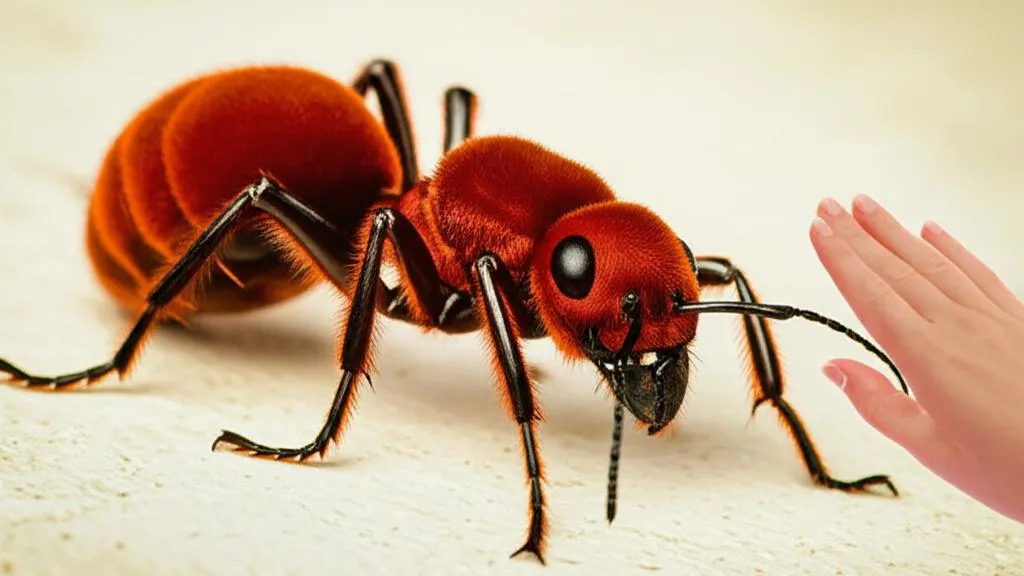
Have you ever walked around your garden or yard and seen a beautiful, bright red, velvety little creature? It looks like a big, furry ant. Some people are scared when they see this creature, and its name is a bit scary. 'Cow Killer Ant'. So today, let's talk about who this creature really is, is it as dangerous as its name suggests, and what happens if it bites.
Who really is this Cow Killer Ant?
The first thing to say is that even though this animal's name has the word 'ant' in it, it is not an ant. And as the name suggests, 'Cow Killer', it does not kill cows. So who is this?
Simply put, this is a wasp. The female has no wings, so when she walks on the ground, she looks like a large, hairy ant. Some people call it the 'Velvet Ant' because of its velvety appearance. Ants, wasps, and bees all belong to the same scientific order. We call it (Hymenoptera).
Another unique feature of these animals is that the male and female look very different from each other. Scientifically, this is called sexually dimorphic''. They are so different that some people think they are two different species of animals.
Let's see what the difference is.
| Characteristic | Female | Male |
|---|---|---|
| Wings | No. He walks on the ground. | It has dark brown or black wings. |
| Size | Usually about 3/4 inch long. | The male may be slightly larger than the female. |
| Appearance | The black body is covered with bright red or orange fur. | Although they have similar color patterns, their wings give them a different appearance. |
Unlike other wasps and ants, these ones don't live in colonies or build nests. They are solitary creatures. The adults usually live by drinking nectar from flowers.
Is this animal really dangerous to us?
Although the name may sound scary, as mentioned earlier, this animal cannot kill a cow. However, that doesn't mean they are completely innocent. They have several ways to protect themselves.
You see the bright red color on their bodies. It's not just pretty. It's a warning. In the animal kingdom, this is called aposematic coloration.'' It's a signal to predators, to animals that want to eat them, saying, "I'm dangerous, don't come near me."
Apart from that, they have other security measures.
| Security system | Description |
|---|---|
| Strong skeleton | The outer part (exoskeleton) that covers their body is very strong. |
| Emitting a foul odor | When threatened, it emits an unpleasant odor. |
| Making a sound | They make a chirping sound by rubbing their legs together to warn each other. |
Learn about the bite!
The wingless female has the main weapon to defend herself. That is their fang. Like other wasps, these ones can sting very painfully.
According to a pain index developed by an entomologist, the pain of this animal's bite is classified as one of the highest levels of pain. This means that if you get bitten, it will hurt a lot.
But, the most important thing here and the one that will bring you relief is,Although this venom is painful, it is not toxic. That is, for an average person, this bite will not cause life-threatening or fatal injury. Also, these animals are not aggressive animals that will intentionally attack.
Although not dangerous to humans, it is a bit dangerous to other insects. When the female wasp is ready to lay her eggs, she finds a cell in another wasp species and lays her eggs inside it. The larvae that hatch from that egg live by eating the larvae of that other species. These animals are also called parasitoid wasps.
Where do we see these people the most?
Although this species (Dasymutilla occidentalis) is most commonly seen in America, there are species of this velvety-looking wasp in various parts of the world. In Sri Lanka, we can also see such animals, especially in open areas, gardens, flower beds, grassy fields and forested areas.
We may catch sight of the females walking on the ground, and the males drinking nectar from flowers. They are most active during the day, when the sun is up.
What should you do if you see or are bitten at home?
Since they live alone, they are unlikely to become a threat if they swarm inside a house. If they do suddenly enter a house, never touch them with your bare hands. Because if they are a female, they may think they are a threat and bite. You can safely put on gloves, grab them with a cup, and then throw them outside.
If you see an animal like this in your yard or garden, the best thing to do is leave it alone. Teach young children not to touch these brightly colored animals. They won't bite unless they feel threatened.
If you are suddenly bitten, don't panic.
- First, wash the bite area thoroughly with soap and water.
- Apply an ice pack to reduce pain and swelling.
- The pain usually subsides after a while. However, if the pain is unbearable, the swelling is very high, or if you suspect you have an allergy (e.g., difficulty breathing, hives, dizziness), it is best to see your doctor immediately.
- If you are showing symptoms of a severe allergic reaction, go to the nearest hospital Emergency Department (ETU) without delay.
💡 Take-Home Message
- The 'Cow Killer Ant' is not an ant, but a species of wingless female wasp.
- Their bright red color is a warning that says, "Don't come near."
- Although the bite is very painful, its venom is not fatal.
- These animals don't come to attack intentionally. If you see them, it's best to leave them alone.
- If you are stung, wash with soap and apply ice. If you experience severe pain or allergic symptoms, see your doctor immediately.



Janiw kuna arsuwinakas jichhakamax uñt’ayatäkiti. Aka chiqanx amuyt’awim jan ukax jiskt’awim yapxatañamawa.