

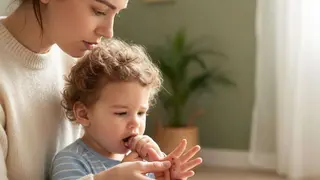
When you see your little one sleeping soundly and soundly with his thumb in his mouth, you feel a little happy and a little scared, "Hmm... wouldn't it be better if this continued?", right? This is actually a common problem faced by parents not only in Sri Lanka, but all over the world. So let's find out more about this today.
Why do babies like to suck their fingers so much?
Actually, sucking the thumb or other fingers is an innate habit that babies have from birth. Some babies can be seen sucking their fingers on scans while still in their mother's womb. We call this non-nutritive sucking. It means it is not something they do to satisfy their hunger.
Babies do this for several main reasons:
- Security and comfort: Finger licking provides them with a sense of security and comfort. It feels like they are with their mother. They use this method to comfort themselves when they are scared, tired, or in unfamiliar places.
- Learning about the world: Babies learn about their surroundings through their mouths. Even if it's a toy they can hold in their hands, the first thing they do is put it in their mouths. So, sucking their own fingers and hands is also part of that learning process.
- Stress reduction: Imagine, they feel a little stressed when they go to get an injection or meet someone new. At that time, they try to reduce that stress by sucking their finger.
Surprisingly, some studies have found that children who suck their thumbs as children have stronger immune systems and a lower risk of developing certain allergies as they grow up. This is because they are exposed to common germs in their everyday environment through their fingers.
Is a thumb or a pacifier better?
Some parents think that giving a pacifier or a pacifier is better than sucking a finger. Others think that pacifiers are dirty and interfere with breastfeeding. Let's look at the pros and cons of both.
| The point | Pacifier | Thumb |
|---|---|---|
| Stopping the habit | When the child gets a little older, we can remove the soup. That way, it's easier to break the habit. | This habit can be difficult to break because the finger is always with the child. |
| Cleanliness | It can be easily removed and cleaned by boiling it in hot water. | Hands can be dirty all the time. Since a child touches everything, there is a high chance that germs will get into their mouths. |
| Impact on teeth | Well-designed braces put less pressure on the teeth. | Long-term finger-snapping can cause problems such as teeth moving forward and gaps between the teeth. |
If you are serving soup, keep these things in mind:
If you decide to give your baby soup, be sure to follow these safety tips.
- Give the soup after the baby has finished feeding. Do not give it between meals or when the baby is hungry.
- Never tie a pacifier around a child's neck or in a crib with a cord. It can get stuck in the child's neck and cause a serious injury.
- Choose a single-piece soup pot that can be boiled and sterilized.
- The lid of the soup pot should be wider than the child's mouth. It should also have small holes for ventilation.
- Never add honey or sugar to soup. It increases the risk of tooth decay.
What are the risks if the finger continues to tear?
Children usually outgrow this habit between the ages of 2 and 4, before their permanent teeth start to come in. However, if a child continues to suck their thumb after the age of 4 or 5, some problems may arise.
- Dental problems: This is the main risk. As you continue to suck your thumb, the front teeth of your upper jaw may push forward. This can also cause an anterior open bite. This means that the front teeth do not meet when you close your mouth. Sometimes, if this condition becomes severe, you may even need surgery later.
- Speech problems: When there are gaps between the front teeth, it can be difficult to pronounce certain letters. You may also drool while speaking.
- Skin problems: Blisters and calluses may develop on the skin of the finger that is frequently bitten. Skin infections may also occur around the nail.
How can I help stop this habit?
The most important thing is, don't try to stop this by punishing or scolding the child. That will only make the child more depressed and addicted to this habit.
If your 4-year-old child still doesn't break this habit, you can try these things:
1. Find the cause: First, see when your child sucks their thumb. Is it when they are bored? When they are scared? When they are sleepy? If you find the cause, it will be easier to find a solution.
2. Talk to the child: In simple words that the child understands, teach him something lovingly, such as, "Son, if you pull your finger like that, your teeth will fall out and your beautiful smile will disappear."
3. Distract: As soon as the child tries to put his finger in his mouth, give him a toy that he can do with both hands (e.g., playing with clay, drawing).
4. Praise and reward: Praise your child a lot when he doesn't suck his thumb. Give him a small gift like, "Shh... my son didn't suck his thumb today, that's great."
5. Dentist's help: If all else fails, see a dentist. Sometimes the doctor may recommend a mouth appliance. Devices like the Palatal Crib work by taking away the sensation of putting your finger in your mouth. This will help break the habit.
The most important thing is patience. This habit cannot be stopped overnight. Trying with love and patience is the most successful way.
💡 Take-Home Message
- For most babies, finger sucking is a normal, comforting habit that comes naturally. Don't be too afraid of it in the early stages.
- Most children will naturally give up this habit before their permanent teeth come in, around the age of 4.
- It is important to lovingly help stop the habit, as it can cause damage to the teeth if this habit continues after the age of 4-5.
- Punishing or scaring your child can make the habit worse. Instead, offer praise and positive reinforcement.
- If the problem persists or you notice any changes in your teeth, be sure to consult a dentist. There are special treatments for this.





Janiw kuna arsuwinakas jichhakamax uñt’ayatäkiti. Aka chiqanx amuyt’awim jan ukax jiskt’awim yapxatañamawa.