

When your little one was born, or a few days after birth, you may have noticed a small spot or discoloration on their skin. You may have even been a little scared, wondering, "What is this?" These are often what we call " birthmarks ." As the name suggests, these are the spots that most babies have on their skin at birth. Some of them can appear before birth, and some can appear after birth. So today, let's talk a little more about these birthmarks, shall we?
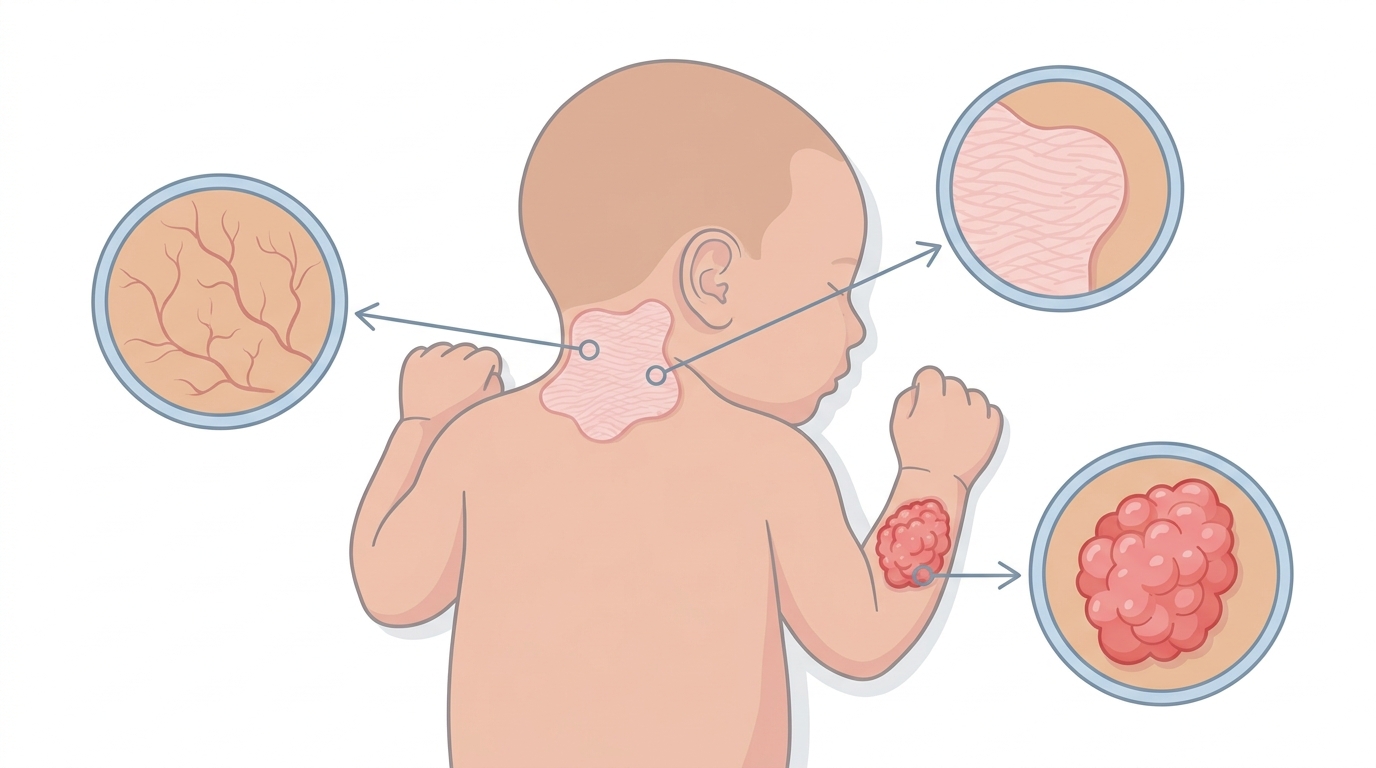
What are these birthmarks? Why do they form?
Simply put, birthmarks are discolorations or spots on the skin . They can come in a variety of shapes. Some are flat, while others are raised. They can also come in a variety of colors, such as red, pink, brown, blue, and black.
Now you're probably wondering, "Why on earth do these birthmarks happen?" To be honest, no one knows the exact reason why most birthmarks happen. It's pretty weird, isn't it? But the most important thing is, most of these birthmarks aren't a sign of any disease and they don't usually cause any pain to the baby. So don't worry unnecessarily, okay?
The popular birthmark called Hemangioma
One of the most common types of birthmarks is a hemangioma . You may have heard of this one. A hemangioma is a cluster of very small blood vessels (the kind that carry blood in our bodies) growing together in one place on the skin . Think of it like a bunch of blood vessels coming together to form a small lump. That's why they often look red or purple.
There is no clear reason why these blood vessels come together in this way. But remember one thing, this type of birthmark called hemangioma is also usually harmless . You can see these on the body of many newborn babies. Sometimes there are spots like this between the eyebrows (some people also call them "angel kisses"). These are usually caused by slightly dilated blood vessels, and they fade away in the early years of life.
What are the types of Hemangioma?
There are two main types of hemangioma. Let's take a look at that as well.
1. Superficial Hemangioma (also known as "strawberry spot")
This is sometimes called a strawberry hemangioma . You guessed it, right? It gets its name because it looks a bit like a strawberry. This mole is bright red and slightly raised above the skin.
Imagine that your baby has a raised spot on their arm or leg, the color of a small strawberry. That's what this looks like.
Most of these superficial hemangiomas disappear on their own by the time a child is about 5 years old . Some may disappear even earlier. In most cases, by the time a child is about 10 years old, this type of hemangioma has almost completely disappeared. Therefore, there is nothing to worry about.
2. Deep Hemangioma (or "deep mole")
The other type is Deep Hemangioma . This is sometimes called Cavernous Hemangioma . "Cavernous" means "cavern-like." Caverns are located deep inside the skin. This type of birthmark is located just below the top layer of the skin, a little deeper.
This deep hemangioma is a little more swollen than the strawberry mole mentioned earlier. The color is also different. It is not as dark red as a strawberry, but more like a bluish-red color . This can also shrink and fade over time. But sometimes it can take a little longer than superficial ones.
A special stain called Port Wine Stain
Another popular type of birthmark is the Port Wine Stain . These are not caused by a large number of blood vessels, but by the dilation of existing blood vessels. These spots do not protrude from the skin like the previously discussed hemangioma, and they are not raised or raised. They are flat on the surface of the skin .
A port wine stain is a dark maroon or red spot on the skin. It is named after the dark purple-red wine called "port wine." Children with these spots often have them on their face and neck.
Port Wine Stains rarely go away on their own . But don't worry. Doctors can sometimes use treatments like laser surgery to reduce the size of these spots to a point where they are barely noticeable. But the most important thing to remember is that birthmarks are not really a big deal, and there is no difference between children with and without birthmarks. Every child is equally valuable.
And the brown and blue spots? Are they moles?
Yes, if you have brown, blue, or black spots on your body that you were born with, they are most likely moles ! Moles are small clusters of pigment cells – the cells that give your skin its color – that form in one spot. Like other birthmarks, moles are usually painless, and in children they are rarely a sign of any illness. They are sometimes called "beauty marks/beauty spots."
When should you tell a doctor about a birthmark?
Although most birthmarks are harmless, there are times when it's best to seek medical advice. For example:
- If the birthmark suddenly gets bigger, changes color, or changes shape.
- If the spot is bleeding , itchy, or painful.
- Depending on where the mole is (e.g. near the eye, near the nose), it may seem like it is causing discomfort to the baby.
- If you have any doubts or fears about the spot.
Remember, even if you have the slightest doubt, it's best to talk to your baby's pediatrician and ask about it. They will tell you exactly whether it's normal or something you need to pay special attention to.
Finally, take-home message:
So, birthmarks are very common among babies.
- Most birthmarks are completely harmless and do not require any treatment.
- Some moles, like hemangioma, fade away on their own over time .
- Some spots, such as port wine stains, may persist, but can be treated if necessary.
- The most important thing is that having a birthmark does not mean your baby is worthless or different from others .
- If you have any questions or doubts, never hesitate to ask a doctor .
If your baby has a birthmark, accept it as part of their identity. They are all very special!
` Birthmark, Hemangioma, Strawberry Hemangioma, Deep Hemangioma, Port Wine Stain, Moles
ukat juk’ampinaka Doctoran qillqatapa
ukat juk’ampinaka Yurïwi chimpunakax saminakan chimpunakapawa, ukax wawax yurïwipan jan ukax mä juk’a pachat janchiparuw uñsti. Ukanakax pä chiqaruw jaljasispa, vascular (wila vasonak apthapita) jan ukax pigmentado (melanina celulanak apthapita). Cigüeña ukan chhuxriñchjatapa/salmón ukan ch’akhanakapa ukat hemangioma de fresa ukanakax sapakiw chhaqtawayxi, wawax jilxattaski ukhaxa. Ukampis yurïwipan mä chimpupax jankʼak jachʼaptaspa jan ukax wilax mistuni ukhaxa, qullirinakaruw iwxtʼasiñasa.
❓ ukat juk’ampinaka Mä qawqha juk’amp jiskt’äwinakampiw jikisipxasma (FAQ) .
ukat juk’ampinaka ¿Kunas wawanakan yurïwipan chimpunakapar puriyi?▼
ukat juk’ampinaka Yaqhipa yurïwi chimpunakaxa wila ch’akhanakaxa (Vascular) jan wali tantachasiwimpiwa lurasi, yaqhipaxa células pigmentarias (Melanocitos) ukanakana tantachasitapampiwa lurataraki, ukaxa janchiru color churaraki.
ukat juk’ampinaka ¿Taqi yurïwi chimpunakax wiñayatakïpachati?▼
ukat juk’ampinaka janiwa Jilapart yurïwi chimpunakaxa, salmón ch’akhanaka ukhamaraki hemangiomas de fresa, wawaxa preescolar mararu puriñkamaxa q’al chhaqtawayxi.
¿Kunapachas qullirir uñjañamaxa, yurïwitpach mä chimpunïñapataki?▼
ukat juk’ampinaka Yurïwi chimpuxa jank’aki saminakapa jan ukaxa uñnaqapa mayjt’ayaspa, usuchjata ukhamaraki wila mistu, jan ukaxa nayra jak’an utjchi ukatxa jani uñjañapatakixa, jank’aki qulliriru uñjañawa.


💬 Comments (0)
No comments have been posted yet. Add your comment here for the first time.
Add your comment