
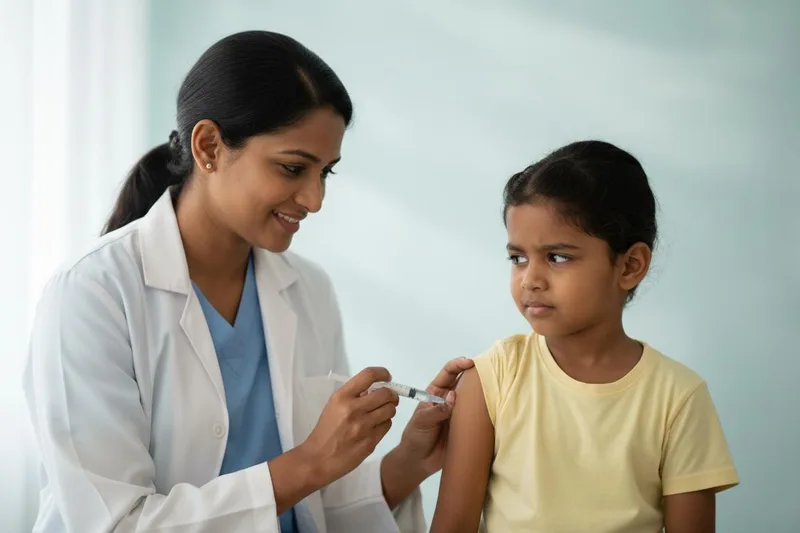
Nobody really likes getting a 'shot', that is, an injection with a needle, right? Especially little children. But did you know that doctors and nurses can protect your child from many dangerous diseases with these tiny injections? If your child gets these diseases, they can be in a lot of trouble. So, how much more valuable is it to be protected from these diseases than to feel the slight pain of the injection, right?
What exactly is a 'shot', or vaccine? How does it protect the baby?
Simply put, a vaccine is something that is given to your child. But it does not cause the disease. What it does is give a tiny piece of the disease-causing germ, or a dead or very weakened germ, to your child. Imagine if you gave a whole, live germ, it would cause the disease (like measles, for example).
But when you give a small, weakened, or dead part of a germ like this, it doesn't cause the disease. In fact, the opposite happens. Your child's body responds to the vaccine by producing antibodies . These antibodies are part of your child's immune system . They stay in your child's body. This way, if that bad germ ever enters the body in the future, your child's body is ready to fight it off.
When a child's body is protected against a disease in this way, we say that it has acquired immunity to that disease. Most of the time, this means that the child will not get that disease again. But sometimes, the child can get the disease. Take chickenpox, for example. Even children who have been vaccinated against chickenpox can sometimes get chickenpox. But the good news is that even if they do get it, it is usually very mild. There are fewer blisters and less itching.
How are these vaccines given to the baby?
Vaccines are given to your child by injection using a needle. The device that holds the liquid vaccine is called a syringe . The liquid medicine is injected into the body through a small hole in the needle. The injection is usually given in your child's arm (or sometimes in the thigh).
At what time are these vaccines given to young children?
The good news for moms is that most of the vaccines that children need are given before they turn two . So if you're old enough to read this article, you've probably already received most of your vaccines! After that, your child won't need many more.
Generally, in Sri Lanka, we vaccinate children according to the National Immunization Programme. Your child's Child Health Development Record (CHDR), I mean, that pink book has all these details. According to it, several vaccines are given during infancy, at 2, 4, 6 months, then at a year, and at 18 months. Then, several vaccines are given to children between the ages of 4 and 6. The next batch of vaccines is usually given when children are about 10-12 years old.
We should also mention the flu vaccine that is given every year. Now in some countries, this can be given as a nasal spray instead of a needle. However, in Sri Lanka, the most common vaccine is the shot. Both methods work equally well. Your doctor will tell you what is best for your child and whether any other vaccines are needed.
Why are these vaccines so important for our children?
Vaccines are very important for children because they protect them from the dangerous diseases mentioned above. Also, when every child in the community is properly vaccinated, the chances of someone else getting these diseases are greatly reduced. Imagine how much it means to stop a disease from spreading from one child to another? This is what we call herd immunity .
Because most children in Sri Lanka are properly vaccinated, it is now very rare to see someone with diseases like measles and mumps . Don't your parents have to show that your child has been vaccinated before sending them to school? Schools and kindergartens do this to prevent the spread of dangerous diseases among children and to protect children.
Does it really hurt when a vaccine is given? What can we as parents do at this time?
Okay, to be honest, yes. It hurts a little when a vaccine is given. The child feels it. But that pain usually comes and goes away very quickly. Don't worry about it if the child cries. Most children cry, it's normal.
You can try these things to make vaccinations a little easier for your child:
- Take the child's favorite toy, such as a teddy bear.
- Hold your child's hand while giving the vaccine. Your touch is a great source of strength for the child.
- Divert your child's attention. Sing a song, tell a story, or show them a beautiful picture in the room.
- The most important thing is to stay calm and not panic. If you panic, your child may become even more scared.
- Maybe the doctor will give the child something like a small sticker after the vaccination. When you get home, you can praise the child, give him a small gift, or even take him to a playground.
Sometimes after a vaccine is given, the area where the child was injected may be sore, red, or have a small blister-like bump. Also, a low fever may occur.There is a chance of an injection. If you have any problems like this, talk to your doctor. Usually, the redness and fever in this hand will go away quickly. If necessary, you can give your child a painkiller such as Paracetamol, which your doctor prescribes. Never give other medicines (especially aspirin) to young children without a doctor's advice.
It's normal for your child to not like vaccines. But remember, the best protection to keep them healthy is vaccinations!
Finally, the most important thing to remember! (Take-Home Message)
So, from all of this talk, you can probably understand how valuable vaccines are to the health of our children.
- Vaccines are the safest and best way to protect your child from serious, dangerous diseases .**
- Make sure your child gets all the necessary vaccinations on time. Check your Child Health Development Record (CHDR) regularly, and talk to your family health worker (midwife) and doctor regularly.
- If you notice anything unusual in your child after receiving a vaccine, if the fever does not go down, or if there is any other problem, see a doctor immediately.
- Don't believe the rumors and misconceptions of others. Always seek accurate, scientific information about vaccines from a doctor or family health worker.
Seeing your child healthy and happy is the dream of every mother and father. So vaccination is one of the biggest ways to achieve that dream. Don't be afraid, don't hesitate. Get your child vaccinated.
Vaccines, child health, immunization, baby vaccines, parenting advice, vaccination schedule, pediatric diseases


💬 Comments (0)
No comments have been posted yet. Add your comment here for the first time.
Add your comment