

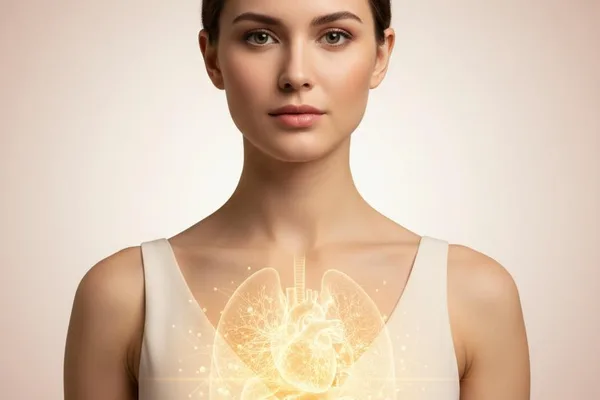
When you think of your chest, what comes to mind? Most of the time, it's your heart and lungs, right? That's true. But did you know that between your lungs, right in the center of your chest, there's a special space where your heart, as well as many other very important organs and blood vessels, are located? In medicine, this space is called the mediastinum. It's like a very busy, important intersection in our body. Let's talk about it briefly today.
What exactly is the mediastinum?
Simply put, the mediastinum is not an organ, it's a space. To be precise, it's a part of your chest cavity. Think of your chest as a house with three rooms. One room contains the left lung, and the other room contains the right lung. The space between these two rooms, which is like a living room, is what we call the mediastinum.
This space extends from the top of the chest to the bottom, that is, from the base of the neck to the diaphragm, and from the sternum in front to the spine in back. So this is not just an empty space, but a place that protects many things that are essential to our lives.
What is inside this mediastinum?
There are a lot of things in this space. Let's break them down into a few parts.
Important organs and structures
Within this space are several very important organs in our body.
| Organ/Structure | What to do simply |
|---|---|
| Heart | Our main motor that pumps blood throughout the body. It is located in the middle of the mediastinum. It is surrounded by a protective membrane (pericardium). |
| Esophagus | The tube that carries the food we eat and drink from the throat to the stomach. This also passes through the mediastinum. |
| Trachea | The main windpipe that carries the air we breathe to the lungs. It is located in front of the esophagus. |
| Thymus gland (Thymus) | A gland that helps our immune system. It's especially active when we're young. It's located in the upper, anterior part of the mediastinum. |
Great Vessels
The largest blood vessels that connect to the heart, that is, those that bring blood to and carry blood away from the heart, are also located within this mediastinum.
- Aorta: The largest blood vessel in the body. It carries clean (oxygenated) blood from the heart to the entire body.
- Superior Vena Cava: Brings impure blood from the upper part of the body ( head , neck, arms) to the heart.
- Pulmonary Trunk: Carries blood from the heart to the lungs to receive oxygen.
In addition, there are many other important blood vessels in this area.
More things
In addition to these main things,
- Lymph nodes
- Nerves
- This space is also filled with things like fatty tissue and connective tissues.
So what is the function of the mediastinum?
This has several main functions.
1. Being a safe house: Simply put, this is like a safe house for the heart, large blood vessels, and airways. It helps keep these organs together and in order.
2. Provides protection: The fatty tissue and connective tissue in this space provide good cushioning and protection for the internal organs. Also, the breastbone (sternum) in front protects these important organs from external blows.
3. Being a transit center: This is a major junction, like Colombo Fort. Everything that moves from one place in our body to another passes through this space. For example, food and drink travel from the throat to the stomach along the esophagus, which passes through the mediastinum. Similarly, nerves and blood vessels travel from the neck to the chest, and from the chest to the stomach, through this space.
Do doctors divide this mediastinum into sections?
Yes. To pinpoint the exact location of a problem, doctors divide this space called the mediastinum into smaller sections. The most modern method currently used is the classification of the three sections based on three-dimensional (3D) examinations such as CT scans.
| Part | Location and contents |
|---|---|
| Prevascular part | The part in front of the heart, behind the breastbone. The thymus gland, lymph nodes, and fatty tissue are located here. |
| Middle (Visceral) part | It contains things like the heart and its associated major blood vessels, the trachea, and part of the esophagus. |
| Posterior (Paravertebral) part | The part behind the heart and in front of the spine. This is where the nerves and soft tissues are. |
By talking about it in parts like this, it is a great help for doctors to guess where a tumor or other problem is located and what kind it might be.
What are the conditions that affect the mediastinum?
There are many conditions that can affect this important space. Some may start in the mediastinum itself (e.g. tumors), while others may originate elsewhere and spread here (e.g. cancer).
- Mediastinal tumors: Tumors that arise from the tissues in this space. These may or may not be cancerous.
- Mediastinitis: Infection or swelling in this area.
- Lymphoma: A type of cancer that occurs in the lymph nodes.
- Diseases of the aorta: Dangerous conditions such as a swelling of the aorta (Thoracic aortic aneurysm) or a tear in its wall (Aortic dissection).
- Esophageal cancer
- Cardiac tamponade: Fluid builds up in the sac surrounding the heart, causing pressure on the heart.
What is 'Widened Mediastinum'?
Have you ever seen a chest X-ray report that says "widened mediastinum"? This does not refer to a disease. It is a sign that a doctor sees on an X-ray.That means the mediastinum appears wider than normal.
There can be many reasons for this. It can be caused by the aforementioned problem with the aorta, a tumor, an infection, or even a chest injury. If something like this is seen, the doctor will order further tests, such as a CT scan, to find out the exact cause.
How to keep the mediastinum healthy?
Because the mediastinum is a space, keeping it healthy means keeping the organs inside it healthy. It's especially important to take care of your heart and blood vessels.
- Avoid smoking completely. Smoking is extremely harmful to the heart, blood vessels, and lungs.
- Eat a heart-healthy diet. Eat a diet low in oil, salt, and sugar, and high in fruits and vegetables.
- Exercise regularly. Talk to your doctor before starting any exercise program.
- Limit alcohol consumption.
- Use the medications you are prescribed exactly as prescribed (e.g. for high blood pressure, diabetes, cholesterol).
- Have a medical checkup at least once a year.
Doing these things can reduce the risk of many conditions that affect the mediastinum.
Take-Home Message
- The mediastinum is not an organ, but an important space in your chest between your lungs.
- Many things essential to life, such as your heart, major blood vessels, trachea, and esophagus, are protected within this space.
- The main function of the mediastinum is to provide a safe home for these organs and a passageway for important things to travel.
- 'Widened mediastinum' is a sign seen on an X-ray, not a disease. Further tests are needed to find the cause.
- The best way to keep this area healthy is to adopt a heart-healthy lifestyle. If you have any questions about this, talk to your doctor.




💬 Comments (0)
No comments have been posted yet. Add your comment here for the first time.
Add your comment