
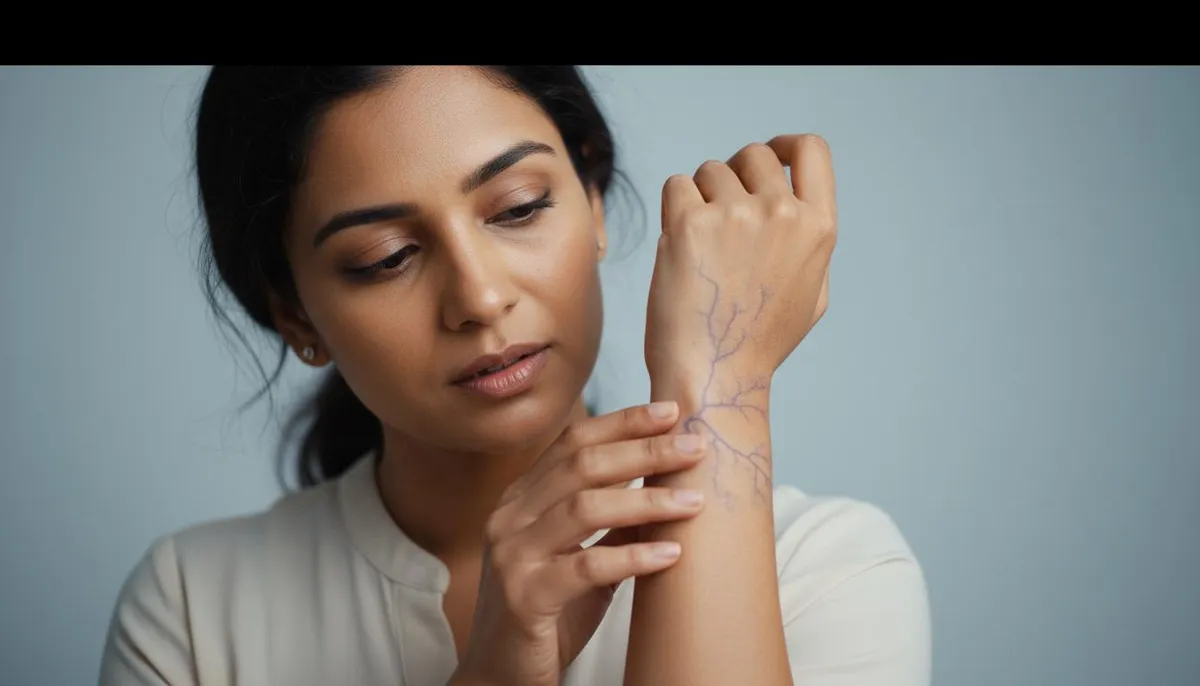
Have you ever noticed a red, bluish-red, net-like pattern on your skin, especially on the legs of a small child? Or maybe you've seen something like this on your own skin that scares you. While many people think it's normal, sometimes it can be a sign of another underlying condition. So today, let's talk about this condition called Mottled Skin, or Livedo Reticularis in medical terms.
What is Mottled Skin?
Simply put, this is a condition that occurs when the tiny blood vessels under our skin become blocked. When the blood flow to our blood vessels becomes irregular, oxygen-poor blood pools under the skin. That's when a blue-red, lace-like pattern appears on the skin's surface. This is what we call Mottled Skin or Livedo Reticularis.
What are the main types of this?
Although this condition may seem similar, it can be divided into several main types based on how it occurs. It is important to understand this, as treatment options depend on the type.
| Type | Description | Who gets it most often? |
|---|---|---|
| Physiologic Livedo Reticularis (Cutis Marmorata) | This is the most common and harmless type we see. It occurs when we are exposed to extreme cold and goes away on its own when the body warms up again. | Small babies, children, and young women with fair skin. |
| Primary Livedo Reticularis | This is also temporary. But it is not caused by cold . The exact cause is not known. This type is only diagnosed after confirming that there is no other underlying medical condition. | It can happen to anyone. |
| Secondary Livedo Reticularis | This is the type we should be most concerned about . Here, this skin pattern occurs as a side effect of another underlying condition in the body. It will not go away until the underlying condition is treated. | People with underlying medical conditions (e.g. autoimmune diseases). |
Are there other types besides this?
Yes, there are several other specific types.
- Congenital type (Congenital Livedo Reticularis): Some babies have this condition at birth. It usually appears on an arm or leg. Sometimes it can be associated with other complications in the brain, eyes, or heart.
- Erythema ab igne: Imagine you are constantly working with your laptop on your lap, or you are holding a hot water bottle in one place for a long time. Some people hold a charcoal iron between their legs. This type of skin rash can also occur due to prolonged exposure to extreme heat.
What are the causes of mottled skin?
There are many possible causes of Secondary Livedo Reticularis, which we talked about earlier, which is the type caused by another disease. That's why it's important to see a doctor as soon as you see it.
The most important thing is that if you see a pattern like this on your skin, don't just assume, "It's probably just a cold," but definitely see a doctor and get advice. Because it could be the first sign of a serious illness.
Below are some of the main reasons.
| Cause Category | Examples and simple explanation |
|---|---|
| Autoimmune and Connective Tissue Diseases | These are diseases in which our body's own immune system attacks our own cells. For example: Lupus, Rheumatoid Arthritis, Fibromyalgia. |
| Vascular Disorders | Diseases caused by blockage or narrowing of blood vessels. For example: blood clots in the legs (Deep Vein Thrombosis - DVT), Antiphospholipid Syndrome. |
| Infections | This condition can also be caused by some bacterial and viral infections, such as Tuberculosis, Hepatitis C, and Meningococcal Disease. |
| Some medications (Medication Reactions) | This condition can also occur as a side effect of some medications. It is important to talk to your doctor about the medications you are taking. |
| Neurological Conditions | Diseases that affect the nerves outside the brain and spinal cord. For example: Multiple Sclerosis (MS), Parkinson's Disease. |
| Cancer | Some types of cancer, especially blood-related cancers, can cause this symptom by interfering with blood flow. |
| End of Life | Towards the end of a person's life, blood circulation in the body gradually decreases. At that time, you may also see a skin pattern like this. But at the same time, other symptoms such as difficulty breathing also appear. |
How does a doctor diagnose and treat this?
When you see a doctor with this symptom, the first thing he or she will do is examine your skin carefully. Then, they will ask you about your medical history, family medical history, and any medications you are taking.
- Tests: If there is any doubt, blood tests may be done to find the cause orUrine tests may be ordered. Very rarely, a skin biopsy may be performed.
- Treatment: Treatment depends on the type of mottled skin you have and its cause.
- For the type that comes from the cold: All you have to do is simple things. Warm up your body. Bathing in warm water and wearing clothes that protect you from the cold are enough.
- For the type that is caused by another disease: The most important thing here is to treat the underlying disease correctly . For example, if there is a blood clotting problem, you can give blood-thinning drugs (Anticoagulants). The doctor will decide on the correct treatment.
- For the type caused by heat: This often goes away once you stop being exposed to the heat. If it persists, a doctor may prescribe a medicated cream.
💡 Take-Home Message
- Mottled Skin is a condition in which a blue-red, mottled pattern appears on the skin's surface. This is caused by impaired blood flow in the blood vessels beneath the skin.
- Often, especially in babies, this is caused by cold. It is not harmful and goes away when the body warms up.
- However, if this pattern occurs even when you don't have a cold, persists, or is accompanied by other symptoms such as fever, joint pain, and difficulty breathing, it may be a sign of a serious illness.
- Therefore, if you see a pattern like this on your or your child's skin, don't ignore it and definitely see a doctor to find out the exact cause.
- Don't forget that many medical conditions can be successfully controlled with early detection.


Janiw kuna arsuwinakas jichhakamax uñt’ayatäkiti. Aka chiqanx amuyt’awim jan ukax jiskt’awim yapxatañamawa.