
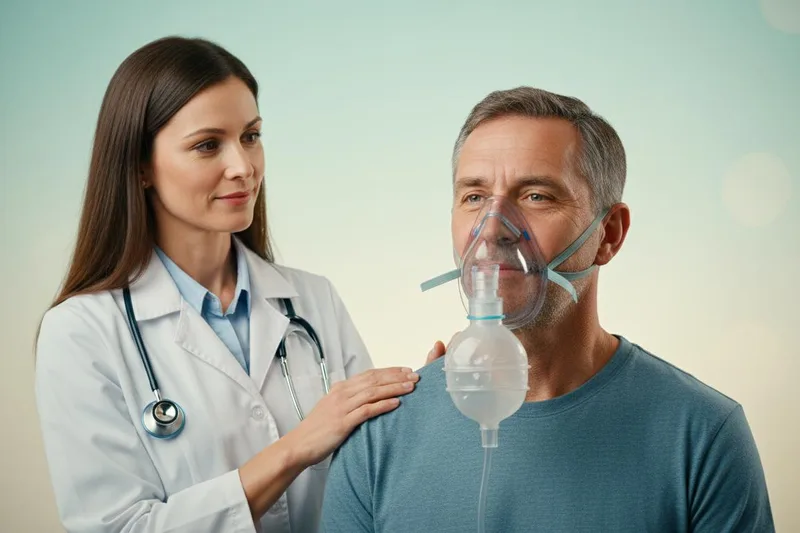
Have you ever seen someone in an ambulance or in the emergency room (ETU) of a hospital, who is having difficulty breathing, wearing a mask over their face, and having a small bag attached to it to give them oxygen ? That's what is often called a Non-Rebreather Mask . This is a very important medical device used to save lives in an emergency. So, let's talk about this simply and clearly today.
Simply put, what is a Non-Rebreather Mask (NRM)?
A Non-Rebreather Mask, or NRM as doctors call it, is a special face mask used to quickly provide a person with a very high concentration of oxygen, usually in an emergency.
Think of it like a face mask. It's designed to fit over your mouth and nose. It's secured to your face with an elastic band that goes around your head. Attached to the mask is a small, transparent bag filled with oxygen. This is called a 'reservoir bag'. This bag is then connected to an oxygen tank via a tube. This is usually used in a hospital, especially in the Emergency Treatment Unit (ETU) or in an ambulance taking a patient to a hospital.
The biggest feature of this mask is the one-way valves that allow air to pass only in one direction . This means that when you inhale, only the pure oxygen from the oxygen bag enters your body, and the air you exhale ( carbon dioxide ) does not go back into the bag, but goes out through other valves in the mask. This means that you do not breathe back the air you exhaled. Also, the air from the outside environment does not enter the mask. Therefore, your lungs receive a high percentage of oxygen that is not mixed with anything.
When is this mask used?
A Non-Rebreather Mask is typically used when a person's blood oxygen level is dangerously low, but they can still breathe on their own . This is not a device that breathes for you like a ventilator, but rather one that adds extra oxygen to the breath you take.
Here are some examples of such emergencies:
- Smoke inhalation: Imagine rescuing someone trapped in a house fire. The person has inhaled a lot of smoke, which can damage their lungs and cause a significant drop in oxygen levels in their blood. In such a situation, this mask is used to quickly provide oxygen.
- Carbon monoxide poisoning(Carbon monoxide poisoning): Sometimes, when a vehicle is started in a place without ventilation, such as when a generator is running, breathing in carbon monoxide gas can cause severe poisoning. This is a very dangerous situation. This mask is essential to provide a high concentration of oxygen in such cases.
- Trauma to the lungs: A person who has suffered severe injuries to the chest and lungs from something like a major car accident may have difficulty breathing. This is also used in those cases.
- Cluster headaches : This is a bit of a special case. This is a very severe, unbearable headache. Some studies have found that giving high concentrations of oxygen during this type of headache provides relief.
- Exacerbation of severe, chronic respiratory disease: If a person with chronic diseases such as COPD ( Chronic Obstructive Pulmonary Disease ) or Cystic Fibrosis suddenly experiences a worsening of their condition and has difficulty breathing , they are admitted to the hospital and given oxygen through this mask.
Important: If you suspect that you or someone you know has inhaled carbon monoxide or other toxic gas, it is very important to call the National Poisons Information Centre at the Colombo National Hospital for advice immediately before going to a hospital.
What is the difference between a Non-Rebreather Mask and other types of oxygen masks?
You may have seen other types of oxygen masks in hospitals. The two main types are the Non-Rebreather Mask and the Partial Rebreather Mask. The main difference between the two is the amount of air you rebreathe.
Let's look at this table to explain this further.
| Feature | Non-Rebreather Mask (NRM) | Partial Rebreather Mask |
|---|---|---|
| Valves | There are one-way valves that operate in only one direction. | There are two-way valves. |
| Breathing air | Only pure oxygen comes from the oxygen tank. No outside air enters. | The oxygen in the oxygen tank is mixed with a little bit of exhaled air and a little bit of outside air. |
| Percentage of oxygen received (FIO2) | Very high (about 60% - 90%). | High, but lower than NRM (around 40% - 60%). |
| Choking hazard | The risk is high if the oxygen tank runs out. | The risk is low because outside air can enter. |
What is FIO2?
This term FIO2 (Fraction of Inspired Oxygen) may be new to you. Simply put, it means "the percentage of oxygen in the air we breathe." The air we normally breathe contains about 21% oxygen. A Non-Rebreather Mask can increase this amount to 90%. That shows how powerful this device is.
What are the advantages and the most dangerous disadvantages of this?
Benefits
The biggest and only advantage of this mask is that it can quickly deliver a very high concentration of oxygen to a patient. This ability is often crucial in saving the life of someone whose blood oxygen levels have dropped dangerously low.
Disadvantages & Risks
The biggest and most serious risk of a non-rebreather mask is suffocation .
Imagine, with this mask, you can only breathe the oxygen in the oxygen tank. No air comes in from the outside. So, if for some reason the oxygen tank runs out, the patient can suffocate and even die because there is no other air to breathe.
For this very reason, a patient wearing a Non-Rebreather Mask must be monitored very closely by a doctor or nursing staff, who will constantly monitor the level of the oxygen tank.
Can't this mask be used at home?
Absolutely not. The Non-Rebreather Mask is not a device for home use. Due to the serious risks mentioned above, it is only used in hospitals, emergency rooms, and under the direct supervision of medical staff.
If you or someone in your family needs oxygen therapy at home due to a chronic respiratory condition, there are other safe devices that can be used. For example, a nasal cannula (a device with two small tubes that are inserted into the nose). Although it provides a lower amount of oxygen, it is safe to use at home for long-term use. You can talk to your doctor about this and choose the treatment method that is most suitable for you.
When should you seek immediate medical advice?
If you or someone you know has difficulty breathing and one or more of the following symptoms, go to the nearest hospital Emergency Department (ETU) without delay.
- Lips turning pale or blue.
- Breathing very fast or having a hard time breathing.
- Nasal flaring when breathing.
- Hearing a 'whistling', wheezing, or other unusual noise when breathing.
These can be warning signs that the body is not getting enough oxygen, so don't ignore them.
Take-Home Message
- A Non-Rebreather Mask (NRM) is a special medical device that provides a high concentration of oxygen in an emergency.
- Because it has one-way valves, you only breathe pure oxygen.
- The biggest risk with this is the possibility of suffocation if the oxygen tank runs out. Therefore, medical supervision is essential.
- The Non-Rebreather Mask cannot be used at home for any reason. It is limited to hospitals only.
- If you have long-term shortness of breath, talk to your doctor about appropriate treatment options.


💬 Comments (0)
No comments have been posted yet. Add your comment here for the first time.
Add your comment