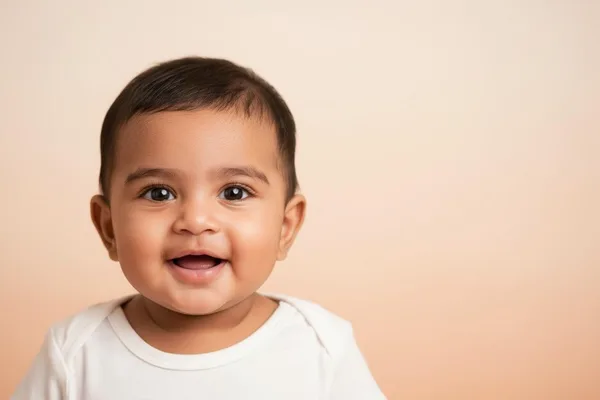
How your 4-7 month old baby starts talking (Baby Communication) - Let's find out.

How your 4-7 month old baby starts talking (Baby Communication) - Let's find out.

Your little one's world is changing every day from four to seven months old, isn't it? His vocalizations and facial expressions are increasing. Now he's smiling brightly, cooing, and babbling to the beat. Did you know? He's also starting to imitate the sounds you make at this time. This is a very important, small first step in his learning to talk. So, today we'll talk about how your baby "talks" to you during this amazing time, and how you can help him.

How do babies talk to us?

It's really amazing how babies at this age talk to us. Even though they don't know words yet, they have their own unique ways of telling us their feelings and needs.

Speaking loudly

Your baby is now using other sounds besides crying to get your attention and to express his feelings, such as happiness and sadness. Babies at this age are starting to experiment with the sounds they can make with their mouths. Think of it like they are discovering the possibilities of their voice. These are the baby's first attempts at speaking , so we should encourage them as much as possible. These babbling sounds are not just sounds, they are trying out the phonemes of language.

Understanding your tone of voice

It's amazing how at such a young age your baby can understand what you're saying just by the tone of your voice.

Simply put, if you speak very calmly, lovingly, and gently, it makes him feel very comfortable and safe. But if you speak a little harshly, harshly, or in a nervous way, he will understand, "Oh... something is wrong."

It is now that the baby is beginning to understand the basics of communication through language . This is very important for the development of the linguistic abilities of his brain.

The first steps in language

Babies can now hear different sounds, understand the differences between them, and get their first idea of ​​how words are put together to form sentences. At this age, they start to do things like:

  • When you make a sound, he learns to make the next sound, that is, to take turns . This is like two people speaking in order.
  • I like to press my lips together and make a 'burr' sound (blowing raspberries) .
  • Chirping loudly, screaming and laughing .
  • He may even start to respond to his name . He may look at you when you say " Urine , son."

So what should I do to help the baby?

There are many things you can do with this baby talk.Develop your skills even more. These are very simple, lovely things.

1. Always talk and play with your baby.

This is the most important thing. Talk to your baby even while you're working.

  • Vocal games: Babies this age love vocal games and interactions with you. Make one sound at a time while playing "peek-a-boo." Sing little songs with simple melodies and repeating words.
  • Imitate: When you imitate their coos and babbles, they are very happy. This tells them that "Oh... Mommy/Daddy can hear what I'm doing, and it's important to them." Imitate your baby's 'ba', 'a-goo' sounds, and then say some simple words that have the same sound. For example, if your baby says "ba..ba..", you can say something like "Yes, baby, ba..ba.. doll."
  • Talk about daily tasks : Talk simply about what you do when bathing, feeding, or changing the baby. For example, "We're going to take a bath now," "Here's some rice," "Let's put on a new outfit."

2. Have a 'dialogue' with your baby

This is a lot of fun. Even though your baby isn't yet able to respond verbally, this is a great help in his communication skills.

  • Talk and let go: You talk to your baby and wait for him to "respond." If he makes a noise or smiles, that's his response.
  • Ask questions, respond with interest: If you ask, "How are you, my dear?" and your baby makes a sound like "Ah..goo...", ask again with interest, "Oh... did that happen?" Your facial expressions and changes in your voice are very important to them.
  • Slow down and emphasize words: It helps to slow down your speech a bit and emphasize individual words clearly. For example, say, "Do you want a toy ? This is your toy, " while pointing to it. Then wait for a response.
  • Silence is important: A short silence after you speak encourages your baby to vocalize .
  • Give-and-take: This early give-and-take between two people paves the way for the first real words and conversations that come later. This is how they learn turn-taking in social interaction, which is a fundamental part of social relationships.

3. Name everything.

This is a great help in building your baby's vocabulary .

  • Introduce simple words:Introduce your baby to simple words related to everyday life. Name people you see often (mom, dad, grandma, uncle), objects (bottle, toy, chair), and activities (bathing, eating, sleeping).
  • Babies understand: Remember, babies understand words long before they can say them. So, use real words and cut down on baby talk. Rather than saying things like "Does your baby 's tummy need anything?", it's better to use simple, real words like "Is your son/daughter hungry? Shall we eat?"
  • Examples: When you feed your baby, you say, "Here's the milk, son/daughter." When you give him a toy, you say, "Here's your doll." When you take him outside, you point to him and say, "Look, there's a beautiful bird."

4. Don't forget to read books!

Don't think that reading books to babies of this age is pointless.

  • Exposure to language: When you show them books with large print and colorful pictures and simply read the contents, they are exposed to new words, the rhythm of the language, and the different tones of your voice.
  • Bonding increases: Also, when you hold your baby and read a book, the bond between you both is strengthened.

When should we see a doctor?

Most of the time, babies learn these things at their own pace. However, sometimes we may have a little doubt.

If you have any doubts or concerns about your baby's communication skills or hearing , don't hesitate to talk to your family doctor or a pediatrician .

Typically, by the time they reach seven months, most babies will be doing the following:

  • When I hear your voice, I turn my head in that direction.
  • Takes turns making noises with you (when you make a noise, it tries to make a noise too).
  • Chirping loudly and laughing .
  • Trying to imitate the sound you make.

But it is important to remember that even though we say 'normal', there is a wide range. Not all babies are the same. Some babies learn these things a little earlier, some a little later. It can vary from baby to baby. So, don't worry unnecessarily. However, if you are having persistent concerns, it is best to consult a doctor. For example, if your baby does not respond to any sounds, does not flinch when hearing a loud noise, or does not try to make any sounds other than crying after about 7 months, it is important to talk to a doctor about it.

The most important thing to remember is

Your 4-7 month old baby's world is a wonderful place, and it's changing every day. Every sound they make, every smile they make, every facial expression they make is how they communicate with you.

So, let's help them a lot during this 'early communication' period, and let's listen to them with love.

Laugh with them, imitate their sounds, talk to them. Talk as if they understand what you are saying. Name everything. Cut down on baby talk and use real words.

Remember, not all babies are the same, and they develop at their own pace. But keep an eye on their progress. If you have any concerns, don't be afraid to talk to a doctor. Your love, attention, and the time you spend with them are the biggest things that will help your baby learn the words in this world and talk to you!

👩🏽‍⚕️ Additional questions (FAQs)

💬 Can a 4-7 month old baby turn around when he hears his name?

Yes! By 6 or 7 months, babies can recognize their own name. As soon as mom or dad calls their name, they stop what they are doing and start looking in the direction of the sound.

💬 Is your baby showing happiness by smiling and making sounds instead of crying at this time?

Yes, that's right. At this time, when the baby is happy, he starts to laugh loudly, flap his arms and legs, make sounds like 'haha.. hoohoo..' (babbling), and pick up toys and make noises.

💬 Is mouthing everything a child can get their hands on at this age a way for them to explore the world?

Absolutely! It's easier for children this age to put something in their mouth and explore its shape and taste (Mouthing) than to touch it with their hands. This is a completely normal development.


` Baby talk, baby communication, 4-7 month old baby, learning to talk, how to talk to a baby, parenting tips , child development

⚠️ Important: The medical articles and information on Nirogi Lanka are for general awareness only, and are by no means a substitute for professional medical advice, diagnosis, or treatment. For any medical problem you have, consult a qualified physician immediately.

💬 Comments (0)

No comments have been posted yet. Add your comment here for the first time.

Add your comment

Please calculate: 2 + 5 =
How your 4-7 month old baby starts talking (Baby Communication) - Let's find out.
CommunicationMarch 31, 2026

How your 4-7 month old baby starts talking (Baby Communication) - Let's find out.

Your little one's world is changing every day from four to seven months old, isn't it? His vocalizations and facial expressions are increasing. Now he's smiling brightly, cooing, and babbling to the beat. Did you know? He's also starting to imitate the sounds you make at this time. This is a very important, small first step in his learning to talk. So, today we'll talk about how your baby "talks" to you during this amazing time, and how you can help him.

How do babies talk to us?

It's really amazing how babies at this age talk to us. Even though they don't know words yet, they have their own unique ways of telling us their feelings and needs.

Speaking loudly

Your baby is now using other sounds besides crying to get your attention and to express his feelings, such as happiness and sadness. Babies at this age are starting to experiment with the sounds they can make with their mouths. Think of it like they are discovering the possibilities of their voice. These are the baby's first attempts at speaking , so we should encourage them as much as possible. These babbling sounds are not just sounds, they are trying out the phonemes of language.

Understanding your tone of voice

It's amazing how at such a young age your baby can understand what you're saying just by the tone of your voice.

Simply put, if you speak very calmly, lovingly, and gently, it makes him feel very comfortable and safe. But if you speak a little harshly, harshly, or in a nervous way, he will understand, "Oh... something is wrong."

It is now that the baby is beginning to understand the basics of communication through language . This is very important for the development of the linguistic abilities of his brain.

The first steps in language

Babies can now hear different sounds, understand the differences between them, and get their first idea of ​​how words are put together to form sentences. At this age, they start to do things like:

  • When you make a sound, he learns to make the next sound, that is, to take turns . This is like two people speaking in order.
  • I like to press my lips together and make a 'burr' sound (blowing raspberries) .
  • Chirping loudly, screaming and laughing .
  • He may even start to respond to his name . He may look at you when you say " Urine , son."

So what should I do to help the baby?

There are many things you can do with this baby talk.Develop your skills even more. These are very simple, lovely things.

1. Always talk and play with your baby.

This is the most important thing. Talk to your baby even while you're working.

  • Vocal games: Babies this age love vocal games and interactions with you. Make one sound at a time while playing "peek-a-boo." Sing little songs with simple melodies and repeating words.
  • Imitate: When you imitate their coos and babbles, they are very happy. This tells them that "Oh... Mommy/Daddy can hear what I'm doing, and it's important to them." Imitate your baby's 'ba', 'a-goo' sounds, and then say some simple words that have the same sound. For example, if your baby says "ba..ba..", you can say something like "Yes, baby, ba..ba.. doll."
  • Talk about daily tasks : Talk simply about what you do when bathing, feeding, or changing the baby. For example, "We're going to take a bath now," "Here's some rice," "Let's put on a new outfit."

2. Have a 'dialogue' with your baby

This is a lot of fun. Even though your baby isn't yet able to respond verbally, this is a great help in his communication skills.

  • Talk and let go: You talk to your baby and wait for him to "respond." If he makes a noise or smiles, that's his response.
  • Ask questions, respond with interest: If you ask, "How are you, my dear?" and your baby makes a sound like "Ah..goo...", ask again with interest, "Oh... did that happen?" Your facial expressions and changes in your voice are very important to them.
  • Slow down and emphasize words: It helps to slow down your speech a bit and emphasize individual words clearly. For example, say, "Do you want a toy ? This is your toy, " while pointing to it. Then wait for a response.
  • Silence is important: A short silence after you speak encourages your baby to vocalize .
  • Give-and-take: This early give-and-take between two people paves the way for the first real words and conversations that come later. This is how they learn turn-taking in social interaction, which is a fundamental part of social relationships.

3. Name everything.

This is a great help in building your baby's vocabulary .

  • Introduce simple words:Introduce your baby to simple words related to everyday life. Name people you see often (mom, dad, grandma, uncle), objects (bottle, toy, chair), and activities (bathing, eating, sleeping).
  • Babies understand: Remember, babies understand words long before they can say them. So, use real words and cut down on baby talk. Rather than saying things like "Does your baby 's tummy need anything?", it's better to use simple, real words like "Is your son/daughter hungry? Shall we eat?"
  • Examples: When you feed your baby, you say, "Here's the milk, son/daughter." When you give him a toy, you say, "Here's your doll." When you take him outside, you point to him and say, "Look, there's a beautiful bird."

4. Don't forget to read books!

Don't think that reading books to babies of this age is pointless.

  • Exposure to language: When you show them books with large print and colorful pictures and simply read the contents, they are exposed to new words, the rhythm of the language, and the different tones of your voice.
  • Bonding increases: Also, when you hold your baby and read a book, the bond between you both is strengthened.

When should we see a doctor?

Most of the time, babies learn these things at their own pace. However, sometimes we may have a little doubt.

If you have any doubts or concerns about your baby's communication skills or hearing , don't hesitate to talk to your family doctor or a pediatrician .

Typically, by the time they reach seven months, most babies will be doing the following:

  • When I hear your voice, I turn my head in that direction.
  • Takes turns making noises with you (when you make a noise, it tries to make a noise too).
  • Chirping loudly and laughing .
  • Trying to imitate the sound you make.

But it is important to remember that even though we say 'normal', there is a wide range. Not all babies are the same. Some babies learn these things a little earlier, some a little later. It can vary from baby to baby. So, don't worry unnecessarily. However, if you are having persistent concerns, it is best to consult a doctor. For example, if your baby does not respond to any sounds, does not flinch when hearing a loud noise, or does not try to make any sounds other than crying after about 7 months, it is important to talk to a doctor about it.

The most important thing to remember is

Your 4-7 month old baby's world is a wonderful place, and it's changing every day. Every sound they make, every smile they make, every facial expression they make is how they communicate with you.

So, let's help them a lot during this 'early communication' period, and let's listen to them with love.

Laugh with them, imitate their sounds, talk to them. Talk as if they understand what you are saying. Name everything. Cut down on baby talk and use real words.

Remember, not all babies are the same, and they develop at their own pace. But keep an eye on their progress. If you have any concerns, don't be afraid to talk to a doctor. Your love, attention, and the time you spend with them are the biggest things that will help your baby learn the words in this world and talk to you!

👩🏽‍⚕️ Additional questions (FAQs)

💬 Can a 4-7 month old baby turn around when he hears his name?

Yes! By 6 or 7 months, babies can recognize their own name. As soon as mom or dad calls their name, they stop what they are doing and start looking in the direction of the sound.

💬 Is your baby showing happiness by smiling and making sounds instead of crying at this time?

Yes, that's right. At this time, when the baby is happy, he starts to laugh loudly, flap his arms and legs, make sounds like 'haha.. hoohoo..' (babbling), and pick up toys and make noises.

💬 Is mouthing everything a child can get their hands on at this age a way for them to explore the world?

Absolutely! It's easier for children this age to put something in their mouth and explore its shape and taste (Mouthing) than to touch it with their hands. This is a completely normal development.


` Baby talk, baby communication, 4-7 month old baby, learning to talk, how to talk to a baby, parenting tips , child development

⚠️ Important: The medical articles and information on Nirogi Lanka are for general awareness only, and are by no means a substitute for professional medical advice, diagnosis, or treatment. For any medical problem you have, consult a qualified physician immediately.

💬 Comments (0)

No comments have been posted yet. Add your comment here for the first time.

Add your comment

Please calculate: 2 + 5 =