

You probably want your little one to love reading books, don't you? In fact, introducing your child to books from an early age is a great investment in their future. So, today we'll talk about how to make our home environment a place where children love to read and play with books. This is not that difficult, if you take a few small things into account.
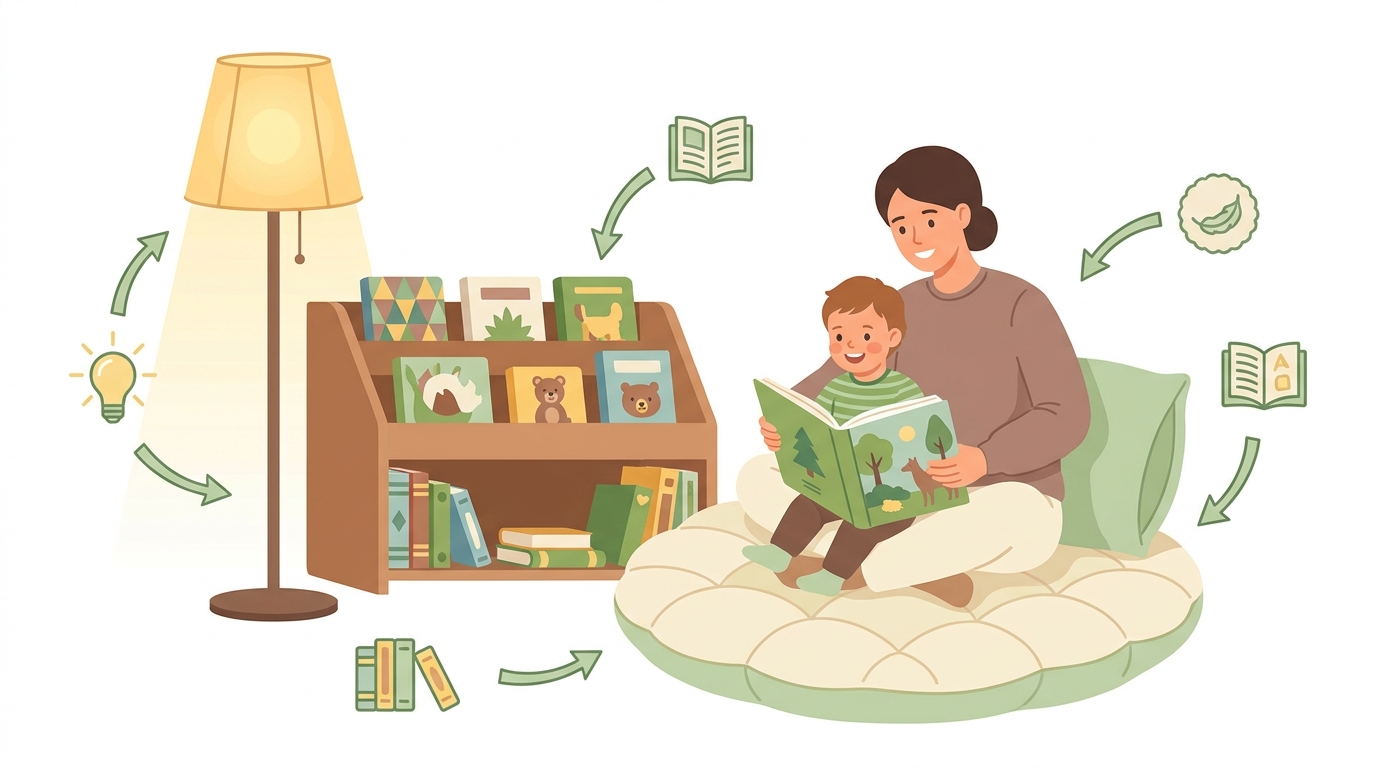
What kind of books should you give your child? (Keep a Variety of Reading Materials)
The first thing to think about is, "What books are right for my child?" Little ones love different things. If your child is a little older, you can ask them directly , "What kind of stories do you like, son/daughter?" Maybe they like stories about animals, or stories about princesses, or stories about spaceships.
But, a small baby doesn't understand that. In that case, you can ask the librarian or an official at your local public library . They know what books are age-appropriate and appealing to children. Also, there are websites on the Internet like "Reading BrightStart!" that can give you ideas for books that are suitable for children from 0 to 5 years old.
The most important thing is to introduce your child to a variety of reading materials, rather than limiting them to the same type of books.
For babies:
- Thick cardboard books (Board books): These are easy for little hands to hold and hard to break. Some have objects attached to them, such as mirrors and various pieces of fabric. They stimulate the baby's senses. Imagine, when a baby touches a rough piece of fabric in a book, he gets a new experience.
For preschoolers:
- Alphabet books: They will enjoy books with pictures, such as 'A' for mom and 'A' for dad.
- Rhyming books: They have a lot of fun when they recite rhymes like "Ha ha
- Picture books: Books with big, beautiful pictures and simple stories are perfect for children of this age.
For elementary-age kids:
- Fiction: Things like adventure stories, fairy tales, detective stories.
- Nonfiction: Books that contain factual information about animals, trees, history, etc. These will greatly expand a child's knowledge.
- Poetry: Simple poems appropriate for their age.
- Dictionaries and other reference books: These help you look up the meaning of words and learn new things.
Remember, your child may like a book that is too complex for him to read on his own. In that case, you can read the book together with him.. When you read, a small child will look at the pictures in the book and ask questions. That's a great thing too.
In addition to books, think about these things:
- Magazines for kids: There are now magazines specifically for children.
- Audiobooks: These are books that you can listen to as if someone is reading a story. Some children really enjoy these, especially before bed.
- Postcards, e-mails, and text messages from relatives: Encourage your children to read these. Point to them and say, "Look what Grandma sent."
- Photo albums or scrapbooks: Looking at family photos and reminiscing about old stories also increases the desire to read.
- Newspapers: Older children can be shown simple articles and cartoons in newspapers.
- Comic books: Many children enjoy reading these.
- Child-friendly websites: There are websites that have educational value and are safe for children.
- Beginning reading and alphabet games on a computer/tablet: Technology can also be used in a beneficial way.
- Magnetized alphabet letters: You can play by sticking them to the fridge to form words.
- `(E-readers)` or `(e-books)` (e-books): Books can also be read using these new methods that come with technology.
Keep reading materials handy.
To instill a love of reading, books need to be in places where a child can see and reach them. Imagine how easy it would be if they just put them in the toy box?
- Sturdy books: Books given to young babies need to be sturdy. They are likely to put them in their mouths or throw them. So, choose books that won't break easily.
- Baby's workspace: If you place a book near the changing table, high chair, or feeding table, it will help to distract your baby a bit during this time.
- Books during bath time: There are plastic books that are safe to put in water. It's a good idea to let your child play with a book during bath time.
- Near comfortable places: Keep some books near a comfortable chair or sofa where you and your baby like to cuddle. This will make it easier to read a book after feeding your baby or before putting him to sleep during the day.
Create a Special Reading Place for Your Child
When children get a little older, it's really worth creating a little reading corner for them.
- Reachable shelves:Raise bookshelves to a height that children can easily reach. It's best to place these shelves in areas of the house where they hang out most.
- Attractiveness: Arrange the shelves in a way that makes you feel good when you see them. Arrange the books in an orderly manner. Place some books with the covers visible . This will make it easier for children to identify a book they like. Just think, when a child sees a cover with a beautiful picture, they want to pick up the book, right?
- A book basket: Place some books and magazines in a pretty basket near where your child likes to sit.
- A cozy reading corner: Create a cozy reading corner with a small mattress and a few pillows. Then, set aside a small amount of time each day as "reading corner time." During that time, read books together with your child.
Make it Inviting
The reading corner you create, or the area with books, should be attractive to the child.
- Good lighting: There should be good lighting in places where you read books. It's also good for your eyes.
- New books often: It's better to change books frequently than to have the same books all the time. Add books that are appropriate for the holiday season (e.g. Christmas stories for Christmas), books about the things your child is interested in at that time (if they like dinosaurs, books about that), and books related to the subjects taught at school.
- Decorate with your child's creations: Decorate the reading corner with your child's own drawings and writings. This will make them love the place even more.
- Facilities for listening to `(Audiobooks)`: Keep electronic devices used to listen to audiobooks nearby.
Encourage Creativity
Encourage your child to not only read, but also to do creative things related to it.
- A place to write and draw: Create a small table where your child can find all the things they need to draw, color, and write (color boxes, paper, pencils) in one place.
- Their own books: Encourage your children to make their own storybooks , posters, and collages. Then, have them draw, write, and decorate them. Children love to read and share their creations with family and friends. Imagine how happy you would be if your daughter or son brought you a book they had made.
- Act out the story: Ask children to act out the characters in a story they have read. This will also develop their imagination.
Think About the Reading Environment
There are several other things you can do to improve the reading environment at home.
- Limit screen time: This is a problem that many parents have these days. Television, computers, smartphones, tablets, video games (Limit the amount of time your child spends on things like video games . When you limit it like that, it automatically leaves less time for your child to read a book or engage in other creative activities. This is not to say that technology is completely bad, but it is important to keep everything in moderation.
- Read together as a family: Reading is something that the whole family can do together. Be aware of what your child is reading and what `(media)` they are watching. No matter how advanced technology is today, you can decide how much printed books (print) and `(e-books)` you use when reading a story. Even if you read `(e-books)`, don't stop telling a story to your child while holding him/her. No matter what format you read a book in, it is very valuable to read a story while holding him/her and feeling that warmth.
- Read together: Take a book and read it to your child. Or, ask your child to read to you from a magazine or book they like. Make it a habit to sit together and spend time quietly, you reading your book and your child reading his or hers. This will also strengthen the family bond.
There is a saying that goes, "Today's reader is tomorrow's leader." So, let's all try to make our children like that, a group of people who love to read and are full of knowledge.
The most important things to remember (Take-Home Message)
Okay, so, shall we simply recap what we talked about?
- Introduce your child to a variety of age-appropriate books. Ask them about their preferences.
- Keep books in places where they are easily visible and accessible to the child.
- Create a cozy reading corner at home that your child will love.
- Reading areas should have good lighting, and new books should be added frequently.
- Encourage your child's creative abilities. Help them make their own books and act out stories.
- Control screen time and make it a habit to read together as a family. Don't forget the value of cuddling your child and reading books.
As you gradually add these things to your home environment, you will realize how much your little one has started to love reading books. This is not something that happens overnight, you need to go on this journey with your child with patience and love. If you want to know more about this, you can also seek advice from a pediatrician or a child development specialist.
` Children's reading, books, home environment, reading habits, child development, parenting tips , Reader-Friendly Home
ukat juk’ampinaka Doctoran qillqatapa
ukat juk’ampinaka Wawanakax jisk’atpachaw panka ullart’añ yatintayaña (Utan ullart’aña) ukax aru ch’amanchañataki, lurañ yatiñanakapar ukhamarak amuyt’añ yatiñanakapar ch’amanchañatakix wali askiwa. Utanxa pankanakaxa wawaru jank’aki puriñkama uchañawa, mä suma liyiña esquina wakicht’aña ukatxa sapa uru janïra ikiña sarkasaxa mä sarnaqäwi libro uñxatt’aña (Ikiña pacha liyt’aña). Awk taykanakax kunjamsa libronak liyipxi uk uñachtʼayañax libronak liyiñ munañapatakiw yanaptʼi.
❓ ukat juk’ampinaka Mä qawqha juk’amp jiskt’äwinakampiw jikisipxasma (FAQ) .
ukat juk’ampinaka ¿Utan libronak liytʼasajj kuna askinakas wawar yanaptʼistaspa?▼
ukat juk’ampinaka Wawan arunakap jilxatayaña, jukʼamp sum amuytʼaña ukat awk taykampi sum apasiñaw wali wakiskirixa.
ukat juk’ampinaka ¿Kunjamatsa libronak liytʼañasa, jan cartanak liytʼañ yatipki uka wawanakaru?▼
ukat juk’ampinaka Jallu qallta libronak ajlliñani, kunayman saminakan jach’a jamuqanak uñacht’ayañani ukat ukakipkarakiw uywanaka jan ukax kuna yänakas jamuqanak uñacht’ayañax wakisi ukat sutinakapx yatiyañawa.
¿Kunanakas mä wawar liyiñ munañapatak yanaptʼaspa?▼
ukat juk’ampinaka Wawax kuna tuqinakattï munaski uka libronak ajlliñapatak jaytañaxa (mä arunxa, uywanaka, autonaka), ukat sapa uru mä qhawqha horanak liytʼañatakis apstʼasiñaw yanaptʼistaspa.


💬 Comments (0)
No comments have been posted yet. Add your comment here for the first time.
Add your comment