
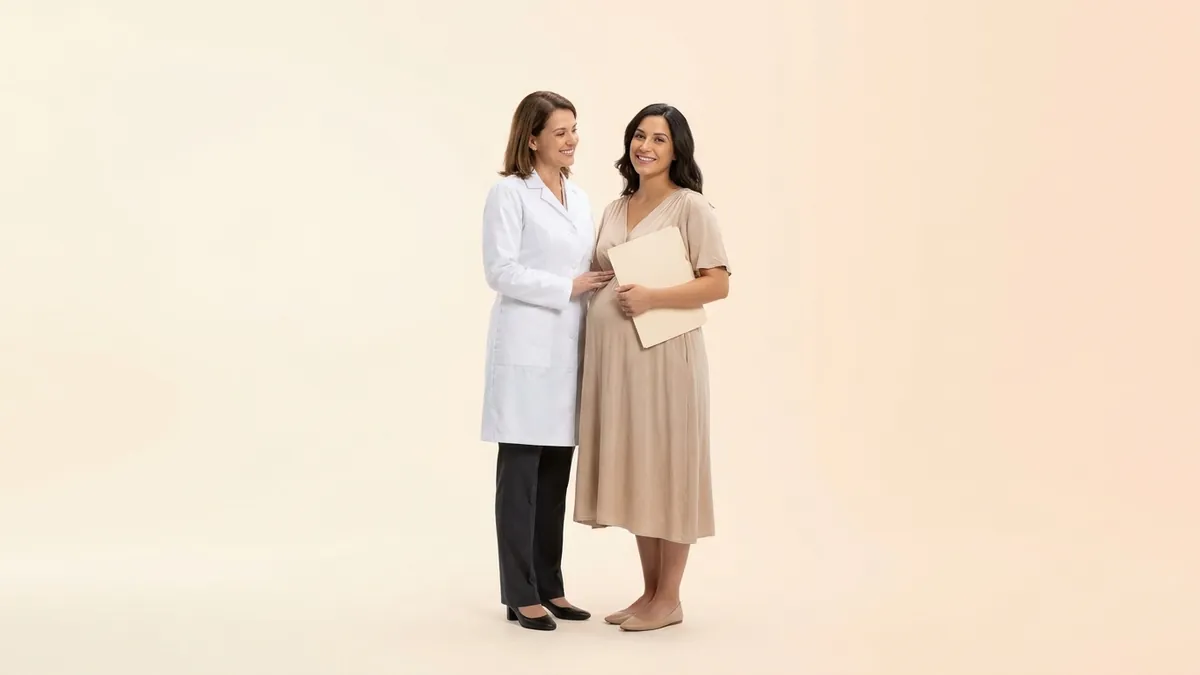
With the news that you are going to become a mother, you have to face a lot of medical tests , right? Maybe you are a little afraid and curious about these tests. It is normal for questions like "Do I need to do all these tests? What are they really looking for?" to come to mind. So today, let's talk, very simply, about the tests that are done during pregnancy .
Gratis usurïña uruxa calculadora. Qhipa periodo uru jan ukax concepción uru qillqt’aña, EDD, jichha trimestre ukat jach’a lurawinakat jikxatañataki.
Why are these tests so important?
The best way to think of these tests during pregnancy is as a big reassurance that you and your baby are healthy. Most of the time, the results of these tests say that everything is going well. What a relief, isn't it?
In addition, these tests do another important thing. That is, they can identify certain conditions that can be treated and cured early. For example, these tests can find out if you have a condition like iron deficiency ( anemia ) or gestational diabetes . If you have one, your doctor can start the necessary treatment for you before it becomes serious.
However, there are some tests that look for genetic problems, for example , Down syndrome , cystic fibrosis , or spina bifida . It's normal for parents to feel a little anxious when they hear about these tests.
The most important thing to remember here is that these screening tests only give an estimate of the risk. They do not determine whether your baby will definitely have a certain disease . They only tell you if there is a higher than normal risk and therefore whether further testing is needed.
So, before deciding which tests are right for you, talk to your doctor about all of this without holding anything back . Be sure to clearly understand what the test will look for, how accurate it is, whether there are any risks involved, and what steps you can take if the results are not as expected.
Okay, so let's see what major tests you'll face throughout these nine months.
Tests performed in the first trimester (months 1-3)
Here are some of the tests that are commonly performed during the first three months of pregnancy.
| Test | What do you see in this? |
|---|---|
| Blood Tests | Your blood type and Rh factor, immunity to rubella (German measles), iron levels (hemoglobin), infections such as hepatitis B, syphilis, and HIV are checked. Sometimes, the risk of hereditary diseases such as thalassemia and sickle cell anemia is also checked. |
| Urine Tests | The hCG hormone is used to check for kidney infections and to confirm pregnancy. Urine is tested for sugar (a sign of diabetes) and a protein called albumin (a sign of preeclampsia, a high blood pressure condition) throughout pregnancy. |
| Pap Smear and other Swabs | A Pap test is done to check for cervical cancer cells. It can also check for sexually transmitted diseases like chlamydia and gonorrhea, and bacterial infections that can cause premature birth. Treating these can help prevent complications for the baby. |
| Chorionic Villus Sampling (CVS) | This is not a test for everyone. It is a special test recommended only for mothers over 35 or those with a family history of genetic diseases. It is performed between 10 and 12 weeks and can detect genetic defects such as Down syndrome. There is a very small risk of miscarriage of 1%. |
Let's also learn about the Combined Test.
Recently, another advanced method has emerged to detect the risk of conditions such as Down syndrome. This involves measuring hCG in the mother's blood between 10 and 14 weeks.and PAP-A hormone levels. In addition, an ultrasound scan is performed to measure the thickness of the skin at the back of the baby's neck (this is called nuchal-translucency ). The results of both are combined to calculate the risk.
Tests performed in the second trimester (months 4-6)
These are some of the main tests you will have to undergo during mid-pregnancy.
| Test | What do you see in this? |
|---|---|
| Multiple Marker Screening | A blood test done between 15 and 18 weeks. It looks at levels of alpha-fetoprotein (AFP) and two other hormones produced by the baby. If these levels are abnormal, there may be a risk of a condition such as Down syndrome or a neural-tube defect. Remember, this is only a risk. |
| Ultrasound scan | This scan, which is usually done between 18 and 20 weeks, can be used to see very clearly whether all of the baby's organs are developing properly. It can check many things like the baby's growth, how the baby is positioned, whether there are twins, and where the placenta is located. This is the test that many parents love because they can see their baby clearly. |
| Glucose Screening | A test to check for gestational diabetes between weeks 25 and 28. You are given a glucose drink and your blood sugar level is checked one hour later. If the value is high, you will need to do a test called a GTT (Glucose Tolerance Test) to confirm further. |
| Amniocentesis | This is not for everyone. It is only recommended between 15 and 18 weeks for mothers who are over 35, have a high risk of genetic diseases, or have had abnormal results from a previous screening test. Here, a very fine needle is inserted through the abdomen, as seen on a scan, and a small sample of the amniotic fluid surrounding the baby is taken. This can detect genetic defects with 99% accuracy. The risk of miscarriage is very low, at 0.5%. |
💡 Take-Home Message
- Pregnancy tests are not something to be afraid of, they are done to ensure the health of you and your baby.
- Many tests detect treatable conditions early, leading to a healthy birth.
- Screening tests for genetic diseases only indicate the risk. They do not determine whether the baby has the disease.
- If you have any doubts or questions about any test, discuss them openly with your doctor . It will help you make the best decision for you.
- This journey is a beautiful, wonderful journey. These tests are just an aid to making that journey even safer.






Janiw kuna arsuwinakas jichhakamax uñt’ayatäkiti. Aka chiqanx amuyt’awim jan ukax jiskt’awim yapxatañamawa.