

Sometimes in life we have to face challenges that we cannot even imagine. Bladder cancer is one such serious and burdensome condition. So, if your doctor tells you that you need to have your bladder surgically removed, it is very normal to feel a lot of fear and anxiety. But do not be afraid. With the advanced medical science today, there are modern methods that can perform even such major surgeries very safely and with less pain. Today we are talking about one such advanced method, 'Robotic Cystectomy' or Robotic Cystectomy .
First of all, what is Cystectomy?
Simply put, a cystectomy is a surgical procedure to remove your bladder. It is mainly done as a treatment for bladder cancer . There are two main types.
| Type of surgery | What is being done |
|---|---|
| Complete removal (Radical Cystectomy) | In this procedure, the entire bladder is removed. Depending on the extent of the cancer and the extent of the spread of the cancer, the prostate gland in men and the uterus and ovaries in women may also be removed. |
| Partial Cystectomy | If the cancer is limited to one part of the bladder, only that part is removed. However, in most cases of cancer, the entire bladder is removed (radical cystectomy). |
In traditional open surgery, this operation is performed through a large incision in the abdomen. But robotic technology is different.
So what is Robotic Cystectomy?
Robotic Cystectomy is the same as Radical Cystectomy, but it is done in a less invasive way. That is, instead of making a large incision in the abdomen,Only a few very small incisions are made.
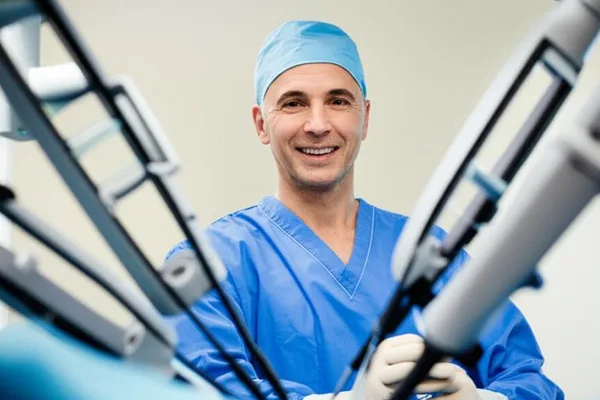
The most important thing is that in this case, the surgery is not performed by a robot. The surgery is performed by an experienced surgeon. He controls the robot's arms through a special computer system (surgical console).
These robotic arms can perform surgeries inside the body with greater precision, precision, and stability than a human arm. In addition, a high-definition three-dimensional (3D) camera allows the surgeon to see the inside of the body clearly and magnified. In short, this robot acts as a super tool that further enhances the surgeon's abilities.
How to perform the surgery step by step
1. Anesthesia : First, you will be fully anesthetized. This means that you will not feel anything during the surgery, you will be in a deep sleep.
2. Creating space: Next, the abdomen is filled with a small amount of carbon dioxide gas to create a comfortable space for the surgeon to perform the operation.
3. Small incisions: Now, instead of one large incision, 4 or 5 small incisions of a few millimeters are made in the abdomen.
4. Insertion of instruments: It is through these incisions that delicate surgical instruments and a 3D camera attached to the robotic arms are inserted into the body.
5. Surgery: Now the surgeon sits at the computer system, controlling the robotic arm to very delicately and precisely remove the bladder, lymph nodes, and other organs if necessary.
How does urine come out after the bladder is removed?
This is a big problem for many people. After the bladder is completely removed, a new way for the urine to pass from the kidneys to the outside of the body needs to be created. This is called Urinary Reconstruction . Your doctor will choose the method that is best for you. There are three main methods.
| Reconstruction method | Simple explanation |
|---|---|
| Ileal conduit | What you do here is take a small piece of your own small intestine and connect it to the ureters on one side and to a small opening (stoma) made in the skin of your abdomen on the other side. Urine collects in a special bag (ostomy bag) that is attached to this opening. |
| Continent cutaneous diversion | Here, too, parts of the small and large intestines are used to create a small bag (reservoir) inside the body that collects urine. It is also connected to a small opening (stoma) made on the skin surface. But there is no external bag. You can empty this bag yourself by inserting a small tube (catheter) several times a day. |
| Neobladder | In this procedure, a long piece of small intestine is used to create a “new bladder” (Neobladder) inside the body. It is connected directly to your urethra. So you can urinate just like before the surgery. But you need to practice special techniques, such as tightening your abdominal muscles. |
What are the advantages of robotic surgery?
Robotic surgery has several clear advantages over traditional open surgery:
- Less bleeding : Due to the small incisions and delicate surgery, bleeding is very minimal.
- Less pain: Since there is less pain after surgery, there is less need for painkillers .
- Reduced hospital stay: Because you recover quickly, you can go home from the hospital sooner.
- Quick recovery: You can return to normal activities quickly.
- Small scars: Instead of a large incision scar, only a few small dot-like scars remain.
- Convenience for the doctor: The 3D camera and delicate instruments allow the doctor to perform the surgery very clearly and accurately.
Are there no risks and side effects?
Like any major surgery, this surgery has some risks, but these are usually rare.
- Bleeding
- Blood clots
- Infection
- Reactions to anesthesia
- Damage to internal organs
Additionally, removing the bladder may have some effects on sexual function.
- For men: Since the prostate and seminal vesicles are removed during surgery, ejaculation does not occur. Sometimes, there may be difficulty in achieving an erection.
- For women: If part of the vagina is removed during surgery, you may experience some discomfort during sex. Sometimes, the nerves involved in sexual arousal and orgasm may be affected.
Any questions or concerns you have about this should be discussed openly with your doctor before the surgery. He or she will explain everything to you.
Recovery time and things to be aware of
Recovery time varies depending on the type of surgery you have had. Recovery after a Robotic Cystectomy is usually quick. You may experience some discomfort at first, such as loss of appetite and constipation. It can take several weeks or months to fully recover.
If you experience any of these symptoms after surgery, call your doctor immediately:
- Signs of infection such as fever, chills, and shivering
- Uncontrollable vomiting and nausea
- Excessive bleeding, redness, swelling, or pus from surgical sites
- Severe pain that cannot be controlled by prescribed painkillers
- Difficulty urinating or failure to urinate with a new method of urination
In such a situation, it is very important to immediately inform your doctor or go to the hospital's Emergency Treatment Unit (ETU) .
Take-Home Message
- Robotic Cystectomy is an advanced, less invasive method of bladder removal surgery.
- Here, the surgery is not performed by a robot, but by an experienced surgeon controlling the robot.
- The main advantages are less pain, less bleeding, and faster recovery than open surgery.
- After the bladder is removed, a new way to pass urine (urinary reconstruction) will be created. Your doctor will explain this to you.
- As with any surgery, there are risks and side effects. Don't be afraid to talk openly with your doctor and resolve all concerns.
robotic cystectomy, cystectomy, bladder removal, bladder cancer, robotic surgery, urinary reconstruction, stoma, neobladder




💬 Comments (0)
No comments have been posted yet. Add your comment here for the first time.
Add your comment