
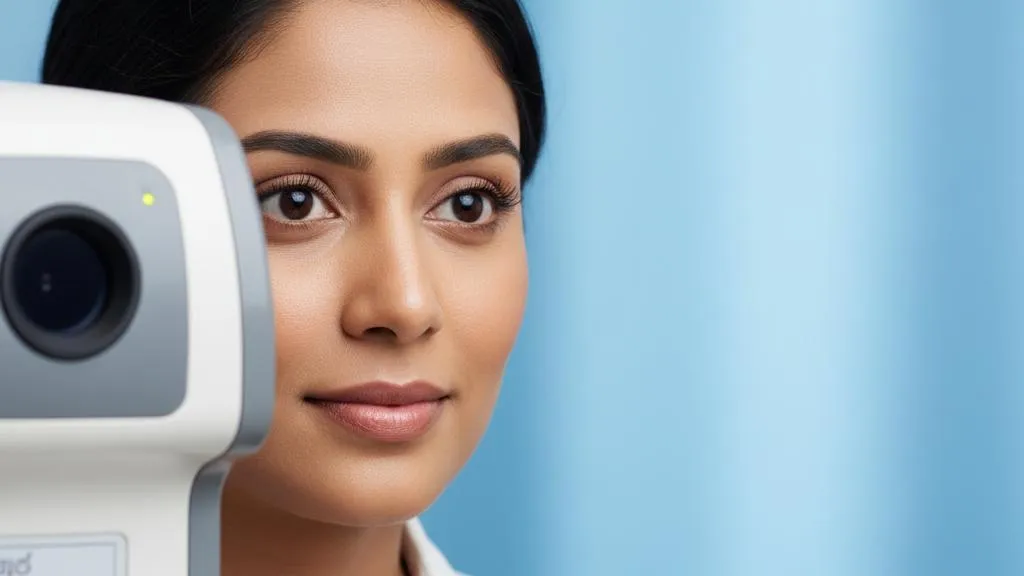
Have you ever had your eyes checked? And then suddenly you get a test where you blow air into your eyes and it makes you feel a little dizzy? Today we're going to talk about some of the ways to measure the pressure inside your eyes, including the test that most people are familiar with. This isn't as scary as you might think. In fact, it's a very important test to protect your eyesight.
What is Tonometry?
Simply put, tonometry is a medical test that measures the pressure inside your eye (intraocular pressure). This is one of the most important tests to diagnose a condition called glaucoma. There are several ways to do this test. All of them are very quick and painless.
Why is this test so important?
Ophthalmologists use this test primarily to screen for and diagnose glaucoma. It is usually done as part of a routine eye exam. It is also done when there is an eye injury or other symptoms.
Sometimes, doctors also use this test to monitor whether eye pressure is increasing as a side effect of certain medications you are taking (ocular hypertension).
If you already have glaucoma, you may need to have this test done regularly to see if your treatment is working. This is the best way to make sure your eye pressure is under control.
How does this measure eye pressure?
Inside our eyes, specifically the anterior chamber, is filled with a fluid called the aqueous humor . This fluid exerts pressure on the inside of the eye, giving it its spherical shape. Tonometry measures the pressure of this fluid.
The unit used to measure this pressure is millimeters of mercury (mmHg). The same unit used to measure your blood pressure is used for this.
What are the main methods of tonometry?
There are several methods your doctor can use to measure your eye pressure. Let's take a look at what they are.
| Test method | Simply put, what happens? |
|---|---|
| Non-contact tonometry (Air-puff) | This is the "airway" test that many people are familiar with. A machine sends a small amount of air into your eye's cornea. The machine measures the pressure in your eye as the air travels through it and back out. |
| Applanation tonometry | This is the most accurate method available. Here, anesthetic eye drops are applied, and the tip of a small instrument is very gently touched to the surface of your eye. The pressure is measured by the force that the eye exerts on the surface of the eye to flatten it. |
| Rebound tonometry | This uses a very small, plastic ball-shaped device with a tip. It measures pressure by the speed at which it approaches the eye, touches the surface, and bounces back. This is also a very gentle, painless method. |
Other methods
In addition to these main methods, there are other methods such as Dynamic contour tonometry and Electronic indentation tonometry. Also, methods that continuously measure pressure while wearing a contact lens are currently under research.
Do I need to prepare anything before the test?
Generally, there is nothing you need to do specifically to prepare for this test.
But there is one small thing. If possible, don't wear a shirt or T-shirt that constricts your neck on the day of the test. If you wear a collared shirt, keep it slightly loose. Because when your neck is constricted, the pressure in your eye may increase slightly, which may be recorded incorrectly on the test report.
What kind of experience do you get when taking the test?
This may vary slightly depending on the method of the test you are taking.
- If you are having applanation tonometry, your doctor will put anesthetic drops and a yellow dye called fluorescein in your eye.
- But none of this is required for the non-contact test.
Most tests take just a few seconds. Sometimes the doctor may take the reading two or three times to get an accurate reading. So don't think, "Oh, did I do something wrong?" It's a normal process.
None of these tests are painful. If you feel any pain, tell your doctor right away.
What are normal values? What to do if the results change?
The pressure in the eye of most healthy people is between 10 and 21 millimeters of mercury (mmHg - 21 mmHg) . If your result is outside this range, there are a few things that could happen next.
If the results are higher than normal
If a simple test shows that your pressure is high, your doctor will often try to confirm it with a more accurate method, such as applanation tonometry. If your pressure is confirmed to be high, your doctor may decide to continue monitoring your condition or start treatment. You will be scheduled for a follow-up appointment.
Emergency: Sometimes, an emergency condition (angle-closure glaucoma) can occur, where the pressure in the eye suddenly increases significantly, causing eye pain and blurred vision. This is a medical emergency. If this happens, you should go to the ETU (Emergency Treatment Unit) immediately. Otherwise, you may lose your sight permanently.
If the results are below the normal value
Low eye pressure (less than 5 mmHg or 6 mmHg) is also a problem. This can also damage the eye and cause vision loss. If your pressure is low, your doctor will explain the next steps and treatment to you.
Can I drive a vehicle after the test?
This is something to think about. If you only had the eye pressure test done, there would be no problem driving a vehicle.
However, in addition to measuring the pressure in the eye, a dilation (eye dilation) is used to examine the inside of the eye. If you dilate your eyes like this, you may have difficulty driving. You may be sensitive to light and may not be able to see things clearly near you for a few hours.
Therefore, it is safest to have someone drive you or use another vehicle on the day of your eye check-up. It is best to ask your doctor for advice on this.
💡 Take-Home Message
- Tonometry is a quick, painless test that measures eye pressure and is essential for early detection of glaucoma.
- Normal eye pressure is between 10 mmHg and 21 mmHg.
- If your results are outside the normal range, don't be alarmed and follow your doctor's instructions.
- If you have applied a numbing medication to your eye, avoid touching or rubbing your eye until the stinging goes away.
- If the pressure suddenly increases with severe eye pain, it is an emergency. Seek immediate medical attention.
- When going for an eye exam, it's safer to have someone drive you home, as dilated pupils may be used.






Janiw kuna arsuwinakas jichhakamax uñt’ayatäkiti. Aka chiqanx amuyt’awim jan ukax jiskt’awim yapxatañamawa.