

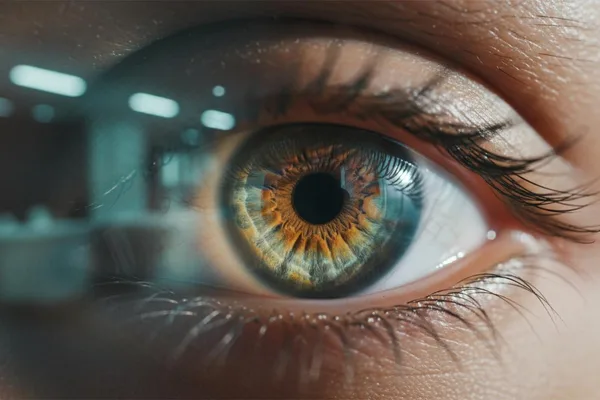
Have you ever looked at your eyes in the mirror? Then you see that the small black circle in the middle of the eye is called the "black ring". The colored part around that black ring is the iris that we are going to talk about today. Some people have it brown, some have it blue, some have it gray, some have it green... There are all kinds of colors. Isn't it very beautiful? So this colored part is not just beautiful, it does a very important job for our eyes.
What actually happens to the colored part of the eye, the iris?
Simply put, your iris is one of the main parts of your eye that helps you see. Specifically, the amount of light that enters your eye is controlled by the delicate muscles in this iris. You know, the muscles in this iris, in response to the light in the environment, shrink or enlarge the black ring in the middle of your eye, which we call the ``Pupil''. Just like the lens of a camera.
Imagine this. You go out on a sunny day. Suddenly your eyes feel blue, don't they? At that moment, your iris is activated quickly, making the iris smaller. Then the amount of light entering your eyes decreases. When you go back to a shady place, or even indoors, it takes a while for your surroundings to become clear. At that moment, the opposite happens. The iris enlarges the iris, making the most of the low light, allowing more light to enter your eyes. When the iris enlarges in this way, we say it `(dilates)`, and when it shrinks, we say it `(contracts)`. All this happens without you even realizing it, and it happens automatically. Isn't it amazing?
So this iris works like an automatic gate that controls the amount of light that enters the eye. That's why we can see clearly in different types of light.
Where is this colored part, the iris, located inside the eye?
Okay, now let's see where exactly the iris is located inside the eye. Think of your eye as an onion. Just as an onion has several layers of skin, our eyes have several layers. The iris is located on the outermost transparent layer of the eye , which is under the cornea , and above the lens inside the eye. To be precise, this colored part is located around the pupil.
How is the colored part of the eye, the ``Iris``, visible? What is it made of?
As we all know, the iris is the part of our eyes that gives them their color. It's a flat, round thing. The color of your eyes is determined by the amount of a natural pigment called melanin that your body produces, as well as by certain genes.You get these genes from your parents. That's why sometimes family members have the same eye color, or different colors. The amazing thing is, your eye color is like your fingerprint. It's unique to you, and no one else in the world has exactly the same eye color.
So do you know what this iris is made of? It is made up of a combination of delicate muscles and nerves. These control the size of the pupil without you even thinking about it, that is, by acting automatically (parasympathetically).
What are the diseases that can affect the colored part of the eye (iris)?
Any eye condition can affect the iris. Let's look at some of the main ones:
- Aniridia: This is the complete or partial absence of the iris.
- Horner's syndrome: This is a condition caused by some effect on the nervous system, which can cause the black tongue on one side to become compressed.
- Glaucoma: This is a condition in which the pressure inside the eye increases, causing damage to the optic nerve. Some types of glaucoma also affect the iris.
- Albinism : In this condition, the body produces less melanin, so the eye color can be very light, sometimes even pink.
- Cataracts: This is a clouding of the lens of the eye, but in some severe cases, the iris can also be affected.
- Uveitis : This is an inflammation of the uvea, a membrane inside the eye. The iris is also part of this uvea.
- Waardenburg syndrome: This is a genetic condition that can cause eye color changes (e.g., two different colored eyes), skin pigmentation, and hearing impairment.
If you have any of these symptoms, it is very important to see an ophthalmologist immediately.
What happens if the colored part of the eye (iris) is damaged?
Any eye injury can damage any part of the eye. Similarly, the iris can also be damaged in an accident. The effect on the iris depends on the type of injury. Some minor injuries can be treated with rest and home care. However, some serious injuries can cause serious damage to the eye and even lead to loss of vision. Therefore, if you have an eye injury, do not waste time and see an eye specialist or go to an emergency room.
What tests are done to examine the colored part of the eye (Iris)?
When you go for a regular eye exam, the eye doctor will also examine your iris. They will use a special device called a slit lamp exam to look closely at the inside of your eye.
If your doctor suspects a specific medical condition or wants to investigate a problem, you may need to have some other tests. For example:
- MRI (magnetic resonance imaging) scan
- CT scan (computed tomography scan)
- Ultrasound test
- Optical Coherence Tomography (OCT) test
These tests can provide clear images of the delicate parts inside the eye.
So, how do we take good care of the colored part of the eye (Iris)?
Here are some things you can do to keep your iris, and your entire eye, healthy:
- Wear sunglasses that offer 100% ultraviolet (UV) protection or are labeled UV400 whenever you go out in the sun. This can greatly reduce eye damage.
- If you notice any changes in your vision, whether it's something as minor as needing to change your glasses or something more serious, see an eye doctor right away without waiting for symptoms to worsen.
- If you suddenly lose your vision or experience severe eye pain, go to the hospital immediately. These may be emergencies.
Can these iris scanners harm the eyes?
Nowadays, facial and eye scanning methods (Iris scanners) are becoming increasingly popular for unlocking things like phones and computers, or for security systems. What these scanners do is to direct a small amount of infrared light at your face and eyes to confirm who you are. According to the research done so far, there is no evidence that these devices are dangerous or harm your eyes. So there is nothing to worry about.
So, the final take-home message:
The colored part of your eye, the iris, is like your unique colored fingerprint. But it does more than just give you beautiful eyes. This iris plays a major role in helping you see clearly at all times and in all places. Therefore, it is very important to have your eyes checked regularly by an ophthalmologist so that you can recognize any changes in your eyes before they occur. Only then can we always see this beautiful world clearly. Do you understand?
👩🏽⚕️ Additional questions (FAQs)
💬 What is the iris of the eye?
This refers to the visible part of our eyes that gives them their color. Some people's eyes are blue, brown, or black because of the pigment (melanin) in this iris.
💬 What is the biggest benefit that stands out from this section?
The muscles in the iris control the amount of light entering the eye by expanding and contracting the pupil. When there is too much light outside, it contracts, reducing the amount of light entering.
💬 Can the iris develop diseases?
Yes, sometimes this part can become infected and swollen (Iritis). Also, in some people, it can develop cancer (Melanoma).
` Eye, iris, eye color, cataract, vision, eye health, eye diseases




💬 Comments (0)
No comments yet. Be the first to share your thoughts here.
Add Your Comment