
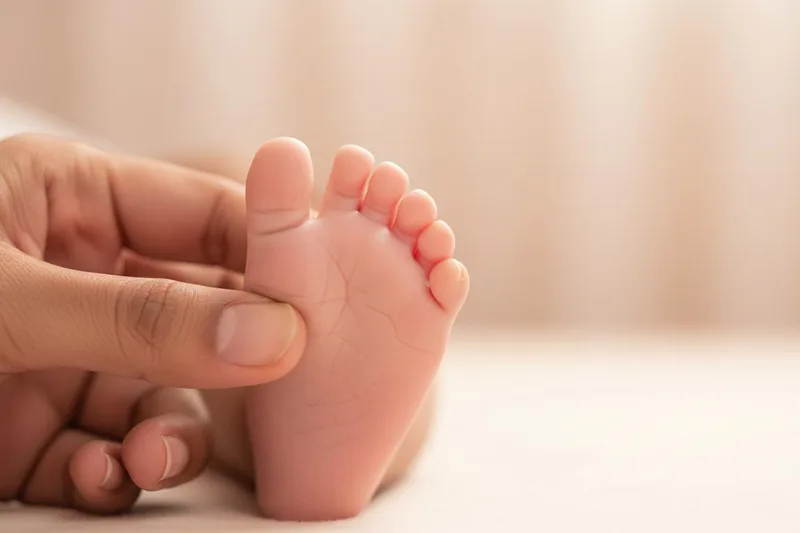
Does your little one's toes turn up when you rub their soles? That could be the Babinski Sign!

Does your little one's toes turn up when you rub their soles? That could be the Babinski Sign!

Moms and Dads, have you ever noticed that when you gently rub your baby's bottom , his big toe goes up and his other toes spread out? Isn't it amazing? This is what doctors call the Babinski sign. This is actually quite normal for young babies. But it's important to know exactly what it is. Let's talk about this in detail and simply today.

What is the Babinski Sign?

Simply put, the Babinski sign is a response that occurs when your baby's sole is tickled or something is run up the sole of their foot. The baby's big toe will curl up and the other toes will spread out like a fan. Isn't that amazing?

Now let's look at what a "reflex" is. A reflex is a muscular response that our body makes automatically, without us even thinking about it, to a stimulus. Imagine, if someone suddenly touches your eyes with something, you automatically close your eyes, right? That's something like that. In the Babinski sign, the stimulus is rubbing the sole of the foot. These are things that happen automatically, not things we do consciously.

The Babinski sign is a test that is done to see how a baby's nervous system is working, called the plantar reflex . The plantar reflex test is one of many neurological examinations that your baby's doctor will perform to check the functioning of your baby's brain, nerves, and spinal cord.

The plantar reflex is tested by applying pressure to the sole of the foot. The doctor will gently apply pressure from the baby's heel, towards the little toe, and then from there towards the big toe. If the big toe is raised and the other toes are spread out, we say that there is a "Babinski sign."

The important thing is that this Babinski sign is normal in young children, especially those under the age of two. However, if this sign is present in children over the age of two or in adults, it means that there may be some damage to their motor nervous system, that is, in the brain or spinal cord.

This sign was first discovered in 1896 by neurologist Joseph Babinski. That's why it's named after him. It's also sometimes called the "extensor plantar reflex."

Why does this Babinski sign occur?

To understand why this is, we need to know a little about our nervous system. There is a special pathway of nerve fibers that runs from our brain down our spinal cord. This is calledIt's called the Corticospinal Tract (CST). This is what helps us move, that is, move our limbs. To be precise, this is an important pathway that carries movement commands from the brain down the spinal cord.

Doctors check the health of this corticospinal tract (CST) by testing the plantar reflex and looking for the Babinski sign. When pressure is applied to the sole of a baby's foot, nerve fibers carry that information along this pathway to the spinal cord and brain. The brain then responds by telling the leg to move.

The corticospinal tract (CST) of young babies is not yet fully mature , that is, it has not fully developed. It is like the time it takes for a small plant to grow into a big tree. It is because of this immaturity that young babies see the Babinski sign. But as children grow older, this corticospinal tract (CST) also matures and develops. Then, around the age of two, this Babinski sign disappears.

So what is this plantar grasp reflex?

The reflex that replaces the Babinski sign after the age of two is called the Plantar Grasp Reflex . If you place your finger under your baby's toes, he will automatically curl his toes down around your finger, as if grasping it. This reflex stays with us into adulthood. This is the normal response to the Plantar Reflex in people over the age of two. This lets the doctor know that your motor system is working properly.

The main difference between the Babinski sign and the Plantar Grasp Reflex is the direction in which the toes move. It's like turning a light switch on and off:

  • Babinski sign: The fingers move up and out, as if you were turning on a light switch.
  • Plantar Grasp Reflex: The toes bend downwards. Like turning off a light switch.

Do you understand the difference? Up in one case, down in the other.

When does the Babinski sign disappear?

Usually, the Babinski sign disappears by the time your child is two years old. However, not all babies have it by the time they are two years old. Some babies may lose this reflex earlier, even within the first year.

Can adults have the Babinski sign? What if they do?

Yes, if an adult or a child over the age of two has the Babinski sign, it indicates a problem with their Central Nervous System (CNS)., which means that there has been some damage to the parts of the brain or spinal cord that control movement.

Here are some of the central nervous system (CNS) conditions that can cause the Babinski reflex to be seen after the age of two:

  • ALS ( Amyotrophic Lateral Sclerosis ) - This is a disease that causes the muscles to gradually weaken.
  • Brain tumor
  • Meningitis - This means inflammation of the membranes covering the brain.
  • Multiple Sclerosis - A disease that damages the nerve sheaths.
  • Neurodegenerative conditions, such as Alzheimer 's disease, are conditions in which the nervous system gradually deteriorates.
  • Spinal cord injury.
  • Stroke .

These conditions can cause the Babinski sign in an adult to appear.

How is the Plantar Reflex Test performed?

The plantar reflex test is a quick, painless test to check for the presence of the Babinski sign. It can be performed by a pediatrician or neurologist at birth, during a wellness visit, or during a neurological examination of adults suspected of having a central nervous system (CNS) problem.

This is how this test is done:

1. First, the doctor will ask you or your child to take off your shoes and socks and either sit or lie down.

2. Then, using a dull instrument - for example, a tongue depressor or a reflex hammer - the sole of the foot is moved slowly, in a stroking motion, upwards from the heel to the base of the big toe.

3. When doing so, the doctor will watch to see if the big toe comes up (dorsiflexion) and if the other toes are spread out.

If you or your child has fewer than five toes, or if there is another effect on the sole of the foot, there are other ways to check the Babinski reflex.

This reflex movement should occur as soon as the doctor moves the instrument along the sole of the foot. The result can be either "positive" or "negative".

What is a "positive" Babinski sign?

A "positive" Babinski sign means that during the plantar reflex test, your big toe is raised and your other toes are spread out.

Remember, a "positive" Babinski sign is normal for children under two years of age.But if it's "positive" in children over two years old or adults, it's abnormal. It could be a sign of a central nervous system (CNS) condition.

What is a "negative" plantar reflex?

A "negative" plantar reflex means that your toes did not respond to the plantar reflex test, or that your toes bent down instead of going up (plantar grasp reflex).

A "negative" plantar reflex test should be normal after the age of two. Some children may lose the Babinski reflex before the age of two and develop a plantar grasp reflex.

Sometimes there may be no movement at all. This may indicate that there is a weakness in the way your or your child's spinal cord sends messages to different parts of the body.

Finally, things to remember

Your little one has many new reflexes. You're probably learning about them together. You may first notice the Babinski sign by accident, perhaps while bathing your baby and rubbing their feet, or while tickling them to make them laugh. You'll be amazed at how their toes move when you rub their feet. Then, it's amazing how your baby's brain and muscles work together to make this movement happen.

This testable reflex helps doctors understand how your baby's brain and spinal cord are communicating. This reflex disappears within their first two years.

If you suddenly notice that your child has this Babinski sign even after the age of two, don't panic. Tell your child's doctor about it. They can help you with what to do next, if necessary.

I hope this information is helpful to you. Always remember, if you have any doubts or questions, it is best to seek medical advice.

👩🏽‍⚕️ Additional questions (FAQs)

💬 What is the Babinski Sign that the doctor does when he rubs the soles of children?

This is a basic test of the nervous system. If, when the palm is pressed upwards from the bottom of the foot, the toes instead of going down, but the big toe points upwards and the other toes spread out, it is called a 'positive Babinski sign'.

💬 Is it a dangerous neurological disorder if newborn babies' toes go up like this?

Absolutely not! Since the nervous system of babies under 2 years of age is not yet fully developed, this upward spreading of the fingers (positive Babinski sign) is 100% natural and healthy.

💬 So who is this test dangerous for?

If a child over 2 years old or any adult's soles are raised like this while being stroked, it is extremely dangerous. It means that at that moment there has been significant damage to the brain or a major nerve root in the spinal cord.


` Babinski sign, plantar reflex, infant reflexes, nervous system, brain development, child health, neurological tests

⚠️ Important: The medical articles and information on Nirogi Lanka are for general awareness only, and are by no means a substitute for professional medical advice, diagnosis, or treatment. For any medical problem you have, consult a qualified physician immediately.

💬 Comments (0)

No comments yet. Be the first to share your thoughts here.

Add Your Comment

Please calculate: 3 + 5 =
Does your little one's toes turn up when you rub their soles? That could be the Babinski Sign!
How the Body WorksApril 7, 2026

Does your little one's toes turn up when you rub their soles? That could be the Babinski Sign!

Moms and Dads, have you ever noticed that when you gently rub your baby's bottom , his big toe goes up and his other toes spread out? Isn't it amazing? This is what doctors call the Babinski sign. This is actually quite normal for young babies. But it's important to know exactly what it is. Let's talk about this in detail and simply today.

What is the Babinski Sign?

Simply put, the Babinski sign is a response that occurs when your baby's sole is tickled or something is run up the sole of their foot. The baby's big toe will curl up and the other toes will spread out like a fan. Isn't that amazing?

Now let's look at what a "reflex" is. A reflex is a muscular response that our body makes automatically, without us even thinking about it, to a stimulus. Imagine, if someone suddenly touches your eyes with something, you automatically close your eyes, right? That's something like that. In the Babinski sign, the stimulus is rubbing the sole of the foot. These are things that happen automatically, not things we do consciously.

The Babinski sign is a test that is done to see how a baby's nervous system is working, called the plantar reflex . The plantar reflex test is one of many neurological examinations that your baby's doctor will perform to check the functioning of your baby's brain, nerves, and spinal cord.

The plantar reflex is tested by applying pressure to the sole of the foot. The doctor will gently apply pressure from the baby's heel, towards the little toe, and then from there towards the big toe. If the big toe is raised and the other toes are spread out, we say that there is a "Babinski sign."

The important thing is that this Babinski sign is normal in young children, especially those under the age of two. However, if this sign is present in children over the age of two or in adults, it means that there may be some damage to their motor nervous system, that is, in the brain or spinal cord.

This sign was first discovered in 1896 by neurologist Joseph Babinski. That's why it's named after him. It's also sometimes called the "extensor plantar reflex."

Why does this Babinski sign occur?

To understand why this is, we need to know a little about our nervous system. There is a special pathway of nerve fibers that runs from our brain down our spinal cord. This is calledIt's called the Corticospinal Tract (CST). This is what helps us move, that is, move our limbs. To be precise, this is an important pathway that carries movement commands from the brain down the spinal cord.

Doctors check the health of this corticospinal tract (CST) by testing the plantar reflex and looking for the Babinski sign. When pressure is applied to the sole of a baby's foot, nerve fibers carry that information along this pathway to the spinal cord and brain. The brain then responds by telling the leg to move.

The corticospinal tract (CST) of young babies is not yet fully mature , that is, it has not fully developed. It is like the time it takes for a small plant to grow into a big tree. It is because of this immaturity that young babies see the Babinski sign. But as children grow older, this corticospinal tract (CST) also matures and develops. Then, around the age of two, this Babinski sign disappears.

So what is this plantar grasp reflex?

The reflex that replaces the Babinski sign after the age of two is called the Plantar Grasp Reflex . If you place your finger under your baby's toes, he will automatically curl his toes down around your finger, as if grasping it. This reflex stays with us into adulthood. This is the normal response to the Plantar Reflex in people over the age of two. This lets the doctor know that your motor system is working properly.

The main difference between the Babinski sign and the Plantar Grasp Reflex is the direction in which the toes move. It's like turning a light switch on and off:

  • Babinski sign: The fingers move up and out, as if you were turning on a light switch.
  • Plantar Grasp Reflex: The toes bend downwards. Like turning off a light switch.

Do you understand the difference? Up in one case, down in the other.

When does the Babinski sign disappear?

Usually, the Babinski sign disappears by the time your child is two years old. However, not all babies have it by the time they are two years old. Some babies may lose this reflex earlier, even within the first year.

Can adults have the Babinski sign? What if they do?

Yes, if an adult or a child over the age of two has the Babinski sign, it indicates a problem with their Central Nervous System (CNS)., which means that there has been some damage to the parts of the brain or spinal cord that control movement.

Here are some of the central nervous system (CNS) conditions that can cause the Babinski reflex to be seen after the age of two:

  • ALS ( Amyotrophic Lateral Sclerosis ) - This is a disease that causes the muscles to gradually weaken.
  • Brain tumor
  • Meningitis - This means inflammation of the membranes covering the brain.
  • Multiple Sclerosis - A disease that damages the nerve sheaths.
  • Neurodegenerative conditions, such as Alzheimer 's disease, are conditions in which the nervous system gradually deteriorates.
  • Spinal cord injury.
  • Stroke .

These conditions can cause the Babinski sign in an adult to appear.

How is the Plantar Reflex Test performed?

The plantar reflex test is a quick, painless test to check for the presence of the Babinski sign. It can be performed by a pediatrician or neurologist at birth, during a wellness visit, or during a neurological examination of adults suspected of having a central nervous system (CNS) problem.

This is how this test is done:

1. First, the doctor will ask you or your child to take off your shoes and socks and either sit or lie down.

2. Then, using a dull instrument - for example, a tongue depressor or a reflex hammer - the sole of the foot is moved slowly, in a stroking motion, upwards from the heel to the base of the big toe.

3. When doing so, the doctor will watch to see if the big toe comes up (dorsiflexion) and if the other toes are spread out.

If you or your child has fewer than five toes, or if there is another effect on the sole of the foot, there are other ways to check the Babinski reflex.

This reflex movement should occur as soon as the doctor moves the instrument along the sole of the foot. The result can be either "positive" or "negative".

What is a "positive" Babinski sign?

A "positive" Babinski sign means that during the plantar reflex test, your big toe is raised and your other toes are spread out.

Remember, a "positive" Babinski sign is normal for children under two years of age.But if it's "positive" in children over two years old or adults, it's abnormal. It could be a sign of a central nervous system (CNS) condition.

What is a "negative" plantar reflex?

A "negative" plantar reflex means that your toes did not respond to the plantar reflex test, or that your toes bent down instead of going up (plantar grasp reflex).

A "negative" plantar reflex test should be normal after the age of two. Some children may lose the Babinski reflex before the age of two and develop a plantar grasp reflex.

Sometimes there may be no movement at all. This may indicate that there is a weakness in the way your or your child's spinal cord sends messages to different parts of the body.

Finally, things to remember

Your little one has many new reflexes. You're probably learning about them together. You may first notice the Babinski sign by accident, perhaps while bathing your baby and rubbing their feet, or while tickling them to make them laugh. You'll be amazed at how their toes move when you rub their feet. Then, it's amazing how your baby's brain and muscles work together to make this movement happen.

This testable reflex helps doctors understand how your baby's brain and spinal cord are communicating. This reflex disappears within their first two years.

If you suddenly notice that your child has this Babinski sign even after the age of two, don't panic. Tell your child's doctor about it. They can help you with what to do next, if necessary.

I hope this information is helpful to you. Always remember, if you have any doubts or questions, it is best to seek medical advice.

👩🏽‍⚕️ Additional questions (FAQs)

💬 What is the Babinski Sign that the doctor does when he rubs the soles of children?

This is a basic test of the nervous system. If, when the palm is pressed upwards from the bottom of the foot, the toes instead of going down, but the big toe points upwards and the other toes spread out, it is called a 'positive Babinski sign'.

💬 Is it a dangerous neurological disorder if newborn babies' toes go up like this?

Absolutely not! Since the nervous system of babies under 2 years of age is not yet fully developed, this upward spreading of the fingers (positive Babinski sign) is 100% natural and healthy.

💬 So who is this test dangerous for?

If a child over 2 years old or any adult's soles are raised like this while being stroked, it is extremely dangerous. It means that at that moment there has been significant damage to the brain or a major nerve root in the spinal cord.


` Babinski sign, plantar reflex, infant reflexes, nervous system, brain development, child health, neurological tests

⚠️ Important: The medical articles and information on Nirogi Lanka are for general awareness only, and are by no means a substitute for professional medical advice, diagnosis, or treatment. For any medical problem you have, consult a qualified physician immediately.

💬 Comments (0)

No comments yet. Be the first to share your thoughts here.

Add Your Comment

Please calculate: 3 + 5 =