

Sound is an indispensable part of our lives. The voice of a loved one, a beautiful song, the laughter of a small child... All of these bring great joy to our lives. But sometimes, with age or due to other medical conditions, we gradually lose these precious sounds. For some, using a 'Hearing Aid' can solve the problem. But for others, even with a hearing aid, it is difficult to understand what is being said clearly. It is in such cases that doctors talk about a technology called 'Cochlear Implant'. So today, we will talk about everything about this, very simply, in a language that you and I can understand.
What exactly is a cochlear implant?
Many people think that this is the same as a hearing aid. But that's actually wrong. These are two completely different devices that work in different ways.
- Hearing Aid: Think of it like a microphone. It picks up sounds in the environment, amplifies them, and sends them into the ear. That is, a hearing aid is only useful if the parts of the ear that capture sound are working well.
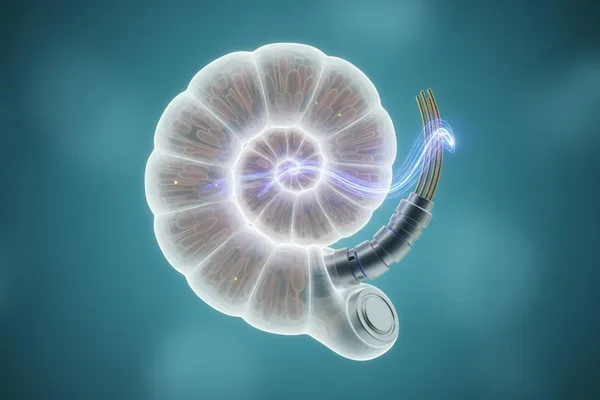
- Cochlear Implant: This is much more complex. Simply put, it bypasses the damaged parts of the ear and sends sound signals directly to the auditory nerve, which is connected to the brain. It's like building a new road where there's a broken road.
This device is usually recommended for people with severe to profound hearing loss , or for those who do not benefit much from hearing aids. While it may not restore 100% of your lost hearing , it can greatly improve your ability to understand speech and identify surrounding sounds.
How does this small device do such a big job?
To understand how this works, we first need to understand how we normally hear. When sound reaches our ears, it travels to a snail-shaped part inside the ear called the cochlea . Inside this cochlea are thousands of very fine, hair-like sensory cells (sensory hair cells). These cells are what convert sound vibrations into electrical signals that the brain can understand. Often, hearing loss occurs when these sensory cells are damaged.
A cochlear implant replaces the function of these damaged cells. It has two parts:
1. The outer part: This has a microphone, a sound processor, and a transmitter.
2. The part that is surgically implanted: This has a receiver and electrodes.
Now let's see how this works step by step:
- Step 1: The microphone you wear behind your ear picks up ambient sounds.
- Step 2: Those sounds go to the sound processor you wear and are converted into digital signals.
- Step 3: These digital signals are sent to a transmitter attached to the scalp via a magnet.
- Step 4: The transmitter sends the signals to the receiver , which is surgically implanted under the skin.
- Step 5: The receiver sends those signals to electrodes placed inside the cochlea.
- Step 6: These electrodes directly stimulate the auditory nerve .
- Step 7: Finally, the auditory nerve carries those signals to the brain, which interprets them as speech, music, or other sounds.
Simply put, this is like creating a shortcut in the natural hearing process.
What happens after the surgery and after that?
This is a two-part process: first the surgery, then the device activation.
Surgery
This is usually done by an ear , nose, and throat specialist (otolaryngologist).
- First, you will be put under general anesthesia , so you won't feel anything.
- Then the doctor makes a small incision behind the ear and creates a very small hole in the skull bone.
- It is through that hole that the internal parts of the device (the receiver and electrodes) are very carefully inserted.
- Finally, the incision is closed using dissolvable stitches.
This is not a major surgery. In most cases, you can go home the same evening (outpatient procedure).
Device Activation
About two weeks after the surgery, when the incision has healed well, you will be asked to come back. That is when this amazing device will be put into operation for the first time. This is done by an audiologist.
- Then, the outer part will be attached to your scalp using a magnet.
- Then turn it on and adjust/map the device to the sounds you hear.
- The sounds may be a little strange at first, but over time your brain will adjust to this new way.
What are the benefits and risks?
As with any medical treatment, there are benefits and very small risks. But in most cases, the benefits far outweigh the risks. Let's take a look at what those are.
| Benefits | Possible risks |
|---|---|
| You can talk on the phone and join in conversations even in crowded places. | The usual risks of any surgery (allergy to anesthesia, infection). |
| Tinnitus, a ringing in the ears caused by hearing loss, decreases or disappears for many people. | There is a very small chance of nerve damage at the surgical site. |
| Children with congenital hearing loss can learn to speak at about the same age as other children (even children over 9 months old can do this). | Risk of meningitis (this is why the doctor may recommend getting a vaccine before surgery). |
| Life becomes safer because they hear sounds that provide safety (a vehicle horn, someone talking). | If there is any remaining hearing in the ear, it is likely to be lost (but with modern technology it can now often be preserved). |
| The ability to listen to music is restored. | Rarely, balance problems (such as dizziness) may occur. |
How long will it take to adjust to this?
This is a very important question. Don't expect everything to sound clear and normal right after you get a cochlear implant. Your brain needs to relearn how to interpret these new signals.
At first, especially for older people, the voices may sound robotic (mechanical). But don't worry. With time and proper training, this will disappear and the sounds will become more natural.
Typically, you will see a significant improvement in your hearing within a month of using the device. It may take 3 to 6 months to fully benefit from it. During this time, it is essential to participate in auditory rehabilitation with an audiologist or speech-language pathologist. Your commitment will determine the results.
What can be done to make this journey easier?
To get the most out of this treatment, some commitment is required on your part.
- Always wear the device: Wear the outer part of the device almost every time you are awake. This will help your brain get used to it more quickly.
- Be sure to attend training sessions: Follow the instructions given by the doctor and therapist exactly.
- Know your limitations: You should remove the outer part when bathing or swimming. Also, it is best to stay away from contact sports that involve a hard blow to the head. If you get hit, the inner part can be damaged.
- Enjoy new opportunities: This is not a restriction on your life. Instead, it is an opportunity to reconnect with the world you have missed. Make the most of this opportunity to talk to others and be social.
When do you need to see the doctor?
After the device is inserted, you will have regular follow-ups. However, if you experience any of the following symptoms, you should see your doctor immediately .
- If you notice a sudden change in your hearing.
- If you experience ear pain or discomfort.
- If the surgical site becomes red, swollen, feverish, or pus-like fluid is coming out (these may be signs of infection).
- If you get a hard blow to the head.
Take-Home Message
- A cochlear implant is not a hearing aid. It is an electronic device that bypasses the damaged parts of the ear and delivers sound signals directly to the auditory nerve.
- This is usually recommended for people with very severe hearing loss or those who are not getting adequate results from hearing aids.
- This requires a minor surgery and is a lifelong commitment. The inner part lasts a lifetime, while the outer part may need to be replaced every 5-10 years.
- Once the device is inserted, you will not hear sounds as usual. It takes time and rehabilitation therapy for the brain to train to understand these new signals.
- The benefits of this technology far outweigh the very small risks. If you or your child has a hearing loss, talk to your doctor about this and see if it is right for you.




💬 Comments (0)
No comments yet. Be the first to share your thoughts here.
Add Your Comment