
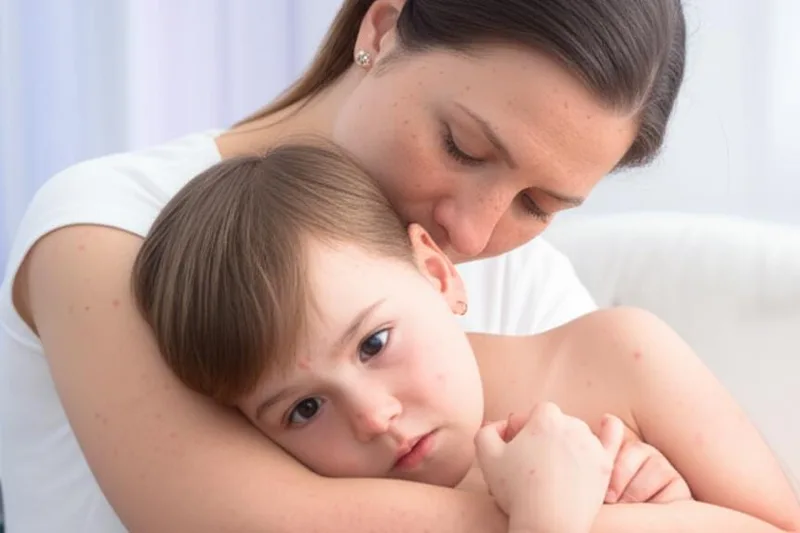
Mom, Dad... Does your little one wake up at night and scratch his body? Or do you suddenly notice red rashes and blisters on his body, and you are worried about them? These are actually a common problem for many parents. Allergies are not just about sneezing and wheezing. They can also show up on our children's skin. So today, let's talk about these common skin allergies that children develop.
1. Eczema, which we all know
The name 'eczema' is probably very familiar to you. More than 10% of children in the world have this condition. Especially if your child has asthma, food allergies, or someone in your family has these diseases, the chances of your child also getting 'eczema' are high.
Doctors can't say exactly what causes this, but it's a condition where the skin's protective layer is weakened, the skin becomes dry, and it's more susceptible to infection.
- For young babies: It starts on the face or scalp. It appears as a red, scaly rash .
- For older children: Later, this can spread to the arms and trunk. The skin is very dry, itchy, and may be red if it is small.
Let's take a look at the common symptoms of eczema and what things can make it worse.
| Common symptoms of eczema | |
|---|---|
| Red rash | The skin may become red and sometimes appear as small water blisters. |
| Itching constantly | Scratching damages the skin and makes the itching worse. It's like a cycle. |
| Dry skin | The skin feels scaly and dry to the touch. |
| Thickening of the skin | When scratched and rubbed over time, the skin thickens and takes on a leathery appearance. This is especially noticeable on the cheeks, elbow/knee bends, and the back of the neck. |
| Recurrent infections | Bacterial infections can easily develop due to scratching and wounds. |
What things aggravate eczema?
Certain things can make this itching and redness worse. We call these 'triggers'.
Remember, not all of these things affect every child. The most important thing is to observe what affects your child.
- Dry air: When you stay in AC rooms, the cold weather makes your skin even drier.
- Sweating: When you sweat, the salty sweat makes your skin itch even more.
- Rough fabrics: Wear rough fabrics like wool and denim. Cotton is best.
- Soaps and detergents: Soaps that have strong scents and are high in chemicals .
- Certain foods: Some children may be allergic to certain foods such as eggs, peanuts, cow's milk, wheat, soy, and seafood, which can worsen eczema. However, this is very rare . Do not eliminate these foods from your child's diet without first consulting a doctor.
2. Allergic Contact Dermatitis
This is also very special. If your child only gets rashes, redness, and itching after touching something they are allergic to, that is what we call `Allergic Contact Dermatitis`. Simply put, it is an `allergy caused by contact.'
Imagine, you put a pair of new earrings on your child, and within two days the earlobes are red and oozing. Or after putting on a pair of new slippers, the feet are red and blistered. These are examples.
| Characteristics | These may be the cause. |
|---|---|
|
3. Sudden onset of hives and swelling (Angioedema)
Hives are what we all know as 'hives'. They are red, itchy, raised bumps or spots that appear suddenly on the skin. They can last from a few minutes to a few hours. They can also come and go, then come back again after a few days.
What are the causes of hives?
| Reason | Examples |
|---|---|
| Dishes | Eggs, milk, peanuts, wheat, soy, seafood, nuts, strawberries. |
| Medicines | Especially antibiotics. |
| Insect bites | Insects like mosquitoes, wasps, and bees. |
| Other | Latex, pet saliva, viral infections (flu, colds). |
Sometimes hives can appear for no reason.
Let's also be aware of the swelling called Angioedema.
If your child has hives, they may also develop a different type of swelling called `Angioedema`. This is a deep swelling that occurs under the skin. It occurs especially in areas with delicate skin, such as the lips, around the eyes, and genitals. It is very rare for this swelling to occur alone without hives.
Recognize an emergency!
Hives or hives are usually not dangerous. However, if your child has difficulty breathing along with these symptoms, or feels like their tongue or throat is swollen , it is a very serious and dangerous condition (Anaphylaxis). Without any delay, take them to the nearest hospital's Emergency Department (ETU) immediately .
I think this information may be very important to you. Don't panic when you see a change in your child's skin, but pay attention to things like what it looks like, when it comes on, and whether it comes on after eating something. Always see your doctor for the most accurate diagnosis and treatment.
Take-Home Message
- Not all rashes or eczema on a child's body are the same. Pay attention to how it starts, where it is located, and the nature of the itching.
- If you suspect that a food or substance is causing your allergy, keep a note of it in a book. It will be very helpful to your doctor.
- Do not apply various creams from the pharmacy to your child's body without consulting a doctor. Some creams can make the condition worse.
- If a skin problem persists, it is best to see a pediatrician or dermatologist for the most accurate diagnosis and treatment.
- Most importantly: If your child has difficulty breathing or throat/tongue swelling along with skin rash, go to a hospital's Emergency Department (ETU) immediately.


💬 Comments (0)
No comments yet. Be the first to share your thoughts here.
Add Your Comment