
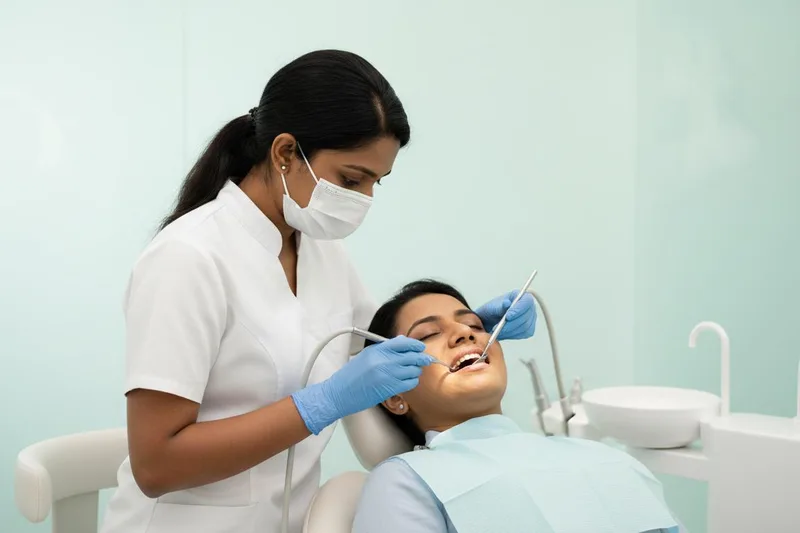
When you go to see a dentist, sometimes before or after the doctor sees you, you may see someone else cleaning your teeth and giving you advice on oral health, right? That person is what we call a Dental Hygienist . Some people also call them Oral Hygienists . So, today we will talk about who these people are, what exactly they do, and how important their services are to us.
Who exactly is a Dental Hygienist?
Simply put, a dental hygienist is someone who is trained to take care of your oral health . Their main job is to clean your teeth, help prevent gum disease, and teach you how to maintain good oral health. They often work with your dentist to help keep your teeth and gums healthy.
What does a dental hygienist do? What services do they provide?
There are many things a dental hygienist does. Let's look at some of the main ones:
1. Dental Cleanings
This is one of the main things they do. During a routine dental cleaning , which you usually get when you go to the doctor, they use special tools to remove plaque – a film of bacteria – and tartar – a hardened layer of tartar that forms on the surface of your teeth. Then, they polish your teeth with a special paste and a rubber cup. Regular cleanings like this can go a long way toward preventing cavities and gum disease.
2. Deep cleaning of the roots of the teeth (Tooth scaling and root planing)
This is a bit of a deep cleaning. Sometimes plaque and tartar build up in places your toothbrush can't reach, even under the gums. That's what this is about. After they've cleaned your teeth, they smooth the root surfaces of your teeth. That way, it's less likely that plaque and tartar will stick to them again.
3. Dental X-rays
Dental hygienists can take dental X-rays of your teeth. These images allow your dentist to get a clear picture of the roots of your teeth, the bone around your teeth, the sinuses, the nerves, and the surrounding area.
4. Administering local anesthesia
In some countries, for example, in many states in the United States, dental hygienists can give local anesthesia injections that numb your mouth. This will help you feel less pain and be more comfortable during the treatment. However, in Sri Lanka, this is usually done by the dentist himself.
5. Oral health screenings
Dental hygienists regularly check your oral health. During this time, they look for signs of cavities, gum inflammation, or oral cancer . They report any findings to your dentist. These tests can help detect any problems early and treat them before they get worse.
6. Dental history review
When you see a dental hygienist, they will talk to you about your previous dental experience, your general health, and any medications or supplements you take. This information is important for them to better plan your treatment.
7. Dental sealants
This is also a treatment that is often done on children to help prevent tooth decay. Our back teeth have small, deep grooves and holes in them. Food particles, plaque, and bacteria can easily get stuck in those places. Dental sealants are a special protective coating that is applied to those places. This stops that sticking and reduces tooth decay.
8. Fluoride treatments
Fluoride is a substance that strengthens tooth enamel and reduces tooth decay. Dental hygienists sometimes apply topical fluoride treatments to your teeth.
9. Oral hygiene instructions
Going to the dentist and getting your teeth cleaned is important. But that's not all. It's also important to brush and floss your teeth properly at home. Dental hygienists can teach you how to brush and floss your teeth in a way that's right for you. For example, if you have a dental bridge , they can show you how to clean underneath it. If you have dental implants , they can tell you which brushes and cleaners are right for you. They can help you deal with any oral health issues you may have.
Important: A dental hygienist is not just someone who cleans your teeth. They are like the guardian angels of your oral health!
How to become a dental hygienist?
This is also good to know. To become a dental hygienist, you need to undergo special training. This usually involves completing a two- to four-year diploma or degree program. It includes dental hygiene, general education subjects, and hands-on clinical work. However, to practice this profession, you must obtain a license.
What is the difference between a dental hygienist and a dentist?
Both of these people provide dental health services, but their roles are different.
- A dentist is a person who treats a wide range of dental diseases and conditions. They perform restorative dentistry, such as dental fillings , crowns , bridges , root canal therapy , and tooth extractions . They also perform cosmetic dentistry, such as dental bonding and porcelain veneers .
- A Dental Hygienist primarily specializes in cleaning teeth. They focus more on preventive dentistry, which helps keep your teeth and gums healthy.
Simply put, a dentist treats more when a disease occurs, while a dental hygienist helps prevent disease from occurring. But they both work together to keep your oral health at its best.
What is the difference between a dental hygienist and a dental assistant?
Both of these people help the dentist, but their work is different.
- A Dental Hygienist specializes in cleaning teeth and providing preventive care.
- A dental assistant is someone who helps a dentist perform dental procedures. For example, they help the dentist with fillings and crowns, help the dentist with instruments, and help the patient feel comfortable. They are like a "two extra hands" for the doctor. This is why it is sometimes called "four-handed dentistry."
The qualifications required to become a dental assistant can vary from country to country and state to state. Some places require special certification and licensing, while others do not.
Finally, remember this (Take-Home Message)
A dental hygienist is someone who plays a very important role in keeping your teeth and gums healthy. No matter how well you brush and floss at home, there are still places that your toothbrush and floss can't reach.
To remove plaque and tartar that accumulates in those areas, it is a good idea to see a dental hygienist at least twice a year to have your teeth cleaned.
Not only will they remove any hard-to-remove plaque from your teeth, they will also teach you how to clean your teeth better at home. So, next time you visit the dentist, remember to mention your dental hygienist. Their services will go a long way in keeping your smile beautiful and healthy!
` Dental Hygienist, Teeth Cleaning, Oral Health, Dentist, Gum Disease, Tooth Decay


💬 Comments (0)
No comments yet. Be the first to share your thoughts here.
Add Your Comment