

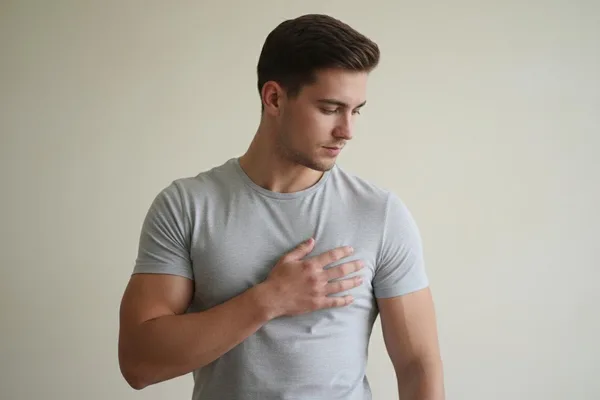
Are you a man, but your chest is a little big, and looks like a woman's breasts? Does this make you feel uncomfortable and embarrassed to wear a T-shirt, go swimming with friends, or even just look in the mirror? This is actually a very common condition that many men experience at some point in their lives. This is what we are talking about today. In medical science, we call this gynecomastia.
What exactly is Gynecomastia?
Simply put, Gynecomastia is the growth of glandular tissue in a man's breasts. It is not a cancerous condition. It is caused by a hormonal imbalance in the body, specifically an imbalance between the male hormone testosterone and the female hormone estrogen.
But sometimes obesity can cause fat/adipose tissue to accumulate in the chest, making the chest appear larger. We call this pseudo-gynecomastia. There is a clear difference between the two.
| Characteristic | True Gynecomastia (due to glandular tissue) | Pseudogynecomastia (due to fat) |
|---|---|---|
| Reason | Growth of mammary glands due to hormonal imbalance. | Fat accumulation in the chest area due to weight gain. |
| The way it feels in the hand | Under the nipple, you can feel a lump that looks like a rubber ball, like a button, and is perhaps a little painful. | The entire chest feels soft and uniform, and there is no specific lump. |
| Affected people | Although it can occur at any age, it is more common in newborns, young adults, and the elderly. | It often occurs in people who are overweight. |
The important thing is that this condition is not harmful to your physical health. However, if it is causing you distress or affecting your self-confidence, it is very important to talk to a doctor about it.
Why does this happen? The hormone story
Simply put, a male body has high levels of testosterone (the male hormone) and very low levels of estrogen (the female hormone). Estrogen is responsible for the development of the mammary glands. If for some reason the balance of these two hormones is disrupted, that is, if the level of estrogen increases relative to the level of testosterone , Gynecomastia can occur.
There are three situations where this naturally happens:
1. During the newborn period: Because the baby receives the estrogen hormone from the mother's body, some male babies may develop small, pubic hair-like breasts. This will go away on its own in a few weeks.
2. Puberty: Between the ages of 12 and 16, the body's hormones are changing rapidly. During this time, if estrogen levels rise faster than testosterone levels, breasts may temporarily enlarge. This usually returns to normal within 6 months to 2 years.
3. With aging: This condition is also common among men over the age of 50. As we age, the body's testosterone production naturally decreases. Also, some medications that people of this age take can cause this .
Could other medical conditions and medications be a cause?
Yes, sometimes Gynecomastia can be a symptom of another underlying medical condition. It can also occur as a side effect of certain medications.
Underlying medical conditions
If these diseases are present, other symptoms will definitely appear along with Gynecomastia.
| Medical condition | A brief explanation |
|---|---|
| Liver disease | Hormonal imbalance due to impaired liver function. |
| Kidney disease | Changes in hormone levels due to kidney failure. |
| Hyperthyroidism | Changes in the body's metabolism due to increased thyroid hormones. |
| Testicular tumors | Affecting the hormones produced by the testicles. |
| Klinefelter syndrome | Low testosterone levels due to a birth defect. |
Types of drugs that may cause
If you are using this type of medication, talk to your doctor about it.
- Spironolactone (for high blood pressure)
- Cimetidine (for gastritis)
- Finasteride (for enlarged prostate)
- Ketoconazole (an antifungal medication)
- Digoxin (for heart disease)
- Methotrexate (for cancer and arthritis)
In addition, this condition can also be caused by certain drugs (marijuana, heroin) and anabolic steroids used for bodybuilding.
What are the treatments for this?
Most people don't need treatment for this. However, if you are experiencing significant psychological distress due to this condition, your doctor may suggest various solutions depending on your situation.
1. Waiting: Gynecomastia, especially in young people, usually goes away on its own when hormones are balanced, so doctors often advise waiting for a while.
2. Changing medications: If this condition is caused by a certain medication, the doctor will prescribe a different medication instead. Do not stop taking your medication for any reason without consulting your doctor.
3. Treating the underlying disease: If the cause is liver disease or kidney disease, treating that disease may also help cure Gynecomastia.
4. Surgery:Some people, especially those who are severely depressed, choose to have excess breast tissue removed through surgery (`male breast reduction`). This is a cosmetic surgery that is performed at their own discretion.
Will this decrease if I exercise?
This is a question that many people ask.
- If you have pseudogynecomastia caused by obesity, yes! Weight loss and exercise can help reduce the fat in your breasts and return them to normal.
- But if you have true gynecomastia caused by hormones, exercise alone won't get rid of the glandular tissue, because it's not fat, but tissue that has grown under the influence of hormones.
When should I see a doctor?
If you experience any of the following, be sure to see your doctor.
- If you feel very stressed or embarrassed because of your large breasts.
- If you feel a lump in your chest and it is painful .
- If there is any discharge from the nipple .
- If other new symptoms (e.g., testicular pain, excessive fatigue) appear along with breast enlargement.
Although male breast cancer is very rare, only a doctor can accurately distinguish between it and gynecomastia. So don't be suspicious.
You can ask your doctor these questions:
- What is causing this situation for me?
- Do I need to change the type of medication I am taking?
- What is the best treatment for me?
- How long will this situation last?
- What can I do to prevent this from happening again?
Take-Home Message
- Gynecomastia is a very common, often harmless condition among men.
- This is mainly due to hormonal imbalances that occur at various stages of life (at birth, during youth, and during aging).
- It is important to understand the difference between breast fat accumulation due to obesity (Pseudogynecomastia) and glandular enlargement due to hormones (Gynecomastia).
- If you are concerned, suspicious, or have pain about a change in your breasts, don't be shy and consult your doctor for advice.
- Never stop taking your medications without consulting a doctor.
👩🏽⚕️ Additional questions (FAQs)
💬 What disease is Amlodipine (Amlodipine / Norvasc) prescribed for?
This is a highly effective blood pressure pill (Calcium Channel Blocker - CCB) that is the most widely used in Sri Lanka and the world to control 'High Blood Pressure'! This pill not only lowers blood pressure, but is also a major medicine recommended by doctors to prevent angina pectoris / coronary artery disease and keep the blood vessels of the heart healthy.
💬 How does taking this blood pressure pill (Amlodipine) help relieve our blood pressure and chest pain?
For a blood vessel to contract/contract and the pressure to rise (and for the chest to tighten), 'Calcium' particles must definitely enter the muscle of the blood vessel! As soon as this pill enters the blood, all the calcium gates (L-type calcium channels) in the heart and blood vessels are blocked/closed and locked 100%! Since calcium does not enter, the blood vessel does not contract and becomes very loose (Vasodilation). Then the blood flows easily and the pressure drops.
💬 What are the annoying side effects of taking this medication (Norvasc/Amlodipine)?
This is a very safe drug, but the biggest and most annoying side effect is 'swelling of the ankles/legs (Peripheral Edema)' (due to the enlargement of the blood vessels). If the legs swell, the doctor will stop this and give you another drug. Also, during the first few days of taking this, you may experience sudden redness/inflammation of the face (Flushing), severe headaches, and rapid heartbeat (Palpitations).




💬 Comments (0)
No comments yet. Be the first to share your thoughts here.
Add Your Comment