

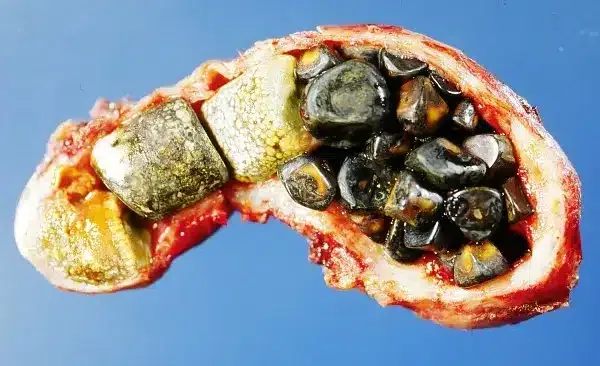
Gallstones are hard, solidified bile stones that form in the gallbladder or bile ducts. Simply put, gallstones. The gallbladder is a small sac-like organ that stores bile. Bile is produced by the liver. The bile ducts carry this bile to the gallbladder and other organs.
Doctors sometimes call this condition “Cholelithiasis.” “Chole” refers to bile, and “Lithiasis” refers to the formation of stones. “Cholelithiasis” refers to the formation of stones in the gallbladder. These stones form when various substances in the gallbladder collect and become solid. Most often, they form this way because of an imbalance in one of the main components of the gallbladder.
🤔 Are gallstones that dangerous?
Gallstones are not always a problem. Many people have gallstones, but they don't even know it. But if these stones get bigger and get stuck somewhere in the bile ducts, they can be dangerous. They can cause blockages in the bile ducts, causing pain and other serious problems.
The problem is that these stones get bigger and bigger. As bile constantly flows over the stones, more and more things get deposited, and what used to be like a grain of sand gets bigger and bigger, and can become big enough to block a bile duct.
🤷♀️ How common are gallstones? (How common are gallstones?)
At least 10% of adults have gallstones. And about 75% of these people are women. But only about 20% of these people ever show symptoms or need treatment.
🤒 What are the symptoms of gallstones? (What are gallstones symptoms?)
Gallstones usually don't cause symptoms, unless a stone gets stuck somewhere and causes a blockage. That's when symptoms appear. The most common symptoms are upper abdominal pain and nausea . These may come and go, or they may be constant. If the blockage is severe or has been present for a long time, you may also experience other symptoms:
- Sweating
- Fever
- Increased heart rate (Fast Heart Rate)
- Abdominal Swelling and Tenderness
- Yellow Tint to Skin and Eyes
- Dark-colored Pee and Light-colored Poop
😣 What is gallstone pain like? (What is gallstone pain like?)
Gallstone pain is a sudden, severe pain. It can make you feel sick and nauseous. This is called a gallstone attack or gallbladder attack. You may feel this pain most after eating. This is because the gallbladder contracts at that time, increasing pressure inside the gallbladder and biliary system. Sometimes this pain can wake you up at night while you are sleeping.
The pain that gradually increases and then decreases after reaching a peak is called Biliary Colic . It comes on and off. It can last from a few minutes to hours. It ends when the stone moves, the pressure decreases, or the bile starts flowing again. People describe this pain as sharp, unbearable, stabbing, or squeezing. You may not be able to sit still.
📍 Where is the pain caused by gallstones located? (Where is gallstone pain located?)
Your gallbladder and biliary system are located in the upper right side of your abdomen, just below your right ribcage. Most people feel the pain from gallstones there. But sometimes the pain can spread to other areas. Some people may feel it in their right arm or shoulder. Or they may feel it in their back, between their shoulders.
Some people feel this pain in the middle of their stomach or chest. This is a bit of a problem, because it can be similar to the pain of other illnesses. Some people may think it's heartburn or indigestion . Others may think they're having a heart attack. But it's a different emergency.
👩 Are gallstone symptoms different in a female?
The symptoms of gallstones are the same for men and women. However, women are more likely to feel the pain in other areas. This means they may feel it in their arms, shoulders, chest, or back.
Women are also more likely to have chronic pain. So they may ignore the pain that comes and goes. Biliary colic also comes and goes, so it may be ignored. However, if you have severe, persistent pain, even if it comes and goes, it is important to see a doctor. If you have had a gallstone attack once, you are more likely to have it again.
❓ What triggers gallstone pain?
Gallstone pain is when a gallstone gets stuck somewhere in your biliary tract, blocking the flow of bile. If it's a large blockage, you'll feel it right away. If it's a small blockage, you may not notice it until your gallbladder contracts. Eating can cause the gallbladder to contract.
When you eat a fatty, heavy meal, your gallbladder contracts more. This is because your small intestine senses the amount of fat in your meal and tells the gallbladder how much bile it needs to digest it. The gallbladder responds by releasing the required amount of bile into the bile ducts.
⚠️ What are the important warning signs of gallstones?
Biliary Colic is the only warning sign that you have gallstones. This is when a gallstone gets stuck in the gallbladder for a while, then moves around again, allowing bile to flow through. Even if the pain has gone away, it is important to understand that this is a warning sign.
Once a gallstone has become lodged somewhere in your biliary system, it is more likely to happen again. Either the same stone that was lodged earlier can come back to the same place and get bigger. Or more stones may have formed. One day, this stone could get lodged in one place and stay there. If that happens, it is dangerous.
😔 What are the possible complications of having gallstones?
If a gallstone blocks the flow of bile through your biliary system, it can cause problems for any or all of the organs in that system. The bile that can't flow can back up into the bile ducts and organs, causing inflammation. It can also lead to bacterial infections . If these conditions become severe, they can be life-threatening.
Possible questions:
- Cholecystitis (Gallbladder Inflammation )
- Pancreatitis (Pancreas Inflammation)
- Cholangitis (Bile Duct Inflammation)
- Hepatitis (Liver Inflammation)
- Jaundice (Bile in your bloodstream)
- Septicemia (blood poisoning – An infection in your bloodstream)
😩 Can gallstones make you tired and dizzy? (Can gallstones make you tired and dizzy?)
Dizziness and fatigue are symptoms of low blood pressure. These are not usually symptoms of gallstones. However, low blood pressure can be a side effect of problems caused by gallstones. If your biliary system becomes severely inflamed or infected, it can cause your heart rate to increase and your blood pressure to drop.
❓ How do gallstones form? (What causes gallstones?)

Gallstones form when there is too much of one of the main components of bile. This excess builds up in the gallbladder or bile ducts, where it gradually hardens into stones. Cholesterol stones are the most common type. The other type is pigment (bilirubin) stones .
There are several things that could cause this:
- Too much cholesterol: Your liver takes cholesterol from your blood to make bile. If you have too much cholesterol in your blood, the composition of your bile changes. For everything in your bile to stay together, it needs to have the right ratio of fats and acids. Anything in excess gets flushed out.
- Excess bilirubin: Bilirubin is a substance produced when old red blood cells break down. If you have a blood disorder that causes excessive destruction of red blood cells, or if your liver is not working properly, you may have excess bilirubin in your body.
- Not enough bile acids: Some diseases can cause bile acid malabsorption. This causes bile acids to be excreted in your poop. If your body excretes too much bile acids, your liver doesn't have enough bile acids to make bile. When bile acids are lacking, the amount of fat (lipids/cholesterol) in your bile increases.
- Cholestasis or Gallbladder Stasis: “Stasis” means dysfunction. If your bile ducts or gallbladder aren’t working properly and sending bile through the biliary system, the contents of your bile are more likely to clump together and become solid. This can be either a problem with the gallbladder itself or a problem with the chemical signals that tell it to move.
🤔 What risk factors contribute to gallstones?
- Various diseases can affect the flow of your bile, or your cholesterol, bilirubin, and bile acid levels. However, not everyone has to have these diseases to develop gallstones.
- Age: Gallstones take time to form. They also take time to grow. Men are more likely to develop these stones after the age of 60. Women are usually more likely to develop them between the ages of 20 and 50, which is when they are able to have children.
Risk factors:
- Hormones: Women are about three times more likely to develop gallstones than men. Their risk increases and decreases depending on their levels of the hormones estrogen and progesterone . Estrogen increases cholesterol levels. Progesterone slows down the emptying of the gallbladder.
- Weight: Body fat increases estrogen production, which increases cholesterol levels. However, sudden weight loss (for example, after weight loss surgery) can also contribute to the formation of gallstones. This is because when fat is lost suddenly, a large amount of cholesterol is added to the bile.
- Genetics: If someone in your family has had gallstones, you are more likely to develop them too. People of Native American and Mexican descent may have higher cholesterol levels in their bile due to their genes.
🩺 Diagnosis and Tests
- How are gallstones diagnosed?
- If you have symptoms of gallstones, your doctor will examine you. They will also do blood tests. Blood tests can check for inflammation, infection, or jaundice. They can also see which organs are affected. They will then do imaging tests to find out where in your biliary tract there is a blockage.
- What tests can detect gallstones?
- The doctor will first do an abdominal ultrasound . This is a quick and easy test. There is no special preparation required. It can detect stones in and around the gallbladder. However, if the stone is stuck somewhere else, another test will be needed to find it.
- Other possible tests:
- MRCP (Magnetic Resonance Cholangiopancreatography): This is a scan that uses magnets.
- HIDA Scan (Hepatobiliary Iminodiacetic Acid Scan): This involves injecting a small amount of radioactive liquid (tracer) into your body and watching how it travels through your body.
- Endoscopic Ultrasound: This involves inserting a small tube (endoscope) with a camera inside your mouth to look inside your body.
- ERCP (Endoscopic Retrograde Cholangiopancreatography): This also uses an endoscope. However, it can also remove stones.
💊 Management and Treatment
What is the treatment for gallstones?
- If your gallstones aren't causing you any problems, you don't need treatment for them. However, if your gallstones are blocking your bile ducts, your doctor will try to remove the stones. This means removing not only the stone that's stuck, but also any other stones. Because once you've had a blockage, it's more likely to happen again.
- Most often, this is done through surgery. This is the only way to prevent stones from forming again. However, if you can't have surgery, or if you don't want to, there are other things you can do. Things like taking medication or other treatments.
Gallstone Surgery
- Cholecystectomy is the best way to prevent gallstones from forming again. This is a common surgery performed all over the world. It is often done laparoscopically , which means that a camera is inserted through small incisions in the abdomen. You can live without a gallbladder without any problems. From here, bile flows directly from the liver into the small intestine.
- Sometimes, people who need treatment for gallstones may not be able to have their gallbladder removed due to their condition. In such cases, a cholecystostomy may be performed. This is a minor procedure. This involves inserting a catheter into the gallbladder and removing bile from it. This can also remove any stones that are currently inside the gallbladder.
Medical Treatments for Gallstones
- Doctors often don't prescribe medication for gallstones because it's not very effective. Medications like Ursodiol and Chenodiol only work for small cholesterol stones. But it takes months or years for those stones to dissolve. Often, the stones will form again.
- So this is not a practical solution for most people. However, sometimes these medications can be given temporarily or to prevent stones from forming. If you cannot have surgery for stones, your doctor will tell you what is best for you.
🚫 How can I prevent gallstones from forming?
- It is not possible to completely prevent gallstones. However, there are things you can do to reduce your risk. For example, you can reduce the amount of cholesterol in your diet to reduce the risk of developing gallstones, which are the most common type. However, this will not prevent the formation of other types of stones, such as pigment stones.
- If you are overweight or obese, losing a little weight can help reduce the risk of cholesterol stones. However, sudden weight loss can also cause these stones to form. If you have had a procedure or are losing weight quickly for some other reason, your doctor may prescribe medication to help prevent stones from forming.
🔮 What happens after treatment? (What is my prognosis after treatment for gallstones?)
- After surgery, most people never need to have treatment for gallstones again. Problems rarely occur. However, some people may develop chronic diarrhea. This is because bile is now flowing back into the intestines. This can be treated with medications called bile acid binders .
🤷♀️ Living with gallstones
Do gallstones ever go away on their own?
- Without treatment, gallstones will not go away on their own. Sometimes, these stones can pass out with your poop. But not all stones pass that way. Even if your doctor removes a stone from your bile duct, there may still be more stones left inside. New ones can also form. To prevent stones from forming again, you may need to have a gallbladder removal surgery.
How do you pass gallstones in your poop?
- If a gallstone comes out of your common bile duct and goes into your intestines without getting stuck anywhere, it can pass out with your stool. For that to happen, the stone has to be smaller than 5 millimeters. This is a matter of luck. Not all stones pass out like that. And there's nothing you can do to make them pass out.
- You can't put your gallstones in the common bile duct. And you can't expect them to pass safely from there to the intestines. They can get stuck in the duct and get bigger. Generally, having stones in your common bile duct is not a good thing.
How does it feel to pass a gallstone?
- You can't feel a gallstone passing out of your gallbladder. Because you can't feel a stone that's small enough to pass out of the common bile duct as it passes through your intestines. However, you may feel pain for a short time as the stone passes through the common bile duct.
What do gallstones look like in the toilet?
- A stone that is small enough to pass through the common bile duct, you might not be able to find it even if you look at it. But if you see a stone in the toilet, it will look like a small pebble. It may not be round in shape, but it will have some edges. Most stones are yellow. But some stones are brown.
Can gallstones pass through your urine?
- Gallstones can't be passed in your urine. This is because gallstones have no way to get into your urinary tract. Stones in your urinary tract are called kidney stones. Gallstones and kidney stones are similar. But they travel through different systems. Painful urination is a symptom of kidney stones, not gallstones.
When should I see a doctor about gallstones?
- If you suddenly feel a stabbing pain in the upper right side of your abdomen or shoulder, especially after eating, you may be having a gallbladder attack. See a doctor right away. Don't assume that this will go away on its own, because it may not. A doctor can help relieve your pain and find out what's causing it.
- If you think you've had biliary colic in the past, even if it's gone away now, see a doctor. They'll check your biliary system for gallstones. If they are, they'll treat them before they cause problems again. If left untreated, these stones can continue to form and grow larger.




💬 Comments (0)
No comments yet. Be the first to share your thoughts here.
Add Your Comment