
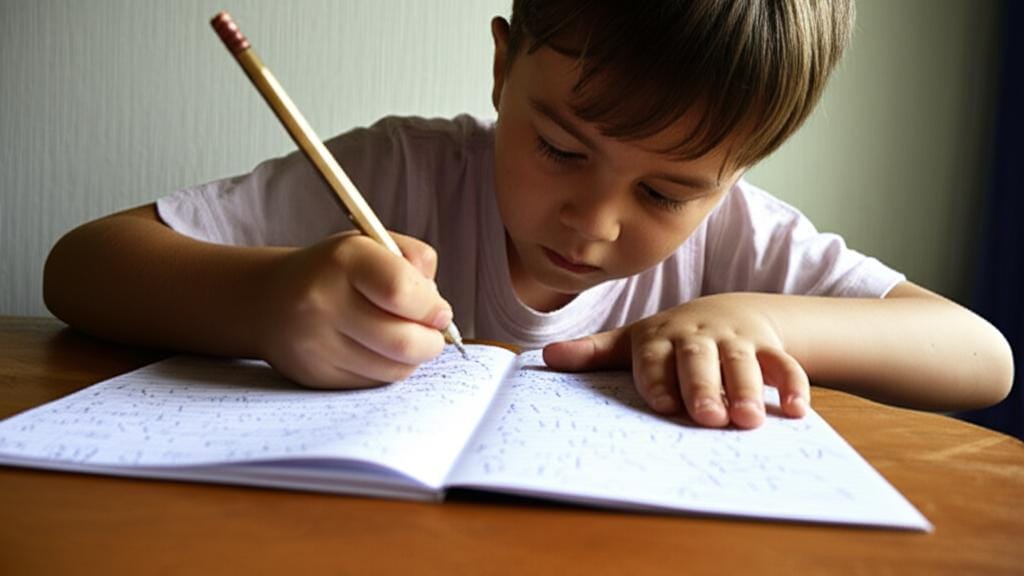
Picture this familiar scene in your home. You sit down at the kitchen table with your child to look over their school homework folder. You pull out a worksheet, and your heart sinks just a little bit. The letters spill across the page like a bumpy roller coaster ride. Some words are giant. This others are squished into tiny corners. Capital and lowercase letters are jumbled together randomly in the middle of sentences.
You might wonder if your child is just rushing, not trying hard enough, or simply being careless. If your child has Attention Deficit Hyperactivity Disorder (ADHD), you are definitely not alone in seeing this daily struggle. Many parents notice that messy, hard-to-read handwriting goes hand in hand with ADHD diagnoses. Let us talk deeply about why this happens, how it affects your child, and what practical steps you can take to help.
Key Takeaways for Parents
- Messy handwriting in children with ADHD is often linked to a condition called dysgraphia.
- It is never a sign of laziness or low intelligence. It reflects neurological and motor coordination challenges.
- Forcing children to write hundreds of lines as punishment does not improve their handwriting skills.
- Classroom accommodations, assistive technology, and occupational therapy can make a massive difference.
- Always work closely with your child's doctor and teachers to build a supportive, stress-free learning plan.
BMI Calculator
Know your body mass index (BMI) and weight classification
ADHD and Handwriting Difficulties (Dysgraphia)
When handwriting is extremely messy, disorganized, and difficult to read, doctors sometimes identify it as a specific learning difference. In medical terms, we call this condition dysgraphia. When a child deals with dysgraphia alongside ADHD, their written work often displays distinct visual signs:
- Letters slant in many different directions across the page without a steady baseline.
- Capital letters and lowercase letters are mixed up randomly within the middle of words.
- Some letters are printed while others are written in cursive script within the exact same sentence.
- Spacing between words and letters is uneven, making whole paragraphs look cluttered.
Beyond how the words look, children with dysgraphia usually write at a much slower speed than their peers. Because they struggle to control the pen or pencil, their hand muscles quickly become tired and tense. This can lead to painful hand cramps during long writing tests at school. Keeping words aligned neatly inside notebook lines becomes an overwhelming daily hurdle.
It is important to remember that not every child with ADHD has messy handwriting or dysgraphia. However, scientific research shows that these two challenges often overlap. One major clinical study discovered that nearly 59 percent of children diagnosed with ADHD also had dysgraphia. Also, about 92 percent of children with ADHD showed noticeable weaknesses in graphomotor skills.
Simply put, graphomotor skills refer to the complex teamwork between your eyes and hands. Your brain must plan movements, guide your hand smoothly, and track visual lines on paper all at once. This connection is so strong that some medical experts suggest adding handwriting assessments to standard ADHD evaluations. Teachers often report that children with ADHD produce handwriting that looks immature and disorganized for their age group.
Why Do Children with ADHD Struggle With Handwriting?
Writing neatly requires several different brain and body skills working together at the exact same time. Unfortunately, the core traits of ADHD make many of these necessary skills quite difficult to manage. Let us examine the specific reasons why handwriting becomes such a struggle.
| Required Writing Skill | Why ADHD Makes It an Obstacle |
|---|---|
| Fine Motor Skills | Fine motor skills involve controlling the tiny muscles in your hands and fingers. Holding a pen correctly and shaping letters takes steady muscle control. Children with ADHD often experience developmental delays in these fine motor areas. |
| Hand-Eye Coordination | Writing requires your eyes to track the paper while your hand follows along accurately. When ADHD affects attention span, maintaining this smooth visual-motor coordination becomes exhausting and inconsistent. |
| Executive Functioning | Executive functions are the brain management systems that help you plan, organize, and finish tasks. Writing a sentence requires organizing thoughts, spelling, and spacing all at once. ADHD disrupts this internal management workflow. |
| Attention and Focus | Staying focused on a repetitive task like writing is tough with ADHD. Every time attention drifts, the letter size, shape, and spacing change instantly on the page. |
Also, children with ADHD often feel an intense urge to finish tasks as fast as possible. When their minds race ahead faster than their hands can write, letters break apart and words blur together. When all of these factors combine, handwriting can deteriorate into an unreadable scribble.
Practical Solutions and Coping Strategies
Messy handwriting causes more than just reading frustration for teachers. It places a heavy emotional burden on your child. Fearing that classmates might laugh or that teachers will scold them for being messy, many children begin pulling away from schoolwork entirely. This cycle hurts their self-esteem and dampens their love for learning.
If you give a child with ADHD a punishment like writing "I will write neatly" one hundred times, it simply does not work. They quickly grow bored with repetitive tasks, and medical research confirms that endless handwriting drills do not fix ADHD-related writing struggles. Thankfully, many helpful, modern solutions exist today.
Classroom Accommodations and Modifications
As a parent, you can collaborate closely with your child's school teacher to set up helpful classroom adjustments:
- Oral Exams and Quizzes: Allow your child to speak their answers out loud instead of writing long essays under tight time pressure.
- Provided Class Notes: Reduce physical writing demands by giving your child printed lesson outlines or teacher-provided lecture notes.
- Alternative Projects: Let your child show what they learned by recording short video reports or giving oral class presentations.
Technological Tools and Assistive Devices
Modern technology offers wonderful tools that relieve the physical strain of handwriting for struggling children:
- Keyboards and Touchscreens: Teaching your child to type school assignments on a computer or tablet removes the physical pressure of pencil grip.
- Speech-to-Text Software: Voice dictation tools let your child speak naturally while a computer or phone automatically types their words on screen.
- Specialized Grips: Ergonomic pencil grips and weighted pens help children hold writing utensils with much greater stability and comfort.
Medicines and Targeted Skills Training
Clinical studies indicate that stimulant medicines prescribed to manage ADHD symptoms can sometimes help improve handwriting legibility as well. However, more research is ongoing in this area. Combining medical guidance with specialized motor skills training helps children build the physical coordination they need.
Before making any changes to your child's routine, medicines, or therapy plans, you must consult your pediatrician or primary healthcare doctor for expert medical advice.
When to Seek Immediate Medical Help
If your child experiences a sudden loss of motor control, severe weakness in both hands, acute neurological changes, or signs of severe emotional distress and depression, seek medical attention right away. In the US and Canada, call 911 or visit your nearest Emergency Department (ER). In the UK, call 999 or go to your nearest Accident and Emergency (A&E) department.
💡 Take-Home Message
Understanding the connection between ADHD and handwriting transforms how you support your child. Keep these key takeaways in mind:
- ADHD and messy handwriting are often connected through a condition known as dysgraphia.
- Struggles with writing stem from fine motor skill delays, executive function challenges, and attention fatigue, not laziness.
- Forcing children to do endless repetitive handwriting punishment drills is ineffective and causes unnecessary stress.
- Practical classroom adjustments, assistive technologies, and ergonomic tools offer empowering solutions.
- Always team up with your family doctor, pediatrician, and teachers to create a balanced support plan for your child.
Sources & Clinical References:
- Cleveland Clinic. Dysgraphia: Causes, Symptoms, and Treatment.
- Mayo Clinic. Attention-deficit/hyperactivity disorder (ADHD) in children - Diagnosis and treatment.
- NHS UK. Attention deficit hyperactivity disorder (ADHD) overview.
- Centers for Disease Control and Prevention (CDC). What is ADHD?.
- National Institutes of Health (NIH) / PubMed. Research on graphomotor difficulties and executive function in neurodevelopmental disorders.






No comments yet. Be the first to share your question or experience below.