
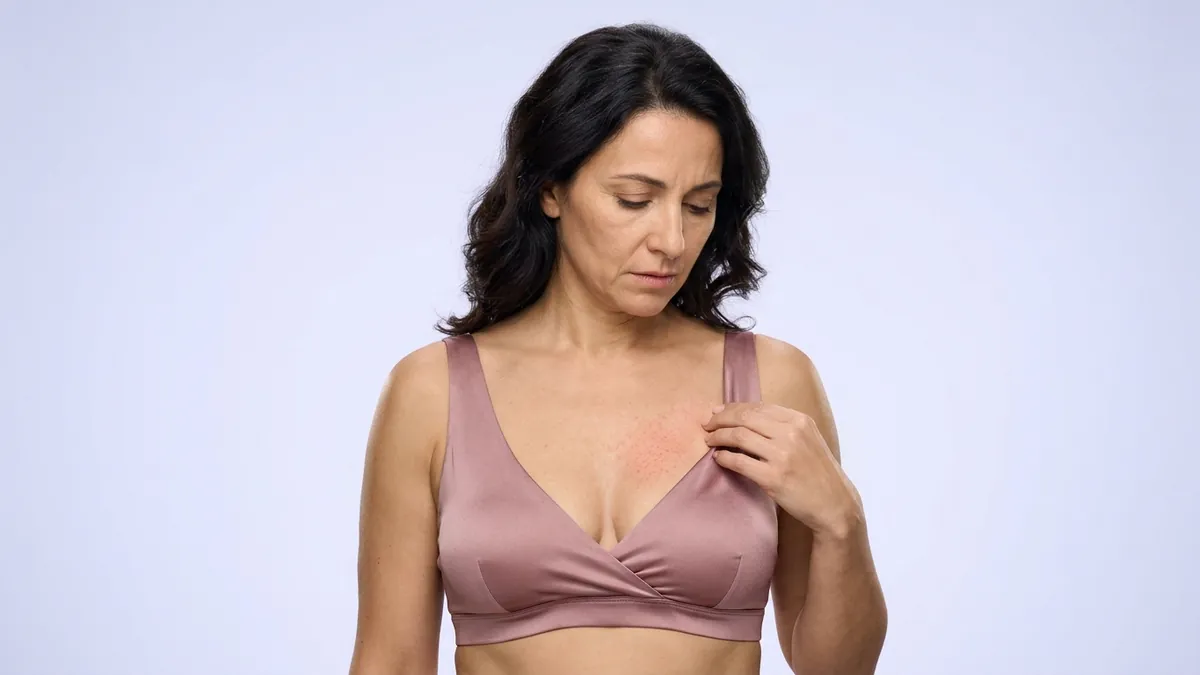
Looking into Early Inflammatory Breast Cancer Rash (Peau d'Orange) vs Breastfeeding Mastitis: Key Differences When Antibiotics Fail is one of the smartest steps you can take if you have noticed unexplained redness, warmth, heaviness, or skin texture changes on one breast. When a breast suddenly turns pink, hot, and swollen, both patients and clinicians naturally think of a breast tissue infection during nursing (lactational mastitis) first. Most of the time, especially if you are breastfeeding or pumping, an inflamed milk duct or bacterial infection really is the culprit. Pretty reassuring at first glance, right?
Think about what happens, though, when you finish several days of prescribed antibiotics and that redness has not budged—or when you develop a warm, swollen breast rash even though you are not breastfeeding at all. Have you ever wondered why two completely different breast conditions can look almost identical in the mirror? Understanding how a fast-growing breast cancer blocking skin fluid channels (inflammatory breast cancer, or IBC) mimics an everyday infection helps you know exactly when to relax and when to ask your doctor for a closer look.
In this guide, we doctors will walk you side by side through what happens beneath your skin, what tiny early rash spots look like, how quickly true mastitis should respond to treatment, and which exact tests give you a clear, confident answer at your Primary Care Physician (PCP) or family GP clinic.
📌 Key Takeaways at a Glance
- Same look, different root cause: Breastfeeding mastitis stems from narrowed milk ducts and bacterial infection, whereas an inflammatory breast cancer rash happens when cancer cells clog tiny fluid-draining skin channels (dermal lymphatics).
- Watch the 48-to-72-hour antibiotic rule: True bacterial mastitis almost always starts feeling less painful, less fiery, and less feverish within two to three days of starting the right antibiotic.
- No hard lump is required: Unlike more common breast cancers, inflammatory breast cancer often spreads in thin sheets rather than forming a distinct marble-like lump you can feel with your fingers.
- Look closely at skin texture and spots: Early warning clues include faint pink or purple patches, tiny bug-bite-like spots, orange-peel breast skin dimpling (peau d'orange), sudden cup-size swelling, or a newly flattened nipple.
- Insist on prompt imaging if antibiotics fail: Any red, swollen, or dimpled breast that does not clearly improve after 7 to 10 days of treatment needs an urgent referral for breast scans and, if needed, a skin sample test.
What Are the Key Differences Between an Early Inflammatory Breast Cancer Rash (Peau d'Orange) and Breastfeeding Mastitis?
An early inflammatory breast cancer rash (peau d'orange) develops when microscopic tumor cells block skin lymph vessels, causing painless or aching redness, dimpled orange-peel skin, swelling, and zero response to antibiotics, whereas breastfeeding mastitis is a milk-duct inflammation or bacterial infection causing flu-like fever that improves within 48 hours of antibiotics.
Let's unpack why those differences matter in everyday life. When you develop infectious mastitis, bacteria—most commonly from your skin or your baby's mouth—multiply inside congested milk ducts. Your immune system rushes white blood cells to that exact wedge of the breast. Within hours, you usually feel hit by a truck: a high temperature above 101°F (38.3°C), body chills, muscle aches, and a sharply tender, hot, wedge-shaped red patch on one breast. We rarely forget how miserable a sudden mastitis fever feels, do we?
Now look at what happens with inflammatory breast cancer. Despite having "inflammatory" right in its name, it is not caused by germs or an infection at all. Instead, abnormal cells grow along the delicate drainage vessels in the breast skin. Because no bacteria are causing the redness, you typically do not get shaking chills or a high flu-like fever. Instead, the breast may feel noticeably heavier, fuller, warmer, itchy, or bruised, and the pink or purplish flush slowly spreads to cover at least one-third of the breast without shrinking on antibiotics.
Why Does Peau d'Orange Happen, and What Do Spots on a Very Early Inflammatory Breast Cancer Rash Look Like?
Have you ever peeled a fresh navel orange from the grocery store and noticed how tiny pinprick pits indent the bright rind? Beneath your breast skin sits a microscopic network of lymph channels whose job is to drain excess tissue fluid toward the lymph nodes under your arm and collarbone. When abnormal cells plug those tiny channels, fluid backs up inside the skin layers, puffing the skin outward while hair follicles and sweat ducts stay tethered down. Look at what happens here: that tug-of-war between swollen skin and anchored pores creates classic orange-peel breast skin dimpling (peau d'orange). Now that makes sense, right?
What Do Spots on a Very Early Inflammatory Breast Cancer Rash Look Like?
Before dramatic orange-peel dimpling shows up, early changes can be surprisingly subtle. Many patients tell us doctors they first thought a bra underwire rubbed them raw or an insect bit them overnight. Very early rash signs can include:
- Pinpoint red or pink spots: Small clustered specks that look like a mild heat rash, prickly heat, or two or three bug bites that refuse to fade after a week.
- Faint bruise-like patches: Pale violet, dusty rose, or reddish-brown blotches on the breast where you never bumped yourself—important to note because on darker skin tones, the rash often looks deeper purple, mahogany, or coppery rather than bright pink.
- Subtle ridges and thickened skin: Running your fingertips lightly across the skin may reveal raised ridges, firmness, or warmth compared with your other breast.
- Nipple and areola shifts: A nipple that suddenly pulls inward, flattens out, or develops persistent itching or flaking alongside breast fullness.
What Should Happen Step by Step When Antibiotics Fail After 48 to 72 Hours?
Remember how we talked about the 48-to-72-hour antibiotic window earlier? Let's trace the exact clinical timeline we doctors follow at your Primary Care Physician (PCP) or family GP clinic so you know what good care looks like at every stage.
If you are breastfeeding and develop classic mastitis symptoms, modern clinical guidelines often start with 24 hours of conservative anti-inflammatory care—gentle physiological feeding, cool packs, hydration, and doctor-approved pain relievers like ibuprofen or acetaminophen (paracetamol in the UK and Australia). If symptoms worsen or high fever persists past 24 hours, your doctor prescribes a targeted oral antibiotic for 10 to 14 days.
How Long Should You Wait Before Requesting Further Tests?
Once you start an antibiotic, fever and throbbing pain should begin easing within 48 to 72 hours. If there is zero improvement at 72 hours, we doctors first check for two common infection complications: an antibiotic-resistant bacterium (such as MRSA) or a pocket of trapped pus (breast abscess), which is quickly checked with a painless sound-wave breast scan (targeted breast ultrasound).
However, if there is no abscess and your breast redness, swelling, or dimpling persists beyond 7 to 14 days—or right away if you are not breastfeeding or pregnant and have no clear infection trigger—waiting for a second or third round of guesswork antibiotics can delay an essential diagnosis. At that point, we doctors arrange an urgent specialist breast clinic referral for:
- Diagnostic breast imaging: Both a breast X-ray scan (diagnostic mammogram) and a targeted breast ultrasound looking at skin thickness, underlying tissue, and underarm lymph nodes.
- Tissue confirmation: A quick, numbed small skin sample test (skin punch biopsy) and/or a hollow-needle breast tissue sample (core needle biopsy), which specialists use to check those tiny skin lymph channels directly under a microscope.
How Do Early Inflammatory Breast Cancer Rash and Breastfeeding Mastitis Compare Side by Side?
When you are staring at a red patch on your breast at 10 p.m., having clear, practical clues side by side helps calm racing thoughts. Here is a straightforward two-column comparison showing how we doctors weigh each feature and what step you should take next.
| Symptom or Clinical Factor | What It Means & What You Should Do |
|---|---|
| Who typically develops it | Breastfeeding mastitis overwhelmingly affects nursing or pumping mothers in the first few months postpartum, though non-lactational mastitis can occur in smokers or people with nipple piercings. Inflammatory breast cancer most often appears in adults who are not breastfeeding, though rarely it can occur during pregnancy or lactation. What you should do: Book an appointment with your family GP clinic or Primary Care Physician promptly whenever breast redness appears outside of breastfeeding. |
| Speed of onset and fever | Infectious mastitis usually strikes rapidly over 12 to 24 hours with a fever above 101°F (38.3°C), chills, and body aches. Inflammatory breast cancer usually builds over days to weeks with warmth and heaviness, rarely causing a high fever. What you should do: Check your temperature with a reliable thermometer and share both your fever readings and symptom timeline with your doctor. |
| Appearance of rash and early spots | Mastitis usually forms one hot, tender, wedge-shaped red area pointing toward the nipple. Early inflammatory breast cancer may start as faint bug-bite-like spots, a bruise, or diffuse pink-to-purple flushing covering one-third or more of the breast, followed by orange-peel dimpling (peau d'orange). What you should do: Take clear, dated smartphone photos in natural daylight every morning so your doctor can see whether the border is shrinking or spreading. |
| Pain vs heaviness and itching | Mastitis tends to feel sharply painful, throbbing, and sore to the slightest touch. Inflammatory breast cancer can ache or burn, too, but often stands out for persistent itching, rapid swelling by a full cup size, or feeling unusually heavy without sharp tenderness. What you should do: Never assume a painless or merely itchy breast rash is harmless; have persistent skin texture or size shifts examined in person. |
| Response to oral antibiotics | Bacterial mastitis steadily calms down within 48 to 72 hours of appropriate antibiotics. An inflammatory breast cancer rash shows no lasting improvement on antibiotics because no bacteria are driving the swelling. What you should do: Contact your doctor if redness and swelling are unchanged after 72 hours of antibiotics, and request breast imaging referral if symptoms linger past 7 to 10 days. |
| Presence of a breast lump | Mastitis may have a boggy, plugged area that softens after feeding or a tender fluid pocket if an abscess forms. Over half of patients with inflammatory breast cancer have no distinct lump at all because cells grow in flat sheets. What you should do: Do not rely on feeling a hard lump to get checked; ask for diagnostic imaging whenever skin dimpling, ridging, or swelling persists. |
How Can You Care for Your Breast Safely at Home While Getting Checked?
Whether you are recovering from confirmed breastfeeding mastitis or waiting a few days for your specialist breast imaging appointment, gentle daily habits keep you comfortable without irritating delicate breast tissue. Be honest—when you feel a swollen spot in your breast, your first instinct is to press and massage it hard to "break it up," isn't it? See? That's exactly why we always caution patients against deep breast massage: pressing forcefully on swollen tissue actually crushes tiny capillaries and worsens skin swelling!
Instead, wear a soft, supportive, wire-free cotton bra that holds the weight of your breast without digging into your ribs or underarms. Applying a clean cool gel pack wrapped in a soft washcloth for 10 to 15 minutes at a time helps soothe heat and throbbing. If you are nursing or pumping, keep feeding on your baby's normal cue schedule rather than over-pumping to empty the breast completely, since over-pumping tells your body to produce even more milk and increases duct congestion.
Support your body from the inside, too. Keep a refillable water bottle or warm mug of caffeine-free chamomile or peppermint tea nearby, and lean on simple, nourishing everyday meals—like oatmeal topped with berries, Greek yogurt, leafy greens, baked salmon, or hearty chicken and vegetable soup—while you rest and let your medical team guide the next steps.
✔️ What You Should Do & ❌ What to Avoid
- ✔️ DO draw a light washable pen line or take daily daylight photos: Tracking the exact edge of a breast rash gives your family GP or PCP objective proof of whether redness is receding or expanding.
- ✔️ DO finish prescribed antibiotics as directed while staying in touch: Check back with your clinic at the 48-to-72-hour mark if pain, heat, or swelling has not started easing.
- ✔️ DO ask explicitly about diagnostic imaging if a rash lasts over 7 to 10 days: Requesting a diagnostic mammogram and targeted breast ultrasound—and a specialist referral for a skin punch biopsy if scans are inconclusive—is proactive self-advocacy.
- ❌ AVOID deep, aggressive breast massage or vibrating massagers: Heavy pressure worsens lymphatic congestion and microvascular inflammation in both mastitis and other breast conditions.
- ❌ AVOID applying leftover steroid creams or random antibiotic ointments: Over-the-counter hydrocortisone can temporarily pale the skin surface and mask vital visual clues your doctor needs to see.
- ❌ AVOID assuming you are "too young" or safe because there is no lump: Persistent one-sided breast swelling and orange-peel dimpling always deserve a proper clinical check at any adult age.
🚨 When to Seek Immediate Emergency Care (Red-Flag Symptoms)
If you or someone near you develops any of these red-flag symptoms, do not wait — call 911 (or 999 in the UK / 000 in Australia) immediately or go straight to the nearest hospital Emergency Room (ER / A&E):
- Signs of a dangerous whole-body infection reaction (sepsis): A spiking fever with uncontrollable shaking chills, racing heartbeat, fast or shallow breathing, dizziness when standing, confusion, or pale, clammy, mottled skin.
- Rapidly spreading fiery redness with red streaks: Angry red lines tracking quickly across your chest wall or toward your neck alongside worsening severe pain (for urgent non-life-threatening guidance in the UK, you can also call NHS 111 immediately).
- A tense, fluctuant, fiercely painful lump or open pus drainage: Signs of a burst or worsening breast abscess accompanied by vomiting or inability to keep fluids down.
- New shortness of breath, chest pain, or sudden swelling of your entire arm: Urgent symptoms that require immediate hospital evaluation to rule out serious chest or blood-vessel complications.
💡 Key Take-Home Message
- Most sudden painful breast rashes during breastfeeding are infectious or inflammatory mastitis and improve steadily within 48 to 72 hours of proper care.
- An early inflammatory breast cancer rash mimics mastitis by causing redness, warmth, bug-bite-like spots, bruised patches, and orange-peel dimpling (peau d'orange)—usually without high fever or a distinct lump.
- Never settle for repeated back-to-back courses of antibiotics without an ultrasound and specialist breast evaluation if breast redness or swelling fails to clear within 7 to 14 days.






No comments yet. Be the first to share your question or experience below.