

You have left the house and are halfway down the street when a sudden, suffocating panic strikes: Did I leave the stove on? Is the front door unlocked? What if the house burns down and it is entirely my fault? Most people experience fleeting doubts, brush them aside, and move on with their day. But for someone living with obsessive-compulsive disorder (OCD), that thought does not fade. It magnifies. The anxiety spikes until turning around, re-entering the home, and checking the lock three, five, or ten times becomes an inescapable command.
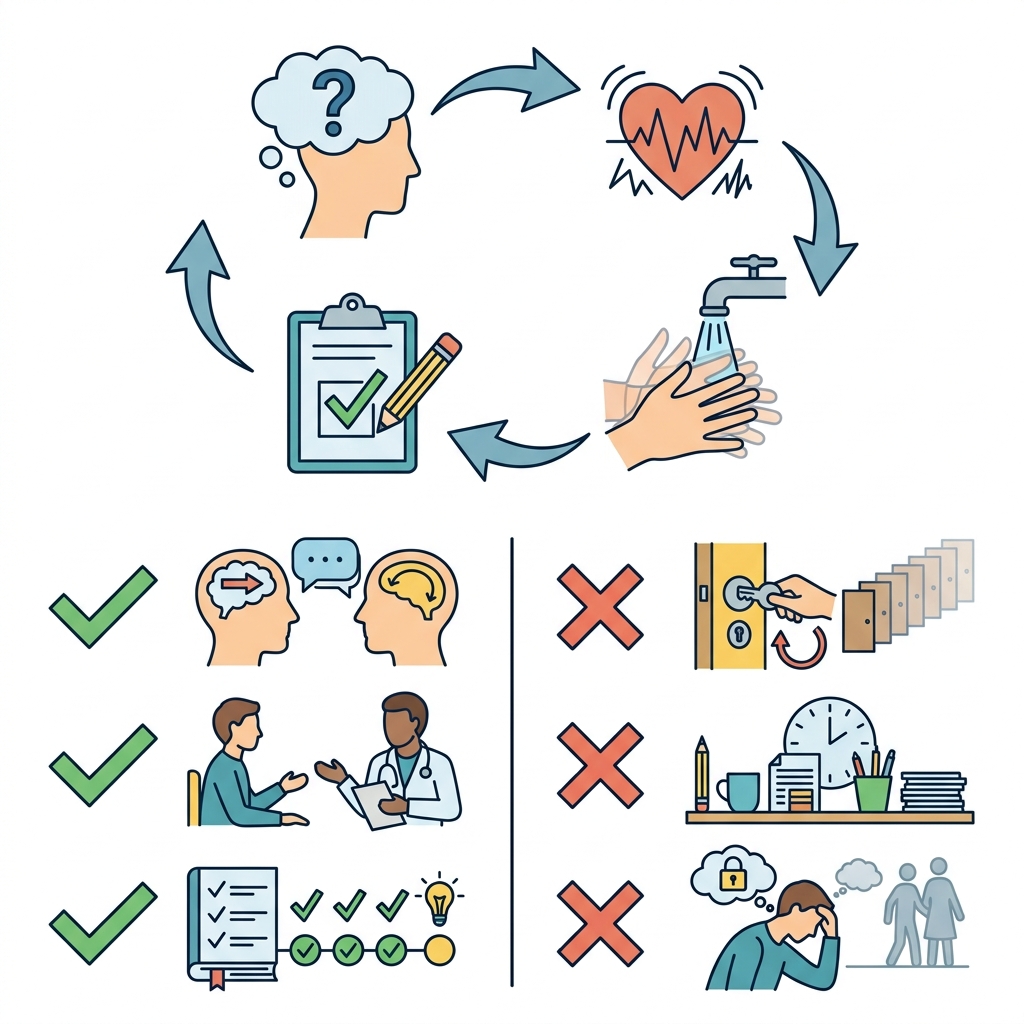
OCD is not a quirky personality trait, an excessive preference for neatness, or a badge of tidiness. It is a chronic, often debilitating neurobehavioral condition recognized globally by the World Health Organization (WHO), the National Health Service (NHS), and the Mayo Clinic. It traps millions of people in a relentless loop of distressing, unwanted thoughts and urgent, exhausting behavioral or mental rituals. Understanding this cycle is the first step toward breaking free.
Key Clinical Takeaways (Quick Summary).
- OCD is Neurobiological, Not a Weakness: It stems from functional miscommunication within the brain's cortico-striato-thalamo-cortical (CSTC) circuitry, modulated by neurotransmitters including serotonin, glutamate, and dopamine.
- The Core Mechanism is Cyclical: Intrusive obsessions trigger acute distress; compulsions provide temporary relief, but paradoxically reinforce the brain's false alarm system over time.
- Gold-Standard Care Exists: Exposure and Response Prevention (ERP)—a specialized branch of Cognitive Behavioral Therapy (CBT)—alongside first-line medicines (SSRIs) can lead to sustained clinical remission.
- Diagnosis Requires Clinical Impairment: To meet diagnostic criteria under the DSM-5-TR and ICD-11, symptoms must eat more than one hour daily or cause significant social, occupational, or personal distress.
What Exactly Is Obsessive-Compulsive Disorder (OCD)?
Obsessive-Compulsive Disorder is characterized by the presence of obsessions, compulsions, or commonly both. While popular culture often reduces OCD to neat desks and aligned color-coded pens, clinical reality is far more distressing. The disorder is characterized by an internal tug-of-war: the person often recognizes that their intrusive fears are irrational, out of proportion, or catastrophic, yet the emotional urgency generated by the nervous system feels overwhelming.
According to the Diagnostic and Statistical Manual of Mental Disorders (DSM-5-TR) and the International Classification of Diseases (ICD-11), the condition is defined by two interlocking phenomena:
1. Obsessions (The Fuel).
Obsessions are recurrent, persistent, and unwanted thoughts, urges, or mental images that intrude involuntarily into conscious awareness. Because these thoughts often conflict directly with a person's core values, beliefs, and morals (known clinically as ego-dystonic thoughts), they generate intense anxiety, disgust, shame, or dread.
2. Compulsions (The False Safety Net).
Compulsions are repetitive physical behaviors (such as handwashing, checking, tapping, or ordering) or hidden mental acts (such as silent counting, praying, reciting specific neutralizing words, or mentally reviewing past events). An person feels driven to perform these acts in response to an obsession or according to rigid, self-imposed rules. Compulsions are executed to prevent a dreaded catastrophe or neutralize internal terror. While they briefly reduce tension, they fail to solve the underlying problem, cementing an addictive cycle of anxiety and temporary relief.
⚠️ Emergency Red Flags: When to Seek Urgent Clinical Care.
While OCD itself involves unwanted thoughts, the emotional toll, severe exhaustion, and co-occurring major depression can lead to acute psychiatric distress. Seek emergency medical attention right away if you or a loved one experience:
- Active thoughts of suicide, plans for self-harm, or feeling unable to keep yourself safe.
- Severe physical harm resulting from compulsions (e.g., chemical burns, deep skin erosion from caustic cleansers, severe dehydration, or malnutrition).
- Total functional breakdown, such as an inability to eat, sleep, leave the house, or care for basic physiological needs for consecutive days.
Call emergency services right away: 911 (US/Canada), 999 (UK), or proceed directly to your nearest Emergency Department (ER/A&E). You can also call or text the Suicide & Crisis Lifeline at 988 in the US/Canada or dial 111 in the UK for urgent NHS mental health support.
The Anatomy of Common OCD Subtypes and Presentations.
Obsessions and compulsions can focus on almost any theme, but clinical practice often identifies several major symptom clusters:
Contamination and Cleaning.
- The Obsession: Intense fear of contact with pathogens, bodily fluids, household chemicals, toxic environmental substances, or moral "contamination" (transfer of negative traits).
- The Compulsion: Ritualized, multi-step handwashing until skin cracks or bleeds; showering for hours; discarding perfectly safe clothing; excessive chemical disinfection of household items.
Checking and Pathological Doubt (Harm OCD).
- The Obsession: The horrific fear that an oversight or careless action will cause catastrophic harm to oneself or others (e.g., leaving a door unlocked resulting in a break-in, leaving a stove on resulting in a fire, or hitting a pedestrian without noticing).
- The Compulsion: Repeatedly inspecting door locks, electrical appliances, car brakes, or driving back over the same stretch of road multiple times to inspect the pavement.
Symmetry, Order, and "Just Right" Sensations.
- The Obsession: Intense physical or psychological discomfort when items are uneven, misaligned, or out of place, often accompanied by magical thinking (e.g., "If my shoes aren't lined up symmetrically, something terrible will happen to my sibling").
- The Compulsion: Arranging, aligning, rewriting words, tapping objects with both sides of the body to preserve balance, or restarting tasks until a subjective "just right" feeling is achieved.
Taboo, Intrusive, and Blasphemous Thoughts.
- The Obsession: Terrifying, unprovoked intrusions involving taboo sexual themes, violent impulses toward loved ones, or blasphemous religious thoughts. People with these obsessions are horrified by the thoughts and are among the least likely to act on them, yet they fear their presence means they are secretly evil.
- The Compulsion: Silent prayers, mental neutralization rituals, repeating "safe" numbers, seeking constant reassurance from partners, or completely avoiding knives, children, or spiritual spaces.
Why Does OCD Develop? Causes and Neurobiology.
OCD is not caused by poor parenting, lack of personal willpower, or personal fault. Groundbreaking neuroimaging and neurochemical research have revealed that it is a complex, biologically driven condition involving:
Brain Circuitry Dysfunction.
Functional neuroimaging reveals hyperactivity within the Cortico-Striato-Thalamo-Cortical (CSTC) loop. This brain circuit acts as an error-detection and habit-filtering system. In a healthy brain, the orbitofrontal cortex detects a potential problem, the striatum filters the message, and the thalamus relays an appropriate signal once the task is complete. In OCD, this circuit remains stuck in an "error alert" loop, firing persistent warnings of danger even when objective risk is absent.
Neurochemical Imbalances.
Multiple neurotransmitter pathways are altered in people with OCD:
- Serotonin (5-HT): Plays a regulatory role in anxiety, mood, and impulse control. medicines that enhance synaptic serotonin availability remain the cornerstone of pharmacotherapy.
- Glutamate: The primary excitatory neurotransmitter. Elevated levels of glutamate in the striatum and anterior cingulate cortex contribute to hyperactive signalling within neural error circuits.
- Dopamine: Modulates reward, habit formation, and stereotyped behavioral patterns.
Genetics and Environmental Triggers.
Twin and family studies show a significant genetic component, with heritability estimated at 40% to 50% in children and adolescents. Major life stressors, hormonal fluctuations (such as pregnancy and the postpartum period), and severe illness can act as environmental catalysts that trigger symptoms in genetically vulnerable people. In rare pediatric presentations, a sudden, acute onset of severe OCD symptoms can follow streptococcal or other infections, known clinically as PANDAS (Pediatric Autoimmune Neuropsychiatric Disorders Associated with Streptococcal Infections) or PANS.
Normal Worry vs. Clinical OCD: How to Tell the Difference.
Everyone double-checks their keys or experiences an occasional unsettling thought. Distinguishing normal caution from clinical pathology depends on duration, severity, and functional impact.
| Feature. | Everyday Caution / Normal Worry. | Obsessive-Compulsive Disorder (OCD). |
|---|---|---|
| Time Consumed. | Seconds to minutes; checked once and dismissed. | Consumes >1 hour per day, often multiple hours daily. |
| Control & Focus. | Focuses on real-world problems (bills, work deadlines). Easily shifted. | Focuses on catastrophic or irrational fears. Thoughts feel intrusive, persistent, and uncontrollable. |
| Emotional Response. | Mild concern; checking brings lasting reassurance. | Intense anxiety, dread, guilt, or terror; compulsions bring only fleeting relief before doubts return. |
| Daily Life Impact. | No disruption to school, work, or personal relationships. | Marked impairment; chronic lateness, avoidance of public spaces, career disruption, strained relationships. |
| Response to Logic. | Reassurance resolves the worry completely. | Logic and reassurance fail to calm the panic for more than a few moments. |
Evidence-Based Medical and Psychological Treatments.
Living with untreated OCD can feel like an endless sentence, but it is one of the most treatable mental health conditions when addressed with clinical methods. Global guidelines from the NHS (NICE Guidelines), the American Psychiatric Association (APA), and the Mayo Clinic recommend two primary therapeutic pillars:
1. Exposure and Response Prevention (ERP) Therapy.
ERP is a targeted subtype of Cognitive Behavioral Therapy (CBT) and is considered the psychological gold standard for OCD. In ERP, the patient works alongside an experienced clinical psychologist to build a fear hierarchy (a ranked list of triggering situations):
- Exposure: The person deliberately confronts thoughts, objects, or situations that provoke obsessional anxiety (e.g., touching a doorknob without washing hands, leaving appliances checked once).
- Response Prevention: The person commits to refraining from performing the compulsive ritual that typically neutralizes the distress.
Through systematic, repeated practice, the brain undergoes inhibitory learning and habituation. The nervous system discovers that anxiety naturally peaks and subsides on its own, and that the feared catastrophic consequence does not occur even without the ritual. Over time, the intrusive thought loses its emotional power.
2. Pharmacotherapy: First-Line Medical Options.
When symptoms are moderate to severe, combining ERP with evidence-based medicines produces the highest response rates. First-line medicine-based agents include Selective Serotonin Reuptake Inhibitors (SSRIs) approved by major regulatory bodies such as the US FDA and European EMA:
- Fluoxetine, Sertraline, Fluvoxamine, and Paroxetine.
- Citalopram and Escitalopram (used off-label or under specific regional clinical guidelines).
Clinical Pearl: Treating OCD typically requires higher SSRI doses than those used for generalized depression or anxiety, and clinical response takes longer—typically requiring 8 to 12 weeks of consistent therapy at target doses before evaluating therapeutic efficacy.
For treatment-resistant cases, clinicians may prescribe Clomipramine (a potent tricyclic antidepressant with profound serotonergic properties) or carefully augment with low-dose atypical antipsychotics (such as Aripiprazole or Risperidone) to modulate dopaminergic pathways.
3. Advanced Neuromodulation.
For severe, treatment-refractory OCD that does not respond adequately to maximum medical therapy and intensive ERP, modern neurotechnologies offer targeted solutions:
- Deep Transcranial Magnetic Stimulation (dTMS): An FDA-cleared, non-invasive therapeutic protocol using magnetic coils to stimulate deeper neural structures (the anterior cingulate cortex and medial prefrontal cortex).
- Deep Brain Stimulation (DBS): Surgically implanted electrodes that deliver targeted electrical impulses to dysregulated subcortical structures, reserved for treatment-resistant cases under strict clinical oversight.
Clinical Do's and Don'ts for Managing OCD.
Navigating OCD requires unlearning natural instincts. What feels helpful in the moment often fuels the disorder long term.
| Do's (Clinically Recommended Actions). | Don'ts (Actions That Strengthen the OCD Loop). |
|---|---|
| Acknowledge intrusive thoughts neutrally: Treat them as meaningless mental noise generated by an overactive alarm system rather than profound personal truths. | Do not debate or analyze the thought: Trying to prove to your brain why the thought won't come true invites endless counter-arguments and fuels obsessional rumination. |
| Delay and taper compulsions: Practice waiting 5 minutes, then 15 minutes before executing a ritual to build distress tolerance. | Do not demand 100% certainty: Demanding absolute certainty about safety, health, or the future is the core cognitive trap of OCD. |
| Seek an ERP-trained therapist: Standard supportive talk therapy can sometimes worsen OCD by focusing on analyzing obsessions rather than interrupting compulsions. | Do not ask family for reassurance: Asking loved ones "Is this clean?" or "Am I a bad person?" provides brief relief while reinforcing reliance on external rituals. |
| Prioritize sleep and stress management: Cortisol and sleep deprivation reduce cognitive inhibition, making intrusive thoughts far harder to dismiss. | Do not isolate yourself: Hiding symptoms out of shame delays diagnosis and prevents you from accessing life-changing clinical care. |
Doctor's Clinical Note: Freedom from the Loop is Possible.
If you are reading this while trapped in a cycle of exhausting rituals or terrifying thoughts, hear this clearly: you are not your intrusive thoughts. Having a dark, violent, or strange thought does not mean you secretly desire it, nor does it make you a bad person. In medical terms, intrusive thoughts are simply misfired electrical signals—neural static. You do not have to fight these thoughts to defeat them. You simply have to stop letting them dictate your behavior. With dedicated Exposure and Response Prevention therapy, medical support, and patience, your brain can rewire itself. Thousands of patients reclaim their time, their relationships, and their peace of mind every single year. You can too.


💬 Comments (0)
No comments yet. Be the first to share your thoughts here.
Add Your Comment