

As a mother, you feel very scared when your little one suddenly starts vomiting frequently and has diarrhea, right? At such times, we are most worried about whether the little one is losing water in his body. This is what we medically call ' dehydration ' . So, today we will talk in detail about this dehydration, how it happens, what are the symptoms, what can be done at home, and when it is necessary to see a doctor.
What exactly is dehydration?
Simply put, dehydration is when our body loses the amount of water it needs. Water is essential for many of our body's functions to function properly. It's like gasoline for a car. So when this amount of water decreases, some things in the body don't work properly. Young children have a slightly higher amount of water in their bodies than adults, and they can become dehydrated very quickly. So we need to be especially careful about this.
What are the causes of dehydration in young children?
There are several main reasons why young children become dehydrated .
- Vomiting and diarrhea : This is the most common cause . When you vomit or have diarrhea, a large amount of water and saliva are released from the body. Imagine how quickly your body's water levels will decrease if you do this several times a day.
- Mouth sores or sore throat: Sometimes little ones get mouth sores or sore throats. Then they don't want to drink or eat anything. Because it hurts to eat or drink. So if they don't get enough fluids, they can become dehydrated.
- Hot weather and excessive activity: When children run around and play, especially on hot days, they lose a lot of water through sweat . If they don't replace the lost water, they can become dehydrated. Some children forget to drink water when they are playing.
- Fever: When you have a fever, your body loses more water. Also, your child may not like food and drink as they may not want to drink as much.
So, for reasons like these, young children are more likely to become dehydrated .
How do I know if my child is dehydrated? What are the symptoms?
Okay, now let's look at the signs that a child is dehydrated . You should pay close attention to these.
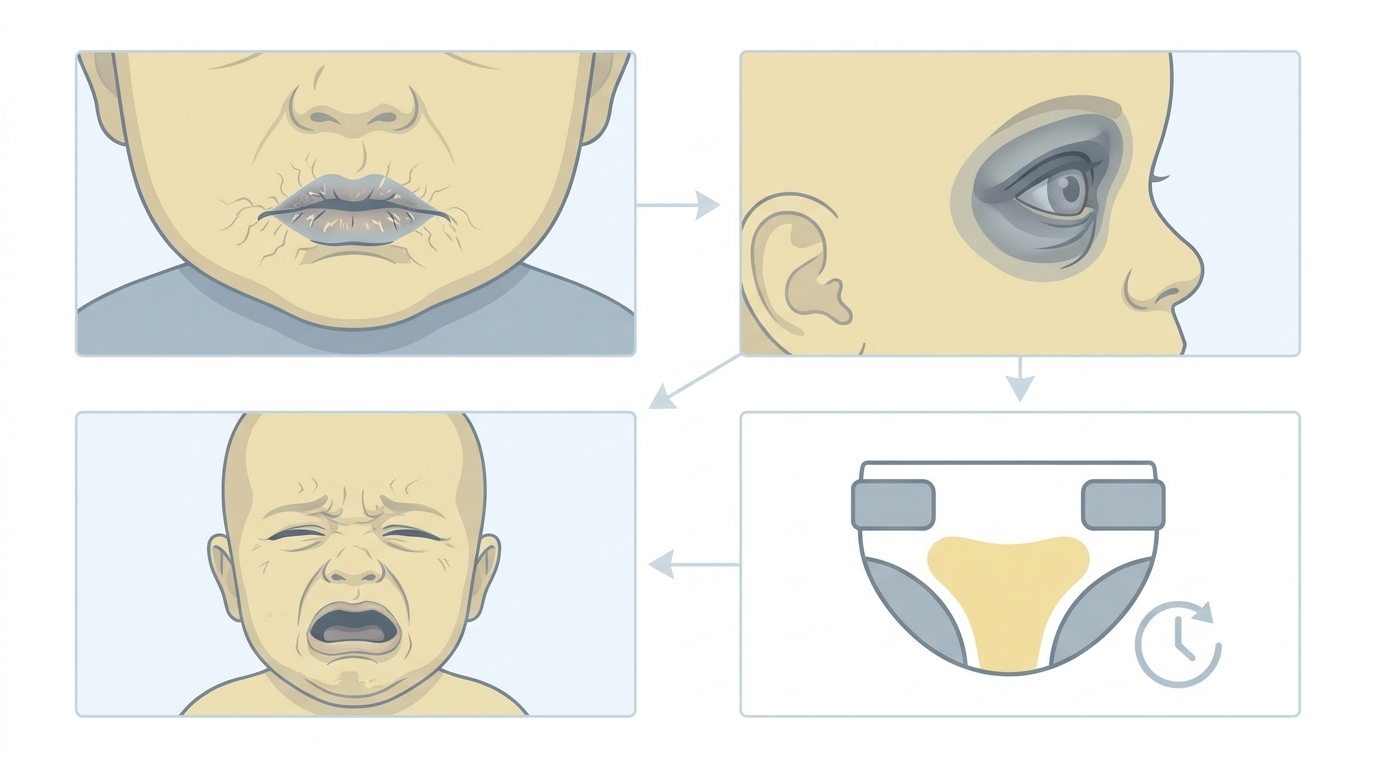
- Dry, sticky mouth and tongue: If the inside of your child's mouth and tongue feel dry, perhaps a little sticky, when touched, it could be a sign of dehydration.
- Fewer or no tears when crying:If you cry a lot and still have very few tears, or no tears at all, that's also a sign that your body is not hydrated enough.
- Sunken-in appearance: If your child's eyes appear sunken or dark circles appear around them, this should also be taken into consideration.
- Sunken fontanelle in babies: Very young babies who are breastfed have a soft spot on the top of their heads called the fontanelle. When they become dehydrated, this soft spot can become sunken and appear sunken.
- Decreased urination /wet diapers : If your baby is urinating less than usual per day, or if your baby is wetting their diapers less often (for example, not urinating for 6-8 hours), this is also a major sign of dehydration. The urine may also be dark yellow in color.
- Frequent crying, fussing, restlessness: If your child is constantly crying, seems unhappy about nothing, or fusses constantly, it could also be due to physical discomfort.
- Sleepiness, listlessness, dizziness : If your child is constantly sleepy, listless and uninterested in playing, or if an older child complains of dizziness, these are also signs of dehydration.
Important: If your child has one or more of these symptoms, it is very important to act quickly.
How to treat dehydration?
The treatment for dehydration depends on its severity.
Generally, if the dehydration is mild , meaning that only a few of the previously mentioned symptoms have started, the condition can be controlled at home by giving the child additional fluids .
However, if the dehydration is severe , the child may need to be admitted to the hospital immediately (i.e., taken to the Emergency Treatment Unit (ETU) ) or treated in the hospital . There, saline may be given intravenously.
Here's how to treat mild dehydration at home:
The best treatment for mild dehydration is to give oral rehydration solutions (ORS) . This is the type of solution you know as 'Jeevani'. You can buy them at pharmacies under names like `(Pedialyte)`, `(Enfalyte)`, or you can buy `(ORS)` that you make yourself at the pharmacy.
- These ``ORS'' contain exactly the right amount of water, sugar, and electrolytes needed by a dehydrated body.)` is included.
- You can buy these from pharmacies and supermarkets without a prescription.
- If you are unable to find ``ORS'' even in an emergency, talk to your family doctor immediately. Ask for advice about giving other fluids.
If your child has mild dehydration, and the doctor allows you to treat it at home, do these things:
- Give small sips of ``(ORS)`` solution as often as possible. Do not give a large amount at once, as this may increase the amount of vomiting that is present.
- For breastfed babies: Give 1-2 teaspoons (about 5-10 ml) every few minutes.
- For older children: Give 1-2 tablespoons (about 15-30 ml) every few minutes.
- If the baby does not continue to vomit, continue to breastfeed or give formula. Do not stop. You can give these while giving ``(ORS)``.
- For older children, you can also give them electrolyte ice pops . These are available at some pharmacies.
- Continue to feed your child their normal diet, unless the doctor advises you to make a change.
- At first, your baby may not be very interested in eating, but if they are drinking plenty of fluids, there is no problem with eating a little less solid food.
- As your child gradually gets better and their appetite increases, you can reduce the amount of ORS they are given and start giving them more of their usual food and drink.
Don't mention these things!
Be especially careful about these, because these mistakes can sometimes make the situation worse.
- Do not give babies water instead of ORS. Water does not contain the electrolytes and sugar needed for dehydration. It can sometimes alter the salt balance in the blood.
- Do not give sports drinks, sodas, or undiluted fruit juice. These are high in sugar, which can make diarrhea worse.
- Do not give any over-the-counter medications for diarrhea or vomiting without a doctor's recommendation. Some medications can cause side effects in young children, and it is dangerous to give medication without properly diagnosing the illness.
When should I see a doctor?
Even during home treatment, there are times when you need to see a doctor right away. If you have any of these symptoms, be sure to seek medical advice.
- If the child does not drink anything for several hours (refuses fluids).
- If a baby under one year old has been drinking only ``(ORS)`` (without breast milk or formula) for 24 hours.
- If you vomit more than a few times (e.g. more than 4-5 times) within 24 hours.
- If the vomit is bright green, red (like blood), or dark brown, these could be signs of another serious condition.
- If the baby has not started eating any solid food after 3-4 days.
- If signs of dehydration (e.g. dry mouth, decreased urination , loss of tears, sunken fontanelles in young babies) seem to be getting worse, or if they are not getting better.
- If the child is very restless, cries constantly, and is lifeless without any play.
- If the condition does not seem to be improving, you may feel that the child is getting weaker and weaker.
Go to the hospital's Emergency Department (ETU) immediately!
In these situations, don't delay even a second. These are emergencies.
- If the child is very sleepy, difficult to wake, or does not respond to what you are saying.
- If the child seems to be having difficulty breathing, or if their breathing is rapid.
- If your hands and feet are cold and your skin is turning blue.
In situations like this, the best thing to do is to take the person to a hospital as soon as possible, rather than keeping them at home.
How to prevent dehydration?
We all know that 'prevention is better than cure'. So there are things we can do to take care of our baby without causing dehydration.
- When your child is sick, especially if he has vomiting or diarrhea, give him extra fluids or ``ORS'' frequently. If he is vomiting, it is best to give him small amounts, often. Giving a large amount at once may cause him to vomit again.
- On hot days, encourage your children to drink water regularly. Don't forget to carry a water bottle with you when you go out.
- For children who play sports and run around, give them an extra drink of water before they start their activity. Also, give them a short break to drink water regularly, about every 20 minutes, during the activity. You need to remind them because they may forget to drink water when they get into the swing of things.
- For young babies, breastfeed or formula frequently, depending on their needs. They can become dehydrated quickly, especially on hot days.
If we take care of these simple things, we can prevent dehydration in children in most cases.
Finally, things to remember
Okay, so we talked a lot about dehydration today, didn't we? I think these points will be very important to you as a mother or father.
Remember,Dehydration can affect young children very quickly, so don't take it lightly.
- Always be aware of symptoms of dehydration (dry mouth, decreased urination , loss of tears, sunken fontanelles, lethargy).
- In case of mild dehydration, give ``ORS'' (such as Jeevani) fluids at home, small amounts and frequently.
- Do not give small babies water, fruit juice, or soda instead of ORS.
- Do not give medication for vomiting or diarrhea without consulting a doctor.
- If you think your child's condition is serious, or if they have any of the warning signs I mentioned earlier, see a doctor without delay, or take them to a hospital (ETU) .
There is no greater joy than seeing your little one healthy and happy. So being aware of these little things will help you prevent big problems from happening. Wishing you all the best!
` Dehydration, Dehydration, Child Dehydration, Life, ORS, Vomiting, Diarrhea, Child Health, Dehydration Symptoms
Doctor's Note
Dehydration in children is a serious medical emergency. When a child has diarrhea, vomiting, or a high fever, the body loses water rapidly. Dry lips and tongue, sunken eyes, no tears when crying, and no urination for 6 hours are the main symptoms of dehydration. In such a case, slowly give ORS (Oral Rehydration Salts) liquid frequently with a teaspoon or syringe. If symptoms persist, seek immediate medical attention.
❓ Some more questions you may encounter (FAQ)
What are the main symptoms of dehydration in a child?▼
Dry lips and mouth, drooping around the eyes, crying without tears, lethargy, and no urination for more than 6 hours are key.
What is the best drink to give at home to prevent dehydration?▼
Jeevani (ORS) liquid is the best solution. In addition, breast milk, liquid rice porridge or clean water can be given. Avoid sweetened beverages (which may increase diarrhea).
What symptoms, if any, require immediate medical attention in the child?▼
If the child refuses to drink anything, vomits continuously, is excessively sleepy, or has blood in the stool, seek medical attention immediately.


💬 Comments (0)
No comments yet. Be the first to share your thoughts here.
Add Your Comment