

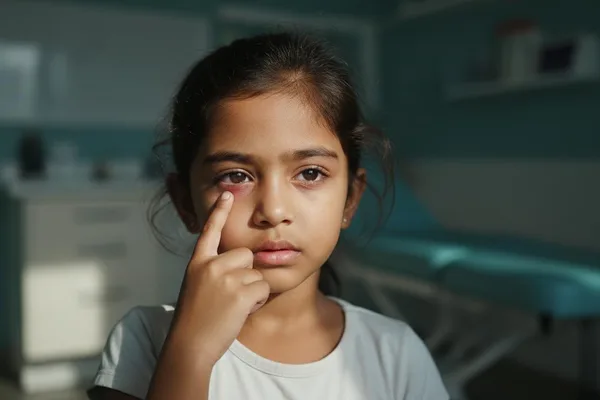
It's scary to see your puppy 's eyes red, and maybe even crusty, isn't it? This condition, which we usually call 'pink eye', is actually medically known as `(Conjunctivitis)'. This is when the white part of the eye, the inner part of the eyelid, becomes infected , swollen, and red. Don't worry, let's talk about it all clearly.
What are the symptoms of red eyes?
Now let's see what symptoms you might see if your little one has `(Conjunctivitis).` There may be one or more of these:
- It feels uncomfortable, like something is stuck inside the eye, sometimes like a grain of sand has gotten stuck . The child may constantly rub or squeeze the eye.
- The whites of the eyes and the inside of the eyelids become very red . Sometimes the first thing you see is a pinkish red color.
- A watery fluid or yellowish pus drains from the eye. Sometimes this makes it difficult to open the eye in the morning.
- When I wake up in the morning , my eyelids are stuck together and covered in crusts . It feels like they've been glued together with glue. I have to clean this off and on.
- The eyes are constantly itchy and teary. This is a common symptom, especially when the eyes are red due to an allergy .
Why does this eye disease occur? What are the causes?
Okay, now let's see why the eyes become red, or `(Conjunctivitis)` develops. There can be several reasons.
- Allergies : Some people can develop eye allergies to things like dust, pollen, animal dander, or certain foods. The eyes become red, itchy, and watery . This is not contagious.
- Irritants: Sometimes, when you get smoke in your eyes ( cigarette smoke , smoke from a wood stove), or chemicals like soap or shampoo in your eyes, or even chlorine in a swimming pool, your eyes can become red. Imagine if you got a little shampoo in your eyes while bathing, and your eyes would turn red, right? That's how it is. This is also not a contagious condition.
- Infections : This is something to be careful about. Conjunctivitis can occur when germs such as viruses or bacteria enter the eye.
- Viral infections: These are very contagious, like the common cold. They usually affect both eyes. The most common symptom is a watery discharge.
- Bacterial Infection: This can also be contagious. It often starts in one eye and spreads to the other. If you have a yellowish, thick discharge, or your eyes are sticky in the morning, this could be the cause.
This type of infection can spread very quickly from one person to another, just like a cold. That's why it's important to be very careful about cleanliness.
What do I do if my little one gets an eye infection?
If your little one has red eyes and symptoms of ``(Conjunctivitis),'' don't panic and do these things.
- See a doctor first: Especially if your baby is a newborn , or if the symptoms are severe (e.g., the eye is very red, very swollen, and pus is draining), you should definitely see a doctor. The doctor will look at it and tell you if it is a bacterial infection, a virus, an allergy, or something else. Treatment will depend on the cause.
- If it's a bacterial infection: Your doctor may prescribe antibiotic eye drops or ointment . These should be used exactly as your doctor tells you, for the number of times you need them, and for the length of time they tell you. Don't stop just because your symptoms have improved in a couple of days. If you don't finish the full course, the infection may come back, or the bacteria may develop resistance to the medication.
- How to clean the eye: Take a clean piece of gauze or cotton wool, soak it in boiled water (not hot, just lukewarm), and very gently wipe away any debris or pus around the eye. Do not press inward, wipe very gently, from the inner corner of the eye outward . Do not use the same cotton wool used for one eye on the other eye. Use a new one every time.
- Cool compress: Soak a clean cloth in ice water, wring it out well, and place it over your eyes (with your eyes closed). Leave it on for a few minutes and then remove it. This can help reduce eye discomfort, swelling, and itching.
- Reduce pain: Only if the doctor says so, you can give paracetamol `(Acetaminophen)` or ibuprofen `(Ibuprofen)` to reduce pain. However, you should give the exact amount according to the weight, at the exact time, as indicated on the package. Do not give `(Ibuprofen)` to babies under 6 months. Do not give any medicine without asking the doctor.
Important: Antibiotic medications are not effective for conjunctivitis caused by a viral infection. It is like a cold and will usually go away on its own in a few days. However, you can do the things mentioned above to reduce the discomfort.
When should you definitely see a doctor if your eyes are red?
Sometimes, home remedies can help relieve eye pain. However, if you have any of these symptoms, you should see a doctor right away. These could be warning signs:
- If there is no improvement after two or three days of starting the medication prescribed by the doctor, or if there is no improvement after about a week without taking the medication.
- If the redness of the eyes is increasing .
- If the eyelids are increasingly swollen , if they are swollen to the point where the eye cannot be opened.
- If your child says, " My eye hurts, I can't stand it, " or if he or she cries constantly, it could be a sign of severe pain.
- If you say that there is a change in your vision , or if you notice something like that (e.g., looking around instead of looking straight ahead, having difficulty recognizing things, difficulty looking at light).
- If you have an earache along with an eye disease (sometimes eye disease and ear infection can occur together).
- If a newborn baby (less than a month old) has red, pus-filled eyes, it's something to be very concerned about. Take him to the doctor immediately.
How to prevent eye diseases? A few tips
Eye diseases, especially those caused by germs (conjunctivitis), are very contagious, so take care of these things to prevent them. "Prevention is better than cure," they say.
- Handwashing is the most important thing: Teach your children to wash their hands regularly and thoroughly with soap. They should rub their hands together for at least 20 minutes. They should wash their hands especially after playing, before eating, after using the toilet, and after going out. We should do the same. Also teach them to reduce their habit of touching their eyes and rubbing their eyes.
- For personal use only: Do not share items such as eye drops, face towels, body washcloths, pillowcases, eyeglasses, and makeup products with another person. Keep each item separate. Always wash and dry your child's towels and pillowcases.
- If you have frequent allergies: If your child's eyes are constantly itchy, watery, or red, talk to a doctor. It could be an allergy. If so, you should get the right treatment for it, and try to stay away from the things that cause the allergy.
- Also think about the home environment:
- Keep your home clean by sweeping, dusting, and vacuuming if possible. Things like dust mites can also cause eye irritation.
- Keep windows and doors closed for long periods of time, especially in the morning, to reduce pollen.
- Use as little as possible things like perfumes and harsh household cleaners. The fumes from these are bad for the eyes.
- Keep children away from smokers: Secondhand smoke is not only harmful to children's eyes, but also to their overall health.
So, what should we remember from this?
Okay, so now we know a lot about `(Conjunctivitis)` or eye disease.
Don't panic, but don't ignore it either. It's normal to feel scared when a child has an eye problem. However, if you see a doctor quickly and find the exact cause and treat it, this is a disease that can be cured quickly.
- Cleanliness is very important: Handwashing and keeping shared items separate can go a long way in preventing the spread of this disease.
- Follow your doctor's instructions exactly: Take your medication exactly as prescribed, as directed, and at the times prescribed. Do not stop or change your medication at will.
- Be aware of the warning signs: If your eyes become increasingly red, swollen, have severe pain, or change in vision, be sure to see a doctor.
- Do not send your child to school when they have an eye infection: It is best to consult a doctor and keep them home until they are completely healed, especially if it is contagious and can spread to other children.
Wishing your little one a speedy recovery! I hope this information is helpful to you.
Eye diseases, conjunctivitis, eye diseases in children, red eyes, eye infections, infectious diseases




💬 Comments (0)
No comments yet. Be the first to share your thoughts here.
Add Your Comment