
Opening your lab portal to look up Quest Cardio IQ Ion Mobility Lipoprotein Subfractions: What Small Dense LDL Pattern B Means Even with 'Normal' Cholesterol can stop anyone in their tracks. Maybe your annual physical showed a "textbook normal" standard LDL cholesterol score, yet this deeper Quest Diagnostics panel came back flagged in bright red for LDL Pattern B and high particle counts. Pretty surprising, right?
Think about it for a second: for decades, routine checkups only weighed the total amount of cholesterol floating in your blood rather than measuring the size and number of particles carrying it. We doctors order advanced cholesterol particle testing (lipoprotein subfractionation) when your family history, blood sugar trends, or blood pressure suggest hidden risk beneath a reassuring basic panel. Uncovering Pattern B now is genuinely good news—because with guidance from your Primary Care Physician (PCP) or family GP clinic, you can actively remodel these tiny particles into safer, larger ones well before heart trouble ever begins.
📌 Key Takeaways at a Glance
- Particle size and count beat cholesterol weight: Standard tests measure cholesterol mass (LDL-C), whereas Quest Cardio IQ Ion Mobility counts actual particles (LDL-P) and measures their physical diameter.
- Pattern B means small, dense particles: An LDL peak size below 217.4 Angstroms (Å) places you in Pattern B—compact particles that slip into artery walls far more easily than large, fluffy Pattern A particles.
- "Normal" cholesterol can hide discordance: Up to 1 in 4 adults with normal standard LDL-C carry excess small dense LDL particles, most often driven by blood sugar resistance (insulin resistance) and elevated triglycerides.
- Pattern B is highly reversible: Trimming refined starches and liquid sugars, eating soluble fiber and omega-3 fats, building muscle, and using targeted medications when needed can shift Pattern B back to Pattern A within months.
Free LDL Cholesterol Calculator (mg/dL & mmol/L). Calculate LDL-C, Non-HDL, and VLDL using both the modern NIH Sampson 2020 equation and classic Friedewald formula.
What Does Quest Cardio IQ Ion Mobility Lipoprotein Subfractions Showing Small Dense LDL Pattern B Mean with Normal Cholesterol?
Quest Cardio IQ Ion Mobility Lipoprotein Subfractions showing Small Dense LDL Pattern B means your bloodstream carries an excess of tiny, compact cholesterol particles (peak size below 217.4 Å) that easily penetrate arterial walls and build plaque, increasing cardiovascular risk even when standard LDL cholesterol looks completely normal.
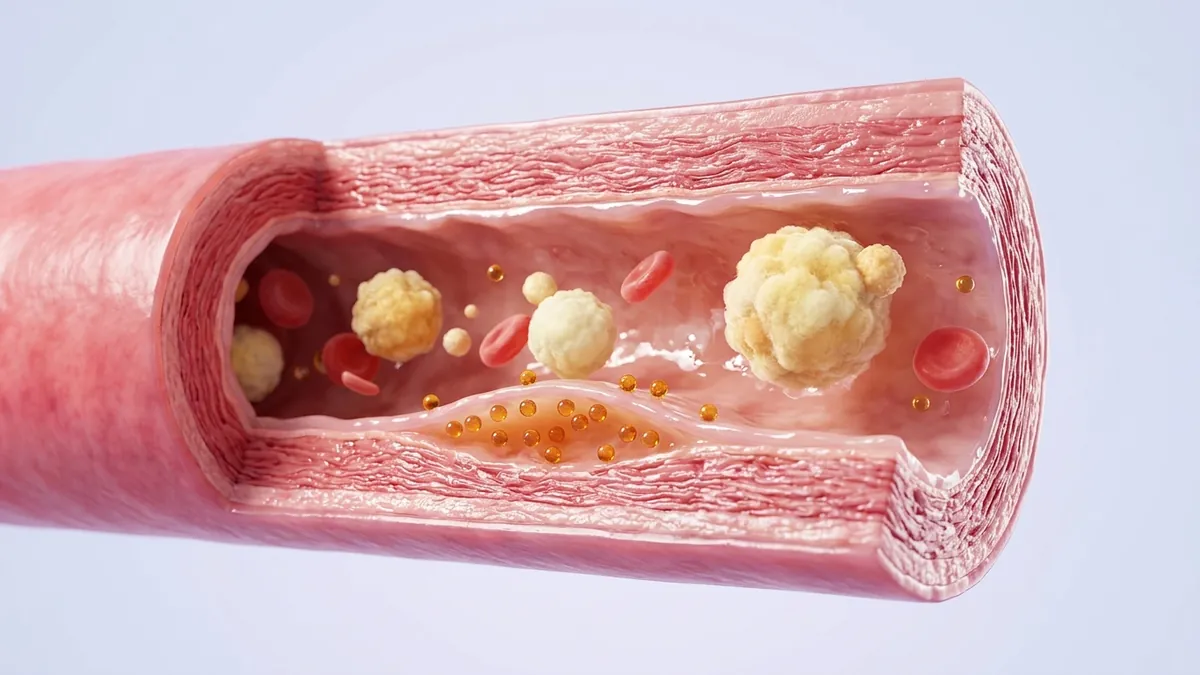
Have you ever wondered why one person with "normal" cholesterol suffers an unexpected blocked artery while another never develops plaque? Look closely at what happens inside your bloodstream here. Cholesterol is waxy and cannot dissolve in watery blood on its own, so your liver packages it inside microscopic protein-wrapped transport spheres called lipoproteins.
A standard lipid panel only reports LDL-C—the total weight of cholesterol cargo inside all Low-Density Lipoprotein spheres combined, typically targeting under 100 mg/dL in the United States (or under 2.6 mmol/L in the UK, Canada, and Australia). Imagine carrying 1,000 commuters down a busy highway: you can fit them into 25 large tour buses (Pattern A) or cram them into 250 tiny compact cars (Pattern B). Total passengers (LDL-C) are identical, yet 250 small cars create dangerous traffic jams! We doctors call this mismatch lipid discordance, and particle traffic—not cargo weight—is what injures arteries.
How Does Ion Mobility Testing Work Compared to Standard Lipid Panels and NMR?
Most routine clinics estimate LDL cholesterol indirectly using a mathematical formula rather than counting particles directly. Even other advanced lipid panels, such as Nuclear Magnetic Resonance (NMR) spectroscopy, infer particle numbers by measuring magnetic signals from fat molecules inside lipoproteins and running computer estimation models. Quest Diagnostics Cardio IQ® takes a uniquely direct physical approach called gas-phase differential ion mobility.
Developed in cardiovascular research laboratories, ion mobility turns intact lipoprotein particles from your blood sample into an aerosol mist, applies a precise electrical charge, and passes them through a controlled air stream. Larger particles experience more aerodynamic drag than tiny ones, allowing a laser particle counter to sort and count every lipoprotein subfraction directly by its exact physical diameter in Angstroms (Å). Pretty clever engineering, isn't it?
Why does that tiny difference in diameter matter so much to your heart and brain vessels? Small dense LDL (sdLDL) causes hardening and narrowing of the arteries (atherosclerosis) through four distinct mechanisms:
- Easier wall entry: Tiny particles squeeze effortlessly through microscopic gaps in your blood vessel inner lining (endothelium).
- Longer bloodstream hang-time: Because small particles change shape slightly, cleanup receptors on your liver struggle to recognize them, leaving them circulating for days longer than large particles.
- Sticky arterial trapping: Once inside the vessel wall, Pattern B spheres bind tightly to structural sugars (proteoglycans) and get stuck.
- Rapid chemical "rusting": Trapped small particles have fewer protective antioxidants and undergo chemical damage (oxidation) quickly, triggering white blood cells to swallow them and form unstable fatty plaque.
Why Do Small Dense LDL Particles Form Even When You Eat Clean?
Be honest, you've probably been told for years that cholesterol trouble simply comes from eating too many eggs, steaks, or butter, haven't you? Yet when we doctors sit down with patients puzzled by LDL Pattern B, dietary cholesterol is rarely the main culprit. Instead, Pattern B is predominantly a metabolic signal coming from how your liver handles sugars, starches, and blood fats (triglycerides).
When your cells become sluggish at absorbing blood sugar—a very common early state called blood sugar resistance (insulin resistance)—or when extra fat accumulates around your waist and liver (metabolic dysfunction-associated steatotic liver disease), your liver pumps triglyceride-heavy particles into circulation. An enzyme called cholesteryl ester transfer protein (CETP) then trades triglycerides into your healthy, large LDL particles in exchange for cholesterol. Right behind it, a liver enzyme (hepatic lipase) digests those traded triglycerides, shrinking each once-fluffy LDL sphere into a dense, shriveled Pattern B pebble. Now that makes sense, right?
Several everyday factors push your body toward Pattern B even if your weight feels steady:
- Refined carbohydrates and sugary drinks: White bread, pastries, sodas, fruit juices, sweetened iced coffees, and evening alcohol rapidly boost liver triglyceride production.
- Subtle triglyceride-to-HDL shifts: Fasting triglycerides creeping past 120–150 mg/dL (1.4–1.7 mmol/L) paired with low "good" HDL cholesterol strongly predict Pattern B.
- Hormonal and medical triggers: An underactive thyroid (hypothyroidism), polycystic ovary syndrome (PCOS), menopause transitions, chronic sleep loss, and certain prescriptions—such as older beta-blockers or thiazide water pills—can shrink LDL size.
- Inherited traits: Conditions like familial combined hyperlipidemia can program smaller LDL particles across generations.
What Are the Exact Quest Cardio IQ Reference Ranges and Test Preparation Rules?
Reading multi-page Quest Cardio IQ color graphs—green for optimal, yellow for moderate, and red for high risk—gets much easier once you know which numbers carry the heaviest clinical weight. Below are the standard Quest Cardio IQ® Ion Mobility adult cutoffs we doctors focus on first:
- LDL Peak Size (determines Pattern): Optimal Pattern A is greater than 222.9 Å; Moderate / Intermediate Pattern sits between 217.4 and 222.9 Å; High-Risk Pattern B is less than 217.4 Å.
- Total LDL Particle Number (LDL-P): Optimal is below 1,138 nmol/L (for higher-risk patients, preventive specialists often aim below 1,000 nmol/L); Moderate is 1,138–1,409 nmol/L; High Risk exceeds 1,409 nmol/L.
- Small LDL Subfraction: Optimal is below 142 nmol/L; Moderate is 142–219 nmol/L; High Risk exceeds 219 nmol/L.
- Medium LDL Subfraction: Optimal is below 215 nmol/L; Moderate is 215–301 nmol/L; High Risk exceeds 301 nmol/L.
- Large HDL Subfraction (protective): Optimal exceeds 6,729 nmol/L; Moderate is 5,353–6,729 nmol/L; High Risk drops below 5,353 nmol/L.
To keep your lab draw accurate, follow three strict preparation habits: fast for 9 to 12 hours drinking plain water only (a late-night snack spikes triglycerides and skews subfractions), avoid alcohol for 48 hours beforehand, and reschedule routine testing if you have had a fever, flu, major injury, or surgery within the past 4 to 6 weeks, since acute inflammation temporarily shrinks LDL particles.
If Pattern B appears, your PCP or family GP will typically pair these results with Apolipoprotein B (ApoB) (one ApoB protein sits on every plaque-forming particle; optimal is generally under 80–90 mg/dL, or lower if high risk), a once-in-a-lifetime genetic Lipoprotein(a) [Lp(a)] blood check, 3-month blood sugar (HbA1c), thyroid-stimulating hormone (TSH), and sometimes a referral to radiology for a quick, low-radiation coronary calcium heart scan (coronary artery calcium or CAC score) to see whether actual calcified plaque exists in your heart arteries.
How Do Subfraction Results Compare, and How Can You Shift Pattern B Back to Pattern A?
Remember how we talked about that highway traffic analogy earlier? Clearing arterial traffic means both shrinking the total number of compact cars (lowering LDL-P and ApoB) and upgrading small cars back into roomy buses (raising peak size above 222.9 Å). Use this quick comparison table when reviewing your printout with your doctor:
| Quest Cardio IQ Finding | Clinical Meaning & Practical Next Step |
|---|---|
| Pattern A (Peak Size > 222.9 Å) with Optimal LDL-P (< 1,138 nmol/L) | Your cholesterol travels mostly in large, buoyant spheres with low traffic density in your bloodstream, signaling lower plaque-forming tendency. What you should do: Maintain balanced whole-food meals, regular aerobic and strength exercise, and routine preventive checkups every 1 to 2 years. |
| Intermediate Pattern (217.4–222.9 Å) | Your LDL particles sit in a borderline transition zone, often reflecting early insulin resistance, creeping triglycerides, or reduced physical activity. What you should do: Cut back on refined grains and sugary drinks, increase daily brisk walking, and recheck fasting lipids and HbA1c in 4 to 6 months. |
| Pattern B (< 217.4 Å) with "Normal" Standard LDL-C | Classic lipid discordance: despite a reassuring standard cholesterol weight, dense small LDL particles are present and can infiltrate arterial walls easily. What you should do: Ask your PCP or GP to check ApoB, fasting glucose/HbA1c, and thyroid function, and start targeted low-glycemic nutrition plus resistance training. |
| Pattern B (< 217.4 Å) + High LDL-P (> 1,409 nmol/L) | Both high particle traffic and small dense particle size are working together, substantially elevating long-term risk for coronary plaque buildup. What you should do: Book a dedicated visit with your family doctor or a preventive cardiologist to discuss both intensive lifestyle shifts and lipid-lowering medication, plus whether a CAC heart scan is right for you. |
| High Small LDL (> 219 nmol/L) + Low Large HDL (< 5,353 nmol/L) | This twin signature strongly points toward underlying metabolic syndrome, visceral abdominal fat, or fatty liver triglyceride spillover. What you should do: Prioritize losing even 5% to 7% of body weight if overweight, eliminate liquid sugars and excess alcohol, eat oily fish twice weekly, and screen for prediabetes. |
In everyday life across the US, UK, Canada, and Australia, food swaps that tame insulin spikes transform Pattern B remarkably fast. Trade white toast, sugary breakfast cereals, biscuits, crisps, and sodas for slow-burning soluble fiber and healthy fats: warm steel-cut oats or morning porridge topped with berries and crushed walnuts, lentils and chickpeas, avocados, extra-virgin olive oil, and omega-3-rich wild salmon, sardines, or mackerel twice a week. Pair 150 minutes of weekly brisk walking or cycling with two 20-minute strength sessions—working muscles soak up blood sugar like sponges without needing extra insulin!
What if lifestyle habits alone aren't enough, especially when total LDL-P stays high or a CAC scan shows existing plaque? We doctors never view medication as a failure. Statins and ezetimibe forcefully pull ApoB and total LDL particles out of circulation by boosting liver cleanup receptors, while prescription purified omega-3 (icosapent ethyl), fibrates, or modern metabolic therapies (such as GLP-1 medications when clinically indicated for diabetes or weight) help calm triglyceride-driven small particles. Rechecking your panel 3 to 6 months after making changes lets you watch those red bars turn green.
✔️ What You Should Do & ❌ What to Avoid
- ✔️ Do look at LDL-P and ApoB alongside Pattern B: Having Pattern B with very few total particles carries far less danger than Pattern B combined with high total LDL particle counts.
- ✔️ Do build meals around fiber, protein, and unsaturated fats: Swapping refined starches for vegetables, legumes, nuts, olive oil, and fatty fish directly lowers liver triglycerides and enlarges LDL size.
- ✔️ Do fast properly before repeat blood draws: Stick to plain water for 9 to 12 hours and skip alcohol for 2 days so your follow-up Quest Cardio IQ comparison is apples-to-apples.
- ❌ Don't fall into the "ultra-low-fat, high-sugar" trap: Replacing healthy fats like olive oil or nuts with fat-free crackers, white rice, and sweetened yogurts actually worsens Pattern B!
- ❌ Don't stop prescribed statins or heart medications on your own: Suddenly halting cholesterol tablets rebounds particle numbers sharply; always review adjustments with your PCP or GP.
- ❌ Don't rely on unregulated "cholesterol cleanse" supplements: Over-the-counter red yeast rice varies wildly in potency and can affect liver or muscle enzymes just like prescription drugs without proper monitoring.
🚨 When to Seek Immediate Emergency Care (Red-Flag Symptoms)
While LDL Pattern B itself has zero day-to-day symptoms, underlying arterial plaque can occasionally trigger sudden heart or stroke emergencies. If you or someone near you develops any of these red-flag symptoms, do not wait — call 911 (US & Canada), 999 or 111 (UK), or 000 (Australia) immediately or go straight to the nearest hospital Emergency Room (ER / A&E):
- Chest pressure, tightness, squeezing, or burning lasting more than a few minutes, or coming on during light exertion or rest (do not drive yourself to an Urgent Care center for chest pain—call an ambulance).
- Discomfort spreading to your jaw, neck, back, shoulders, or one or both arms, or upper stomach pain paired with unexplained cold sweats, nausea, or lightheadedness.
- Sudden unexplained shortness of breath with or without chest discomfort.
- Sudden stroke warning signs (FAST): facial drooping on one side, arm weakness or numbness, slurred or confused speech, or sudden loss of vision or balance.
💡 Key Take-Home Message
- A "normal" standard LDL cholesterol test measures cargo weight, whereas Quest Cardio IQ Ion Mobility reveals whether that cholesterol is packed into high-risk, artery-penetrating small dense Pattern B spheres (< 217.4 Å).
- Pattern B is usually your body's early metabolic whisper about insulin resistance and triglyceride processing—not a permanent genetic sentence.
- Combining smart carbohydrate reductions, soluble fiber, muscle-building movement, and tailored medical care through your family doctor can dramatically cut particle traffic and protect your heart for decades.




No comments yet. Be the first to share your question or experience below.