
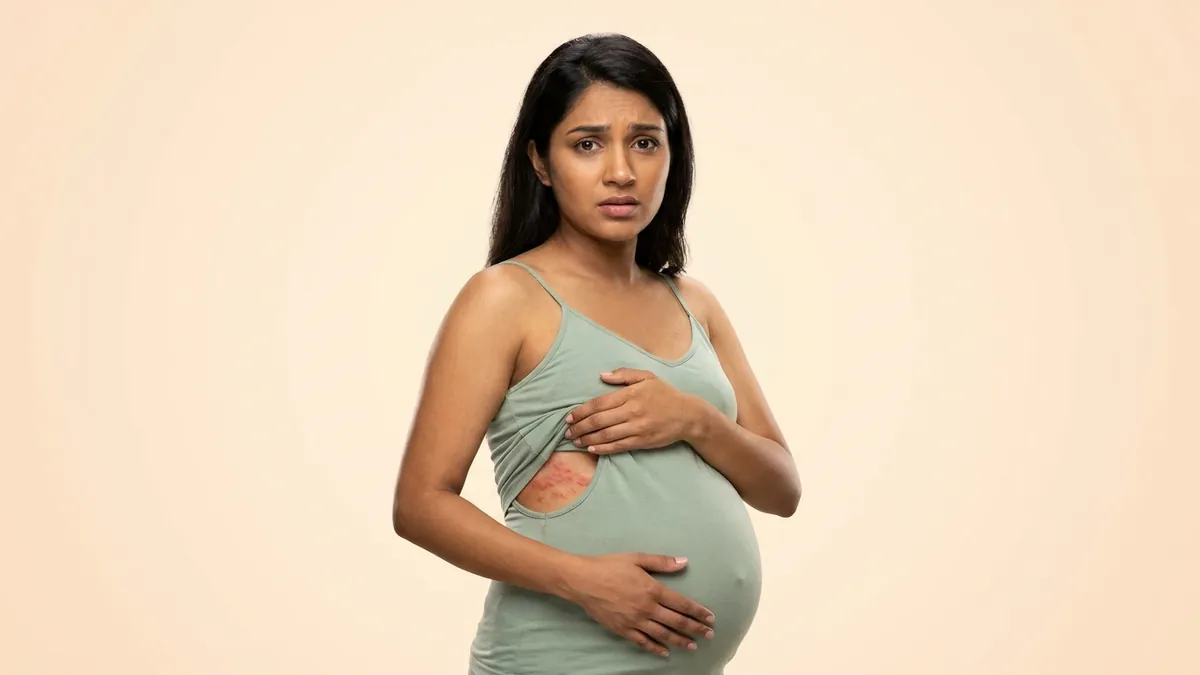
Picture this: you are peacefully resting, cradling your growing bump, when you suddenly feel a strange burning or tingling sensation along one side of your ribs or back. A few days later, red bumps and fluid-filled blisters appear in that exact spot. If you have ever had chickenpox in your childhood, this painful condition might be shingles. Finding out you have a new health issue while pregnant can feel terrifying and overwhelming. Take a deep breath and relax. Shingles during pregnancy is relatively rare, and in almost all cases, it poses zero threat to your developing baby. Pretty surprising, right?
📌 Key Takeaways
- Shingles is caused by the same virus that causes chickenpox, but it only happens if you had chickenpox in the past.
- It typically causes a painful rash and fluid-filled blisters on only one side of your body.
- When caught early, safe antiviral medicines can shorten the illness and lower your discomfort.
- Having shingles during pregnancy does not harm your unborn baby or cause birth defects.
- Always consult your Primary Care Physician (PCP) or family doctor before taking any medicine or pain relief while pregnant.
Free pregnancy due date calculator. Enter your last period date or conception date to find your EDD, current trimester, and key milestones.
Is Shingles Dangerous During Pregnancy?
Shingles during pregnancy is generally safe for your baby, as the infection remains localized to your skin and nerves without crossing the placenta to cause birth defects, provided you work closely with your doctor for early antiviral management.
Just think about it for a second. When you hear the word shingles, you might naturally worry about your growing baby. We talk to expectant mothers every day who feel anxious about any new skin change or illness. Have you ever wondered why this happens and what it means for your little one? Let's break this down together. Unlike a primary chickenpox infection during early pregnancy, shingles is simply a reactivation of a virus your immune system already knows. Your baby is securely tucked away inside the amniotic sac, completely protected from this localized nerve rash. Makes sense, right?
What Is Shingles and Why Does It Happen?
To understand shingles, we need to look back at your childhood. If you had chickenpox when you were young, your immune system fought off the active illness successfully. However, the varicella-zoster virus did not completely leave your body. Instead, it crawled into your nerve roots near your spinal cord and went to sleep, or became dormant.
Your immune system keeps this sleeping virus under control for years. But remember we talked about this earlier? Sometimes, high stress, physical fatigue, illness, or the normal immune shifts of pregnancy can weaken your immune defenses temporarily. When your immune system dips down just a little bit, the sleeping virus wakes up. It travels down your nerve pathways and causes shingles instead of chickenpox. Because the virus was already inside your body, you cannot catch shingles from an outside source. It is simply a reactivation of your own past childhood infection. Pretty fascinating how our bodies store memories like that, isn't it?
What Are the Symptoms and How Do Doctors Diagnose Shingles?
The very first sign of shingles is usually a strange, unmistakable feeling on your skin. You might feel a sharp burn, deep ache, numbness, or tingling sensation days before any visible sign appears. Crucially, this feeling always stays on just one side of your body, following a specific nerve pathway called a dermatome. It might be on your right side or your left side, but it never crosses the midline of your body to appear on both sides at once.
Some pregnant women also feel mild flu-like symptoms during this early stage. You might experience a low-grade fever, chills, mild fatigue, or general body aches. A few days after the pain starts, red patches appear on the skin. These patches quickly turn into tiny, fluid-filled blisters that look remarkably like chickenpox. Over the next seven to ten days, these blisters dry out and form crusts. The scabs eventually fall off, leaving healing skin underneath.
When you visit your Primary Care Physician (PCP) or local NHS GP clinic, we can usually diagnose shingles simply by looking at your rash. We will check the distinct one-sided pattern and ask about your medical history. If you are not entirely sure whether you had chickenpox as a child, we can run a simple blood test to check your antibody levels. What do you think? It is a straightforward process that gives you answers quickly.
| Stage or Symptom of Shingles | Clinical Explanation & What You Should Do |
|---|---|
| Early Tingling & Burning Phase | Occurs 1 to 5 days before the rash. Contact your doctor early if you feel one-sided skin pain to discuss prompt antiviral therapy. |
| Blistering Rash Phase | Fluid-filled blisters appear on one side of your body. Keep the area clean and dry, avoid scratching, and use cool compresses. |
| Crusting & Healing Phase | Blisters dry up and form scabs over 7 to 10 days. Allow scabs to fall off naturally and apply gentle, fragrance-free moisturizers. |
What Are the Safe Medical and Home Treatments During Pregnancy?
If you think you might have shingles, contact your doctor right away. Starting antiviral treatment within the first seventy-two hours of the rash appearing makes a huge difference. Early treatment stops the virus from multiplying rapidly, shortens how long the rash lasts, and lowers your risk of lingering nerve discomfort.
Your doctor may prescribe safe antiviral medicines like acyclovir or valacyclovir. These specific medications have been extensively studied and are considered safe to use during pregnancy. Always follow your doctor's exact dosage instructions. Do not stop taking your prescribed medicine early, even if your skin starts to feel better and the blisters dry up. Just like we said a moment ago, completing the full course ensures the virus stays fully suppressed.
You can also use safe home remedies to soothe your skin while you heal:
- Apply cool, damp cloths to the rash area for fifteen minutes at a time to reduce burning.
- Dab soothing calamine lotion onto the blisters to help control itching.
- Take a lukewarm bath with colloidal oatmeal to offer wonderful relief for irritated skin.
- Wear loose, soft cotton clothing that does not rub against the sensitive blisters.
How Does Shingles Affect Your Baby and Your Health?
Many expectant mothers worry that shingles will harm their developing baby. Large clinical studies and obstetric guidelines show clearly that shingles during pregnancy does not harm the fetus. Unlike a primary chickenpox infection in early pregnancy, shingles does not cause birth defects, developmental issues, or miscarriage. Your baby remains safe and protected inside the womb.
However, shingles is notoriously painful because it affects your nerves. Even after the blisters heal, some people feel lingering nerve discomfort called postherpetic neuralgia. This nerve ache can last for several weeks or months. Fortunately, in healthy pregnant women, it usually fades away completely within a few months as your nerves repair themselves.
✔️ Do's and ❌ Don'ts
- Do contact your family doctor or obstetrician at the very first sign of a one-sided burning rash.
- Do start prescribed antiviral medications within the first 72 hours for the best clinical outcome.
- Do keep the rash clean, dry, and loosely covered with breathable cotton clothing.
- Don't scratch or pop the fluid-filled blisters, as this can lead to secondary bacterial skin infections.
- Don't take over-the-counter NSAID pain relievers like ibuprofen without explicit approval from your doctor, especially during the third trimester.
- Don't expose anyone who has never had chickenpox or received the chickenpox vaccine to your active blisters.
🚨 When to Seek Emergency Care (Red Flags)
If you notice any of these warning signs, don't wait — call your local emergency number right away (911 in the US/Canada, 999 in the UK, 112 in Europe, or 000 in Australia) or go to the nearest hospital Emergency Department (ER / A&E):
- A rash, redness, or blisters appearing anywhere near your eyes, eyelids, or forehead.
- Signs of a secondary bacterial skin infection, such as pus, severe increasing redness, or skin that feels hot to the touch.
- A high fever, severe dizziness, confusion, or difficulty staying awake.
- Intense, unbearable pain that does not respond to approved home care or prescribed medications.
- Any sudden breathing difficulties or neurological symptoms.
💡 Take-Home Message
- Shingles is a reactivation of the chickenpox virus and is entirely contained within your own nervous system.
- Your developing baby is safe from harm because maternal shingles does not cross the placental barrier to cause birth defects.
- Early consultation with your healthcare provider and prompt antiviral treatment make recovery smooth and manageable.






No comments yet. Be the first to share your question or experience below.