

Are you a little worried about a new mole or a small growth on your skin? Or do you feel like the color or shape of a mole that you've had for a long time has changed? These can all be normal. However, since they can sometimes be signs of skin cancer, let's talk about this in a little more detail, shall we?
What is this skin cancer?
Simply put, skin cancer is the abnormal, uncontrolled growth of cells in your skin. Think of our skin cells as little workers. They work hard, get old, and die. Then new cells grow to replace them. This is a healthy, normal process.
But sometimes, especially when we are exposed to harmful ultraviolet rays (UV light) from the sun, this process can go awry. Then the cells start to grow too fast and in an uncontrolled manner. Some of the new cells that form in this way can be non-cancerous (benign). They don't cause much harm and don't spread to other parts of the body. But some of them can become cancerous (cancerous). That's the problem.
These cancerous cells, if not detected and treated early , can spread to nearby tissues and beyond to other parts of the body. That's why early detection and treatment are so important . The good news is that in most cases, skin cancer can be completely cured if detected early. If you notice something unusual or different about your skin, the best thing to do is to talk to a doctor.
What types of skin cancer are there?
There are several main types of skin cancer. Let's take a look at what they are.
The three main types are:
- Basal cell carcinoma: This develops in the basal cells just beneath the epidermis, the outermost layer of your skin. This is the most common type of skin cancer .
- Squamous cell carcinoma: This develops in the squamous cells in the outermost layer of your skin.
- Melanoma : This is the most dangerous type. It develops in cells called melanocytes. These melanocytes produce the pigment called melanin , which gives our skin its color. Melanin also helps protect the skin to some extent from the harmful ultraviolet rays of the sun. Melanoma is dangerous because it has a higher risk of spreading to other parts of the body than the other two types.
Some other types of skin cancer:
In addition to these three main types, there are other rare types of skin cancer.
- Kaposi sarcoma
- Merkel cell carcinoma
- Sebaceous gland carcinoma
- Dermatofibrosarcoma protuberans (`DermatofibroSarcoma protuberans`)
How common is skin cancer?
In countries like the United States, skin cancer is a very common type of cancer. According to statistics, about one in five people will develop skin cancer in their lifetime. Although there is little specific data on the situation in our country, it is very important to be aware of this because of the high exposure to sunlight.
What are the symptoms of skin cancer?
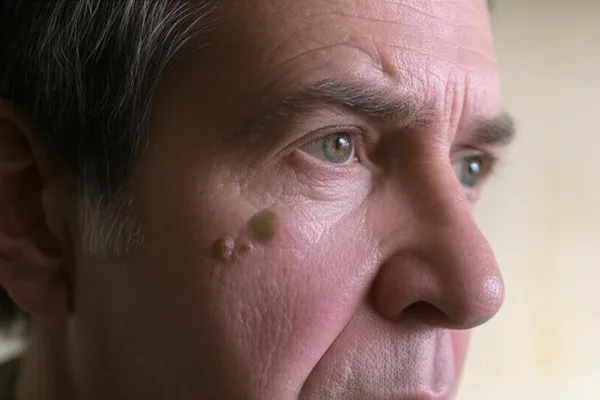
The main warning sign of skin cancer is a change in your skin. This could be a new mole, growth, or a change in an existing mole or spot. Here are some signs of skin cancer:
- A new birthmark appears. Or an existing birthmark changes in size, shape, or color, or bleeds.
- Something like a shiny, waxy bubble on your face, ears, or neck.
- A flat, pink/red or brown spot or lump .
- Some areas of the skin look like scars .
- Wounds that are crusty , have a sunken appearance, or bleed frequently.
- A wound that doesn't heal , or a wound that heals and reappears.
- A rough, scaly wound that may itch, bleed , and crust over.
If you see something like this, don't ignore it, okay?
How does skin cancer look? (ABCDE rule)
What skin cancer looks like varies depending on the type. However, there is an easy way to remember. It's called the ABCDE rule . This tells you what symptoms you should look out for.
- A – Asymmetry: This means that the shape of the mole is irregular. It looks like one side is not the same as the other when cut in half.
- B – Border: The edge of the spot is blurred, unclear, and irregular in shape.
- C – Color: The presence of more than one different color (e.g. brown, black, red, white, blue) in the same spot.
- D – Diameter: The spot is larger than the size of a pencil eraser (more than 6 millimeters).
- E – Evolution: The mole shows changes over time, such as getting bigger, changing shape, changing color, or rising up. This is the most important sign!
If you have any concerns about a birthmark, skin lesion, or anything new on your skin, see a doctor right away. They will examine your skin and, if necessary, refer you to a dermatologist.
What are the reasons for this situation?
The main cause of skin cancer is overexposure to the sun , especially to the point of sunburn and blistering. The ultraviolet rays (`UV rays`) from the sun damage the DNA (`DNA`) in our skin cells. This causes the normal cell division process to become disrupted, and abnormal cells begin to form. These abnormal cells divide rapidly and uncontrollably, forming a mass of cancer cells.
What are the risk factors for skin cancer ?
Skin cancer can affect anyone, regardless of race or gender. However, some people are at higher risk. Skin cancer is more common in women under the age of 50, but it is more common in men after the age of 50. People with fair skin are about 30 times more likely to develop it than people of black or Asian/Pacific Islander descent. Unfortunately, skin cancer in people with darker skin is often diagnosed at an advanced stage. This makes it more difficult to treat.
You are more likely to develop skin cancer if you have these risk factors:
- If you spend too much time in the sun, whether at work or at play, this risk is higher for those who work in our country's agricultural plantations, in the construction sector, and our brothers and sisters who work near the sea.
- If you sunburn easily, or have sunburned in the past.
- If you live in a sunny or high-altitude area like our country.
- If the skin is artificially tanned (`tan`) or if the machines used for that purpose (`tanning beds`) are used.
- If you have light-colored eyes, blonde or red hair, and pale or freckle-prone skin.
- If you have many birthmarks, or if you have irregularly shaped birthmarks.
- If you have a condition called actinic keratosis (rough, scaly, dark pink to brown spots that can become cancerous).
- If someone in your family has had skin cancer.
- If you have had an organ transplant.
- If you are taking medications that weaken the immune system.
- If you have received UV light therapy for skin conditions such as eczema or psoriasis.
How to diagnose skin cancer?
First, a dermatologist will ask you if you've noticed any changes in your existing moles, scars, or new growths. Then, he or she will examine the skin all over your body. This includes your scalp, ears, palms, soles of your feet, between your toes, genitals, and even between your buttocks.
What are the diagnostic tests?
If your doctor suspects skin cancer, he or she may do a biopsy . A biopsy involves taking a small sample of tissue from the suspicious area and sending it to a lab. A pathologist will examine it under a microscope to see if there are any cancer cells. Your dermatologist will then tell you if it is skin cancer, what type it is, and what your treatment options are.
What are the stages of skin cancer?
The stages of a cancer tell you how far the cancer has spread in your body. Skin cancer stages range from 0 to IV (four). In general, the higher the number, the more extensive the cancer is and the more difficult it is to treat. However, the stages of melanoma cancer are slightly different from the stages of non-melanoma cancers, which start in basal cells or squamous cells.
Melanoma stages:
- Stage 0 (melanoma in situ): The melanoma is only in the top layer of the skin.
- Stage I: Melanoma is low-risk, has no evidence of spread, and can usually be cured with surgery.
- Stage II: The cancer shows some signs that it may recur, but there is no evidence that it has spread.
- Stage III: Melanoma has spread to nearby lymph nodes or to nearby skin.
- Stage IV: Melanoma has spread to more distant lymph nodes, the skin, or internal organs.
Non-melanoma cancer stages:
- Stage 0: The cancer is only in the top layer of the skin.
- Stage I (1): The cancer is in the upper and middle layers of the skin.
- Stage II (2): The cancer is in the upper and middle layers of the skin, and has begun to affect nerves or deeper layers of the skin.
- Stage III (3): The cancer has spread beyond the skin to the lymph nodes.
- Stage IV (4): The cancer has spread to other parts of the body and organs, such as the liver, lungs, and brain.
How are skin cancers treated?
Treatment depends on the stage of the cancer. Sometimes, if the cancer is very small and confined to the surface of the skin, the biopsy can remove all of the cancer tissue. Other treatments that may be used alone or in combination include:
- Cryotherapy: The dermatologist uses liquid nitrogen to freeze the skin cancer. It's like removing a wart. After the treatment, the dead cells are sloughed off.
- Excisional surgery: The dermatologist will cut out the cancerous tumor and some of the healthy skin around it to make sure the cancer is completely removed.
- Mohs surgery: In this procedure, the dermatologist removes only the diseased tissue, leaving as much healthy tissue as possible around it. This procedure is used for basal cell and squamous cell carcinomas that develop in sensitive or cosmetically important areas, such as the eyelids, ears, lips, forehead, scalp, fingers, and genitals, and sometimes other skin cancers.
- Curettage and electrodesiccation: A dermatologist uses a sharp, circular-edged instrument to scrape away the cancer cells. Then, an electric current is used to destroy any remaining cancer cells. This procedure is often used for basal cell carcinoma, squamous cell carcinoma, and skin lesions that may become cancerous.
- Chemotherapy: A dermatologist or oncologist uses drugs to kill cancer cells. If the cancer is limited to the top layer of the skin, they may give you topical chemotherapy. If the cancer has spread to other parts of the body, they may give you pills or IV (intravenous) chemotherapy.
- Immunotherapy: The oncologist gives you drugs that train your immune system to kill cancer cells.
- Radiation therapy: A radiation oncologist uses radiation (high-energy beams) to kill cancer cells or stop them from growing and dividing.
- Photodynamic therapy: A dermatologist applies a medication to your skin and activates it with blue or red fluorescent light. This treatment kills cells that could become cancerous, but doesn't harm normal cells.
What are the complications/side effects of the treatment?
The side effects of skin cancer treatment depend on what treatment your doctor thinks is best for you. Chemotherapy can cause nausea, vomiting, diarrhea, and hair loss. Other side effects or complications of skin cancer treatment include:
- Bleeding.
- Pain and swelling.
- Scars.
- Loss of sensation due to nerve damage.
- Skin infections.
- Cancer coming back after being removed.
Can skin cancer be prevented?
In most cases, yes! Skin cancer can be prevented. The best way to protect yourself is to avoid excessive sun exposure and sunburn. Ultraviolet rays (`UV rays`) from the sun damage your skin, and over time, this can lead to skin cancer.
How can I reduce my risk?
Here are some things you can do to protect yourself from skin cancer:
- Use a sunscreen with an SPF of at least 30 or higher . Those labeled "broad-spectrum" protect against both UV-B and UV-A rays. Apply 30 minutes before going outside. Use sunscreen every day, even on cloudy days and in the winter.
- Wear a wide-brimmed hat to protect your face and ears.
- Wear long-sleeved shirts and long pants to cover your arms and legs. For extra protection, look for clothing with an ultraviolet protection factor (UPF) label.
- Wear sunglasses to protect your eyes. Choose ones that block both `UV-B` and `UV-A` rays.
- Use a lip balm that contains sunscreen.
- Avoid the sun as much as possible between 10 am and 4 pm. This is when the sun is at its strongest.
- Don't use tanning beds. If you want a tanned look, use a spray-on tanning product.
- Ask your doctor or pharmacist if any medications you take make your skin more sensitive to the sun. Some medications that can make your skin more sensitive to the sun include tetracycline and fluoroquinolone antibiotics, tricyclic antidepressants (the original source says "tricyclic antibiotics," but these are often antidepressants), the antifungal griseofulvin, and statin cholesterol-lowering medications.
- Check your entire skin regularly to see if the size, shape, or color of your skin spots change, or if any new ones appear. Don't forget to check your scalp, ears, palms, soles, between your fingers, genitals, and buttocks. Use a mirror, and take photos if you want, to help you notice changes over time.
- If you notice any changes in a birthmark or other skin spot, see a dermatologist for a full body check.
What is the recovery rate for people with skin cancer?
The good news is that most skin cancers can be completely cured if treated before they spread. The sooner the cancer is found and removed, the better your chances of a full recovery. It's important to stay in touch with your dermatologist to make sure the cancer doesn't come back. If you notice anything unusual, call your doctor right away.
Most skin cancer deaths are caused by melanoma. If you are diagnosed with melanoma:
- If the cancer is detected before it spreads to the lymph nodes, the five-year survival rate is 99%.
- If it has spread to nearby lymph nodes, the five-year survival rate is 66%.
- If it has spread to distant lymph nodes and other organs, the five-year survival rate is 27%.
Don't be alarmed by these statistics. They highlight the importance of early detection.
When should I see a doctor?
If you see anything like this, see a doctor or dermatologist as soon as possible:
- Any changes to your skin, or a change in the size, shape, or color of existing birthmarks or other skin spots.
- A new bump or spot appears on your skin.
- A wound that does not heal.
- Spots that are different from other spots on your skin.
- Any spot that changes, itches, or bleeds.
Your doctor will examine your skin, take a biopsy if necessary, make a diagnosis, and discuss treatment options. It's also a good idea to have a full skin check by a dermatologist at least once a year.
What questions should I ask my doctor?
Here are some questions you can ask your dermatologist:
- What type of skin cancer do I have?
- What stage is my skin cancer in?
- What kind of tests will I have to do?
- What is the best treatment for my skin cancer?
- What are the side effects of that treatment?
- What are the possible complications of this cancer and its treatment?
- What kind of result can I expect?
- Am I at risk of developing more skin cancer?
- How often do I need to come for follow-up checkups?
Don't be afraid to ask these questions. Having a good understanding of your condition will help your treatment be successful.
How is skin cancer life-threatening?
You might wonder how a skin cancer on the surface of the skin could be life-threatening. It would be reasonable to think that simply scraping off a small amount of skin with cancerous cells or removing the area with a minor surgery would solve the problem. In fact, these methods are effective if cancer is caught early.
However, if skin cancer is not caught early, what you think is “just on my skin” can grow and spread beyond that area. Cancer cells can break away and travel through your bloodstream or lymph system. They can travel to other parts of your body, settle there, and start growing as new tumors. This movement and spread is called metastasis .
The type of cancer cell where the cancer first started – called the `primary cancer` – determines the type of cancer. For example, if a malignant melanoma spreads to your lungs, that cancer is called a malignant melanoma. That's how cancer that's just on the surface of the skin can become life-threatening.
Why do people with dark skin develop skin cancer in areas not exposed to the sun?
Scientists still don't fully understand why people with darker skin develop skin cancer in areas that aren't exposed to the sun, such as the palms and soles of their feet. They think it's because they're less likely to be exposed to sunlight. But that doesn't mean they're immune to the sun. Dermatologists see a lot of melanoma and squamous cell carcinoma, which are caused by ultraviolet (UV) sunlight, in people with skin that ranges from fair to dark skin.
Are all birthmarks cancerous?
No, most birthmarks are not cancerous. Some birthmarks are present at birth. Others may not appear until we are about 40 years old. An adult usually has between 10 and 40 birthmarks.
It is very rare for a mole to turn into melanoma. However, if you have more than 50 moles, you have a slightly higher risk of developing melanoma.
Skin cancer can happen to anyone. It may seem like a small, harmless thing, but it's not. It's important for everyone to do regular skin self-checks. This is especially important if you're at high risk for skin cancer.
Finally, things to remember
Your skin is the largest organ in your body. It deserves the same attention you give to any other health issue. Check your skin at least once a month to see if there are any changes in your skin spots or if any new ones have appeared. Take steps to protect your skin from the sun. Also, don't forget to get your skin checked by a dermatologist on a regular basis.
If detected early, skin cancer is a highly curable disease. So, be vigilant about your skin. If you have any concerns, don't be afraid to seek medical advice. Your health is in your hands!
` Skin cancer, melanoma, sunlight, UV rays, skin spots, birthmarks, cancer symptoms




💬 Comments (0)
No comments yet. Be the first to share your thoughts here.
Add Your Comment