
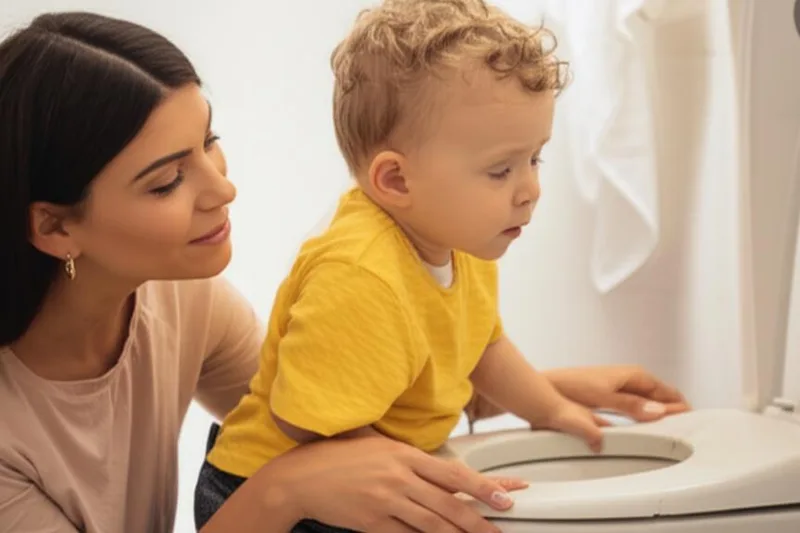
If you are a parent of a young child with autism, you may have wondered, "How do I teach my child to use the toilet?" This may seem like a big challenge, but remember that autistic children, like all other children, are very happy when they learn new things. It also increases their self-confidence. So let's talk about this in a relaxed and understanding way.
How do I know if my autistic child is ready for toilet training?
Like other children, autistic children show the same signs that they are ready for toilet training. However, it may take a little longer for an autistic child to be ready. This is normal. Here are some signs to help you determine if your child is ready for this training.
| Ready sign | Simply put... |
|---|---|
| Trying to communicate | They try to communicate when their diaper is wet or when they have a bowel movement, either through words, signs, or a device that helps them do so. |
| Following simple instructions | You can understand a simple one- or two-step instruction (e.g., "Go sit on the toilet") and do it that way. |
| Privacy search | When urinating , they try to hide in a corner of a room, like behind a curtain. |
| Staying dry for at least 2 hours | You can go two or more hours at a time during the day without wetting your diaper. |
| Being able to go to the toilet | With the help of an adult, you can go to the toilet, take off your clothes, and sit down. |
| Willingness to use the toilet | They are interested and curious about using the toilet. They may even ask you about it. |
What should we do when toilet training an autistic child?
Toilet training for an autistic child is different for every child. It can take a year or more. It depends on the child's personality, learning style, and other circumstances. Patience is the key here.
The most important thing is that you first believe that 'my child can do this'. You need to make the child feel that belief . We call this 'presuming competence'.
If your child is a non-verbal child, you may need another way to let them know that they need to go to the toilet. Sign language or a method using picture cards (PECS - Picture Exchange Communication System) can help.
Here are some ways to help your child navigate this journey while having faith in their abilities:
- Speak in a way that is appropriate for the child's age: Avoid speaking to a small child in " baby talk." Speak in a way that he understands and respects his age.
- Help with alternative communication methods: If speaking is difficult, encourage them to express themselves through signs or pictures, as mentioned earlier.
- Don't talk as if the child isn't there: When you're talking about your child to someone else in front of them, don't talk as if they're not there. Include them in the conversation.
- Understand that behavior is communication: Your child may be behaving in a certain way because they want to say something. Try to understand the reason behind that behavior.
- Allow your child to calm down: Allow your child to do things that help them calm themselves down (for example, clapping their hands, spinning around - we call this `stimming`). This will help them manage their stress.
What are the common problems that autistic children face when toilet training?
While toilet training is a challenge for all children, there are some issues that are unique to children with autism. Understanding these can help us find solutions.
Problems with the sense of interoception
Simply put, this is how we feel things going on inside our bodies (hungry, tired, thirsty, needing to go to the toilet ). Children with autism sometimes have a hard time recognizing these signals. This means they may not fully understand what it means to need to go to the toilet.
What can you do? By wearing washable training pants or underwear with a liner, your baby will start to feel when he or she is wet. This will help your baby learn to be aware of his or her body's signals.
Difficulty tolerating changes in daily routine
Many autistic children like to stick to a routine, a routine where they do the same things every day. Toilet training completely changes this routine. Instead of changing a diaper, they now have to go to the toilet. This change can be stressful for them.
What can be done?
- Reduce changes : If possible, use a training seat that attaches directly to the toilet instead of a baby potty. This will reduce the number of new things your child has to get used to.
- Use Social Stories: Make going to the toilet part of the daily routine and tell your child a short story with pictures.
- Use a timer: Set a timer for a specific time, and when it goes off, remind yourself, "It's time to go to the toilet."
- Use visual timetables: Create a visual timetable that shows the daily routine in order, including toilet times. This will give your child a clear idea of how their day will go.
Sensory Issues
Autistic children can experience some sensations very intensely. Think of the cold tiles of the toilet, the sound of the flush, the constant need to take off and put on clothes... These things can be very uncomfortable for them.
What can be done?
Look closely at your child's behavior and understand what is causing him discomfort.
- Cold floor: Put a small rug or two socks on the bathroom floor.
- Flushing noise: If you are sensitive to noise, you can use ear defenders.
- Clothing: Wear pants, shorts, and other items that are easy to pull on and off without buttons or zippers.
Gastrointestinal (GI) issues
Children with autism are more likely than other children to experience digestive problems, such as constipation and diarrhea. Sometimes this can be due to selective eating or other medical conditions.
If you have frequent stomach problems like this, you should definitely talk to your doctor before starting toilet training. Your doctor will refer you to a dietician if necessary.
Take-Home Message
- Toilet training for an autistic child takes time. Be patient, loving, and work at your child's pace.
- Pay attention to signs that your child is ready. Don't force training.
- First, believe that 'my child can do this.' Give that belief to your child too.
- Understand the sensitive issues the child is facing, such as changes in routine, and provide simple solutions to them.
- If your child has frequent bowel problems such as constipation, or if you have any concerns, never hesitate to seek advice from your doctor .





💬 Comments (0)
No comments yet. Be the first to share your thoughts here.
Add Your Comment