

Today I met a girl. She said she was preparing for A/L... but she only sleeps for two hours a day! I was really surprised and saddened to hear that. How can a child write an exam after studying so hard and not getting enough sleep?
But it's not just this sister, many of our brothers and sisters who are doing A/L and going to campus in Sri Lanka are like you. They sleep until dawn to prepare for the exam, forgetting about sleep. We think that the more time we stay awake, the more we can learn. But is that the truth? The latest science tells a completely different story!
Well, getting enough sleep isn't just good for your body, it's also essential for "locking in" what you've learned and doing well on exams! Rather than just resting, sleep is a time when your brain is very active. It's when you integrate and make sense of the information you've learned throughout the day.
So, this story is for all those who sleep like that A/L sister. Let's see how you can use the superpower of sleep to boost your memory and exam results. Understanding this amazing connection between sleep and memory is the first step to unlocking your full learning potential.
The Connection Between Sleep and Memory: The Science Inside the Brain
To understand why sleep is so important, let's first take a look at how our brains learn and remember. Learning is not a one-time event, but a multi-step process. According to researchers at Harvard, there are three stages: acquisition, consolidation, and recall. Acquiring knowledge means listening in class, looking at a book, and practicing. Recalling means rewriting answers from memory, like on an exam. But in between those two, there's a stage that no one pays much attention to, but is incredibly important: consolidation! That's where sleep becomes a superstar.
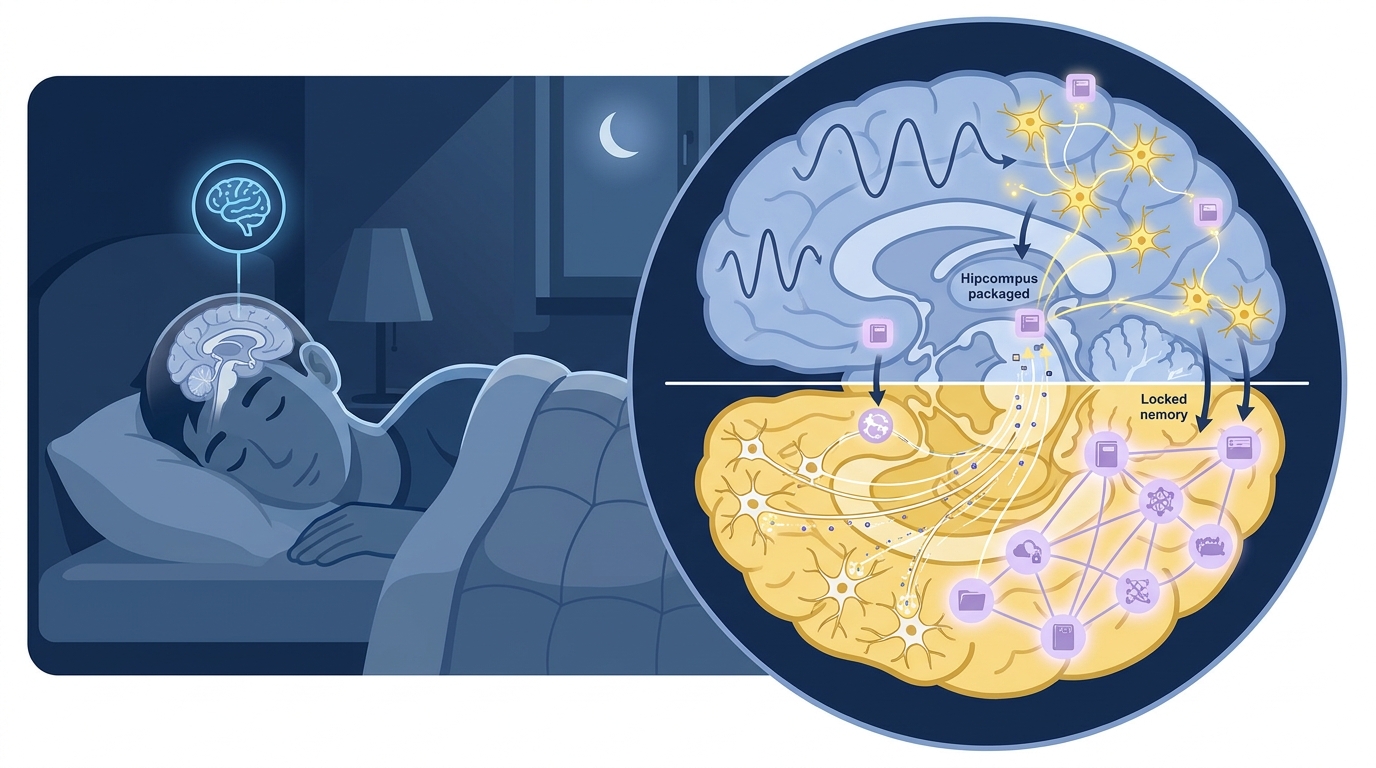
Consolidation is the process of taking newly acquired, not yet fully formed, memories and turning them into permanent, lasting memories. Think of it like saving a file on your computer. If you don't save it, it's gone. That's how it is. Sleep is the best time to hit the 'save' button. When you're asleep, your brain isn't just off, it's working hard to process what you've learned during the day! Research in Nature Neuroscience suggests that memory consolidation during sleep is an active process of replaying and organizing what you've learned. The patterns of neurons that were activated during learning are reactivated, especially during deep sleep (slow-wave sleep - SWS). This process starts in the hippocampus, which is the most important part of the brain for making memories. This replay strengthens the connection of the memory, and gradually transfers it to the neocortex, the brain's long-term library.
This is not just a memory consolidation. The brain chooses at that time, "Okay, this is important, let's keep this. This is not so important, let's remove some." That is, it strengthens important connections and weakens unnecessary ones. This requires different parts of the brain to work together, and special brain waves are also used. Both deep sleep (SWS) and REM sleep, which is when the brain dreams and runs, have separate roles. SWS is important for consolidating facts and events (declarative memory), while REM helps consolidate memories related to skills (procedural memory) and emotions. This is further confirmed by a large analysis published in the Psychological Bulletin. It says that if you sleep after learning, your memory will definitely be ruined. So, sleep is not just 'downtime', it is an indispensable, very active partner for learning and thinking (cognitive function)!
Why is sleep a game-changer for you as a student?
This science between sleep and memory is not just a theory; it has a big practical impact for every student who is faced with exams and assignments. When you understand how sleep affects learning, you will realize that sleeping well is not a weakness, but a great strategy for acing exams. What happens when you don't get enough sleep affects you both before and after you study.
Imagine that you slept through the night before you even opened a book or went to class. The same analysis I mentioned earlier found that there is a big problem with sleeping through the night before learning. Why? Because a tired brain cannot properly complete the first step of learning, which is acquiring knowledge. As the Harvard people say, when you don't get enough sleep, your concentration drops to zero. So what is said in class doesn't go into your head, what is in the book doesn't make sense, and it's hard to grasp something new. That means you need to charge your brain before you start working properly, or without that charge, new data won't be saved!
Falling asleep after studying is the same thing, maybe even worse. You might think, "Oh, I studied until dawn, now it's all in my head." But what you're really doing is disrupting that wonderful process of memory consolidation. The nerve cells that should be replaying and connections that should be made during sleep don't happen. In other words, it's like deleting the things you've worked so hard to memorize! Harvard says that the first sleep after studying is the most important time to form a memory, and if you miss that chance, you can't properly form it again. So, studying without sleeping is like typing an essay and closing it without saving it, all the effort is wasted!
Another important thing is sleep consistency. It doesn't matter if you sleep well the night before an exam, if you don't sleep well the week or month before. Research in the npj Science of Learning found that the way you sleep the week or month before an exam is more directly related to your grades than the night before. This means that the benefits of getting a good night's sleep every day add up over time. A common mistake students make is to sleep late during the week to study and then sleep until noon on the weekend. This is called "social jetlag." It's like going to a foreign country and your body clock is thrown off balance. This roller coaster of sleep is very confusing for the brain and interferes with memory. The study found that sleep quality affects nearly a quarter (25%) of students' grades. Imagine the impact!
How much sleep does a student really need?
Okay, if sleep is so important, how much sleep should you get? While there are slight differences between individuals, there are some major health organizations that say it is best. According to the CDC (in the US), school-age children, that is, those between the ages of 13-18, need between 8 and 10 hours of sleep per day (out of 24 hours) for good health. The NSF (National Sleep Foundation) also says the same (8-10 hours for those aged 14-17).
The NSF recommends that young adults (ages 18-25) who are on campus get between 7 and 9 hours of sleep a night. While this range is slightly lower than for those in school, it is still important to reach this target every day to keep your head up, your mood in check, and your body healthy while facing the challenges of campus. These are not just suggestions, this is a physiological requirement for your brain to function properly, especially to remember what you studied. Just like charging your phone, your brain needs to be recharged every day through sleep!
But what is the truth? Many of our brothers and sisters do not sleep as much as they say. Harvard data showed that only 11% of American college students sleep well every day. About 40% feel refreshed two days a week! It must not be much different in our country, right? This lack of sleep not only causes fatigue, but also reduces the ability to learn and remember. So we want to study more, but we cannot do it properly because of fatigue. So, knowing how much sleep we need and understanding the extent to which we are sleep deprived is the first step to succeeding in student life.
Practical Tips: Let's improve our sleep to boost our memory!
Okay, now you know how important sleep is. But how do you make it work in the midst of studies, assignments, and hanging out with friends? No big deal. If you make a few small adjustments every day, you can improve both the quality and quantity of your sleep. Then you will remember what you learn better, and your body will be healthier. Here are some tips that are right for you. Try these things...
- Let's set a time table: This is the most important thing! Get used to going to bed at the same time every day and getting up at the same time. Don't make big changes even on the weekend. Then that "social jetlag" problem won't arise. The body's natural clock (circadian rhythm) will work properly, and it will be easier to go to sleep and wake up.
- Make your bedroom a haven for sleep: Your bedroom should be a haven for sleep. Keep it dark, quiet, and a little cool. Use blackout curtains, earplugs , and a white noise machine if you need to. Make sure the mattress and pillows are comfy. Then your brain knows, "It's time to sleep."
- Start a Bedtime Routine : Do something relaxing 30-60 minutes before bed. This could include reading a real book (not your phone!), taking a warm bath, doing some light stretching , listening to soothing music, or practicing mindfulness/meditation. Avoid studying or discussing problems close to bedtime!
- The screen is dangerous: Get rid of that blue light monster... The blue light from phones, tablets, computers, and TVs destroys the sleep-inducing hormone melatonin . So, put them aside at least an hour before bed. If you can't give them up, at least turn on that night mode.
- Be careful about what you eat and drink: Avoid drinking caffeine-containing beverages like coffee, tea, energy drinks, and cola in the evening/night. Nicotine (cigarettes) is also a stimulant. They stimulate the body. Eating to your full stomach close to bedtime and drinking half a glass of water are also not good. They can cause discomfort and wake you up at night.
- Nap smartly: Taking a nap late in the day or for a long time can make it difficult to fall asleep at night. But a short nap (about 20-30 minutes) during the day can help refresh your mind and boost your performance without affecting your sleep at night. Give it a try to see if it works for you.
- Let's control stress: Exam pressure, problems with friends, chaos at home... When all these things are running through your mind, you can't sleep. So, practice a way to reduce stress every day. A way to clear your mind... Write a diary, do deep breathing exercises, do yoga, or talk to a trusted person. When you clear your mind during the day, it won't interfere with your sleep at night.
- Exercise, but watch your time: Exercising every day is bad for sleep quality. But don't do intense workouts within a few hours of going to bed. It can stimulate your body and delay your sleep. Try exercising in the morning or evening.
If you practice even a few of these tips every day, you will notice a big difference in your sleep. Your brain will work better, you will remember what you study, and you will be able to cope with exams better. So, sleep is not something that can be cut, but it is essential for your studies and your entire life.
Finally
The story is clear, isn't it? Sleep is not just a pause button in the student's life, it is a very active, indispensable process that is tied to learning and memory. From the memory-building magic of deep sleep, REM sleep, to the way sleep affects exam results as research has shown, one thing is clear: making sleep a priority is an essential strategy for acing exams! Sleeping in thinking you need more time to study is just cutting off the path to that goal. Because it robs your brain of the ability to take in new things, retain what you've learned, and recall it when needed.
So, brothers/sisters, if you want to learn properly, remember, and pass exams, you need to put good study habits and sleep at the top of your priority list. When you understand that while you sleep, your brain consolidates memories, solves problems, and prepares you for the next day, you will realize that sleep is not a burden, but a great investment. If you practice the tips mentioned above and improve your sleep, you will be able to use your brain's super power, your memory will be sharp, your studies will be easier, and you will be able to improve not only your exams but also your life. So, stop napping and make sleep your best friend. Your brain will thank you!
References
Okano, K., Kaczmarzyk, JR, Dave, N., Gabrieli, JDE, & Grossman, JC (2019). Sleep quality, duration, and consistency are associated with better academic performance in college students. npj Science of Learning , 4 (1), Article 16. https://doi.org/10.1038/s41539-019-0055-z
Centers for Disease Control and Prevention (CDC). (n.d.). Sleep in Middle and High School Students . Retrieved from relevant CDC pages (eg, https://www.cdc.gov/sleep/data-research/facts-stats/high-school-students-sleep-facts-and-stats.html )
Harvard Medical School, Division of Sleep Medicine. (n.d.). Sleep and Memory . Retrieved from https://sleep.hms.harvard.edu/education-training/public-education/sleep-and-health-education-program/sleep-health-education-88
Klinzing, JG, Niethard, N., & Born, J. (2019). Mechanisms of systems memory consolidation during sleep. Nature Neuroscience , 22 (10), 1598–1610. https://doi.org/10.1038/s41593-019-0467-3
National Sleep Foundation (NSF). (2020, October 1). How Many Hours of Sleep Do You Really Need? Retrieved from https://www.thensf.org/how-many-hours-of-sleep-do-you-really-need/
Newbury, CR, Crowley, R., Rastle, K., & Tamminen, J. (2021). Sleep Deprivation and Memory: Meta-Analytic Reviews of Studies on Sleep Deprivation Before and After Learning. Psychological Bulletin , 147 (11), 1215–1240. https://doi.org/10.1037/bul0000348 (Accessed via PMC: https://pmc.ncbi.nlm.nih.gov/articles/PMC8893218/ )
Doctor's Note
Healthy sleep is an essential factor in improving students' learning and memory. During sleep, the brain stores what it learned during the day from short-term memory to long-term memory. This process is called memory consolidation. If you don't get at least 7-8 hours of healthy sleep at night, the brain has difficulty absorbing new information and recalling it.
❓ Some more questions you may encounter (FAQ)
How does sleep affect learning and memory?▼
During deep sleep (Deep sleep and REM sleep) the brain analyzes the information learned during the day, removes the unnecessary, consolidates and stores important memories.
Cramming the whole night before the exam is okay?▼
no Sleep deprivation reduces the brain's ability to retain information and can cause mental block in the exam hall.
How to increase sleep quality?▼
Avoid using cell phones and screens at least 1 hour before bed, use a dimly lit room and go to bed at a regular time every day.


💬 Comments (0)
No comments yet. Be the first to share your thoughts here.
Add Your Comment