Hello! Have you ever wondered about the big, important
blood vessels in our legs? The one we're going to talk about today is
the femoral vein . Simply put, this is a major blood vessel in each of your legs. It's like a highway, collecting blood from the lower parts of the legs and carrying it back to the heart. It does a very important job, doesn't it? Let's talk about this in a little more detail.
What are veins? Why are they important to us?
Think about it, our bodies have blood running through them, like a network of little canals. This blood carries
oxygen and nutrients to all of our bones, muscles, and tissues. So, after this oxygen and nutrition is delivered, that blood becomes less oxygenated, and we call it
`deoxygenated` blood . The system of tiny blood vessels that carry that less oxygenated blood back to the right side of the heart is what we call `veins`. These veins are a very important part of our circulatory
system .
So, what is this circulatory system?
It's very simple. Every time your heart beats, it takes
oxygen-rich blood from the left side of your heart and sends it through the arteries to all the tissues of your body. After those tissues get the oxygen and nutrients they need, the remaining waste products, like
carbon dioxide, are collected in tiny blood vessels (we call them capillaries). That's where the work of the veins begins. This oxygen-poor, waste-laden blood travels through the veins and back to the heart. Your heart, these blood vessels, and your arteries all work together to keep this circulatory system working in one rhythm. Isn't it an amazing mechanism?
What is the special function of the femoral vein?
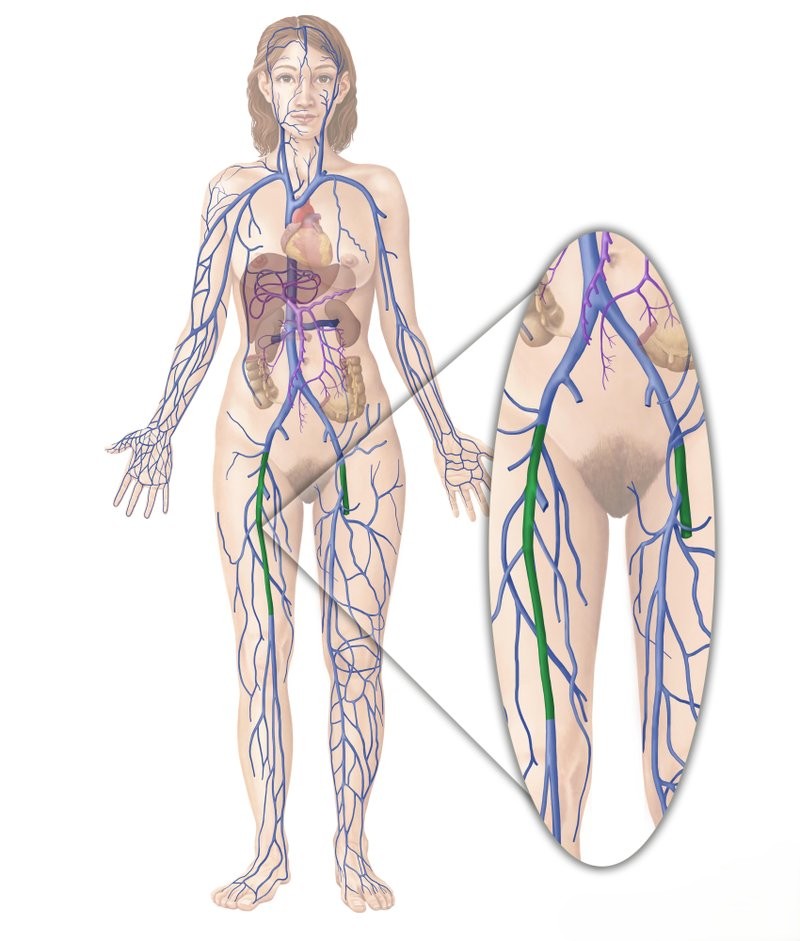
ALT ="Do you know about this large blood vessel in your leg? (Femoral Vein) Let's talk about the details!" width="800" height="941" /> Now let's get back to the main character of our story. That is the femoral vein. Sometimes it is also called
the superficial femoral vein . The blood coming from the lower parts of your leg joins this femoral vein. Then, this femoral vein takes that blood to your
external iliac vein . From there, the blood enters the large veins in your abdomen. It's like small roads joining together to form a big highway.
How does the femoral vein work together with other veins?
This femoral vein is not a single vein. It is just one part of a larger network of veins in our body. All of these veins are interconnected, carrying blood from one vein to another, and ultimately carrying blood to the right side of the heart. It's like a team working together.
How does the femoral vein receive blood?
The femoral vein receives blood from
the popliteal vein, which is located below your knee. The popliteal vein is formed by the joining of small veins in the lower leg. The small veins that supply blood to a larger vein are called
tributaries . The femoral vein also has several similar branches. They are:
- Deep femoral vein: This is located very deep inside your thigh. It joins with the femoral vein to form the common femoral vein .
- Great saphenous vein: This is one of the longest superficial veins in our body. It starts in the foot and goes up the leg to join the femoral vein.
- Lateral and medial circumflex femoral veins: These are other small veins. They collect blood from the tissues of the leg and drain into the femoral vein.
Why is the Femoral Vein so important?
This vein has another special significance. Doctors use this femoral vein to diagnose and treat some heart diseases. Isn't it amazing?
For example, they sometimes insert a catheter (a thin, flexible tube) through this vein to perform tests such as right heart catheterization . They can also perform treatments for certain heart problems, such as cardiac ablation .
That means, this vein is not just a thing that carries blood, but is also very useful in medicine.
Where is the femoral vein located?
This vein is located in your thigh. It starts at the knee, goes up through the groin, and ends in your abdomen. This femoral vein is often located near
the femoral artery , which is the part of the thigh that holds the femoral artery.
How do doctors find the femoral vein?
Doctors can use a
vascular ultrasound to see exactly where the vein is. This can also look at the way blood flows through the vein.
Are everyone's femoral veins the same?
Here's another important thing.
The valves inside the femoral veinYes. These valves stop the blood from flowing back down as it travels up, toward the heart. Think of them as gates that keep a waterway from flowing back up. However, not everyone has the same number of valves. Some people may have more valves, some may have fewer. Also, the number of valves in the femoral vein in your right leg may be different than the number in your left leg.
How big is the femoral vein?
The length of this varies depending on your height, but the diameter (that is, the width of the cross section) can typically range from 6 millimeters (about the size of a pencil eraser) to 11 millimeters (about the size of a regular pea).
The wall of a vein is usually made up of three layers:
- Innermost layer: This is made up of cells that secrete substances that help the blood vessels contract. We call them endothelial cells .
- Middle layer: This is made up of smooth muscle. This is what gives the veins their flexibility.
- The outermost layer: This is made up of connective tissue (such as collagen and elastin) . This allows the veins to stretch and contract as needed.
What are the common conditions that affect the femoral vein?
The veins in our legs, especially the femoral vein, are a little more prone to
blood clots and swelling than veins in other places. This is especially true for people who stand for long periods of time. This is because when we stand, the blood has to move up against gravity. So, if the valves in the femoral vein don't work properly, the blood starts to pool. This can lead to conditions like:
- Chronic Venous Insufficiency: This is a long-term impairment of blood flow in the veins.
- Femoral vein deep vein thrombosis (DVT): This is a blood clot that forms deep in the femoral vein. This can be a bit dangerous, because if the clot breaks loose and gets stuck somewhere like the lungs, it can be a big problem.
What are the symptoms of a problem with the femoral vein?
If your femoral vein isn't carrying blood properly, you may experience symptoms like:
- Feeling of aching and heaviness in the legs.
- Skin problems on the legs (dry skin, peeling, itching).
- Swelling of the legs.
- The formation of ulcers on the legs.
- Varicose veins (these are blue, twisted veins that are visible on the surface).
If you have symptoms like these, it's best to see a doctor as soon as possible.
What tests do doctors use to check if the femoral vein is healthy?
Your doctor may recommend tests like these to check the health of your femoral vein:
- Venous duplex ultrasound: This can be used to see how blood flows in the veins and whether there are any blood clots.
- CT scan
- MRI `(MRI)`
Sometimes doctors inject a special liquid (dye) into the veins and take
X-rays to look at the blood flow. This test is called
a venogram .
How are femoral vein problems treated?
Your doctor will decide on treatment based on your condition. If there are blood clots in the femoral vein, there are treatments to dissolve them and improve blood flow. For example:
- Anticoagulants: These are medications that prevent blood from clotting.
- Thrombolytic medications: These are medications that dissolve blood clots that have already formed.
What should we do to keep our veins healthy?
This is the most important part. There are several things we can do to keep our veins, not just the femoral vein, but all the veins in our body, healthy:
- Eat a healthy diet: Eat more vegetables, fruits, and fiber-rich foods. Reduce oil, sugar, and salt.
- Exercise regularly: Things like walking, running, and swimming are very good for your veins.
- Control high blood pressure: Take your medication as directed by your doctor.
- Drink enough water: It is good to drink at least 8 glasses of water a day.
- Avoid smoking: Smoking is very harmful to the veins.
Important: Your femoral vein, like other veins, helps keep your blood circulating. Making small changes to your lifestyle can help keep these veins healthy. Talk to your doctor for more information.
Take-Home Message
Okay, so, let's summarize some things to remember about the femoral vein we talked about today:
- The femoral vein is a major blood vessel in each of your legs.
- This is done to return oxygen-poor blood from the lower legs back to the heart .
- This vein is also used as an access route for some medical tests and treatments.
- Conditions such as deep vein thrombosis (DVT) and chronic venous insufficiency (Chronic Venous Insufficiency) can affect these veins.
- If you have symptoms such as pain, swelling, or skin changes in your legs , seek medical advice .
- Following a healthy lifestyle (good diet, exercise, and avoiding smoking) can help maintain the health of your veins.
So, I hope you have a good understanding of the Femoral Vein. Isn't it very important to know about such amazing parts of our body?



💬 Comments (0)
No comments have been posted yet. Add your comment here for the first time.
Add your comment