
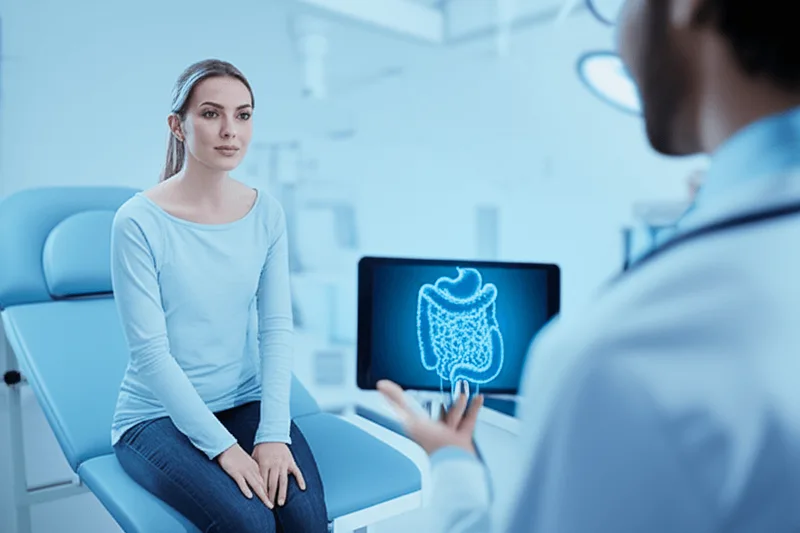
Sometimes when you have a stomach ache, bloating, or other discomfort, when you go to see a doctor, he or she will ask you to do a test like a scan, right? We often hear names like CT scan, MRI, and ultrasound. When we hear these names, some people feel a little scared. Questions like “What will happen with this?”, “Will it hurt?”, “Isn’t it good for the body?” come to mind. So today, let’s talk about what exactly happens with each of these tests that are done to find a disease in your digestive system, that is, your stomach, why they are done, and whether they harm the body.
First, let's look at the CT scan, which many people are familiar with.
When you think of a CT scan, you probably think of a bed that you go into a big round machine, right? That's right. CT stands for ``(Computed Tomography)``. Simply put, it takes a series of pictures that are much more detailed than a regular X-ray.
Think of it like slicing a loaf of bread. This machine takes many cross-sectional images (slices) of the inside of your body at once. This happens very quickly. A computer then puts these images together and creates a very clear picture of your organs, such as your liver, pancreas, and intestines, so that the doctor can see them very clearly. This can help him find out exactly what is causing your symptoms.
Other special types of CT scans
- CT Angiography: This involves injecting a special dye, called a contrast dye, into your body during a CT scan. As the dye travels through your blood vessels , the vessels become more visible on the scan. This is important for checking for any problems or blockages in your blood vessels.
- Virtual Colonoscopy: This is a new technology. In this, the images taken from the CT scan are combined by a computer to create a 3D model of your colon. The doctor can then examine the model on the computer screen as if he were looking inside. Since no actual camera is inserted, you will not feel any pain. But the most important thing is that if something unusual is seen, such as a tumor, it is necessary to see exactly what it is, take a piece of tissue for examination (Biopsy), and then do a regular colonoscopy.
How is an MRI scan different from a CT scan?
MRI stands for `(Magnetic Resonance Imaging).` This is also a test done inside a large machine, but it is completely different from a CT scan. An MRI does not use X-rays at all.
Instead, it uses a strong magnetic field and radio waves. These can produce very clear, detailed pictures of the tissues inside your body. MRI is especially effective at finding problems in soft tissues, such as the liver and gallbladder.
If safety instructions are followed exactly, an MRI scan is a very safe test for the average person, with no risk. However, if you have a pacemaker or metal plates in your body, you must inform the staff before the test.
Radionuclide Scanning
This is also called a nuclear scan. Although the name may sound scary, it is a very safe test. It involves giving you a very small amount of radioactive material that you can drink, inhale, or inject.
Don't worry, the radiation is very low, it won't harm your body, and it will leave your body after a while.
When this substance enters the body, it travels to various organs. Then, a special gamma camera ``Gamma Camera`` is used to watch how this substance spreads in the body and take pictures. The special advantage of this is that it can see not only the shape and size of an organ, but also whether that organ is working properly . A diseased, poorly functioning organ looks different on the scan than a healthy one. This test is very important for finding abnormal tissue growths, such as cancer cells.
If you drink plenty of water after the test, any remaining radioactive material in your body will quickly be excreted in your urine.
Some other important tests to look for stomach diseases
In addition to the types of scans mentioned above, several other tests are used to detect diseases of the digestive system.
Upper and Lower GI tests
These are tests that use X-rays.
- Upper GI Test: This examines the upper part of the digestive system, which includes the esophagus , stomach , and duodenum . You will be given a chalky white liquid called barium to drink. As the barium moves through your intestines, the areas around your stomach will show up as white on an X-ray. A fluoroscope is used to continuously record the movement of the barium.
- Lower GI Test (Barium Enema ):This is a test that looks at the large intestine and rectum. In this test, barium is slowly injected through a tube that is inserted through the anus. This is called a barium enema. When the barium fills the large intestine, it can clearly see things like tumors and polyps .
| Test | Diagnosable medical conditions |
|---|---|
| Upper GI Test |
|
| Lower GI Test (Barium Enema) |
|
Abdominal Ultrasound
This is a test that many people have seen and done. It uses high-frequency sound waves to create a picture of the organs inside your abdomen. The doctor will apply a gel-like substance to your abdomen and move a small device called a transducer over your abdomen. This sends sound waves into your abdomen and reflects them back to create a picture. There is no radiation involved, so it is 100% safe.
Abdominal X-ray
This is a regular X-ray. It uses a very small amount of radiation to take pictures of things like organs and bones inside the abdomen.
Take-Home Message
- If your doctor orders a test for your stomach problem, don't be afraid of it. They are all trying to diagnose your exact condition and provide the best treatment for it.
- CT scans and X-rays use X-rays. MRI uses magnets and radio waves. Ultrasound is a very safe test that uses sound waves and does not involve any radiation.
- Each test has its own advantages. Your doctor will decide which test is best for you, based on your symptoms.
- If you have any concerns, fears, or uncertainties about a test, it is your right to talk openly and honestly with your doctor before having it done.
Stomach ache, digestive system, CT scan, MRI scan, Ultrasound scan, X-ray, Barium test, medical tests, types of scans


💬 Comments (0)
No comments have been posted yet. Add your comment here for the first time.
Add your comment