
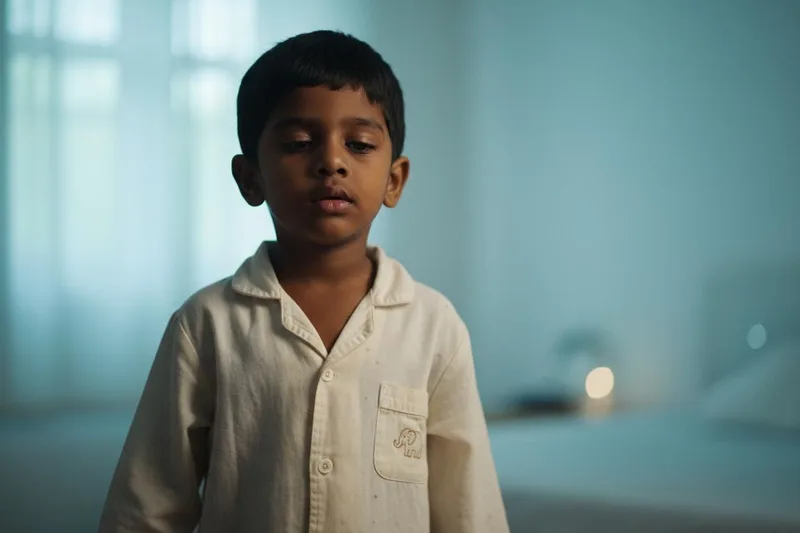
Have you ever seen your child get out of bed at night and walk around the house as if they were awake? Or did you have this happen to you as a child? This is what we call sleepwalking, or medically ``Sleepwalking``. Many parents get a little scared and worried when they see this. But today we will talk about what it really is, why it happens, and what can be done about it.
What exactly is sleepwalking? (What is `Sleepwalking`?)
Simply put, sleepwalking is something that happens when we're in a very deep sleep. You know, there are different stages of our sleep. This happens during that deepest sleep (`(Deep Sleep)`) , usually within the first few hours of falling asleep. Then, even though some parts of the brain are asleep, the parts that control movement can still be activated to some extent.
Not everyone sleepwalks actually 'walks'. Some children sit up in bed, stand up, or act as if they are awake (but they are actually asleep!), perhaps pacing around the room, trying to get dressed, or talking, but what they are saying may not be clear. But most of the time, they can get out of bed and walk for a few minutes, sometimes up to thirty minutes.
You may have noticed that even though a sleepwalker's eyes are open, they don't really see things the way we do when we're awake. Their gaze may seem blank, meaningless. They may think they're in another room at home, or in another place entirely. The amazing thing is that sleepwalkers often go back to bed and fall asleep on their own, and when they wake up in the morning, they don't remember anything that happened the night before! Imagine, it's as if the event wasn't recorded in their head.
Why does this sleepwalking happen? What are the causes?
Now you might be wondering, 'Why on earth does this only happen to my child?' Or 'Is there a specific reason for this?' In fact, sleepwalking is not something that happens for just one reason. It can be caused by several factors.
- Family history: Sometimes this can be hereditary. That is, if you, your spouse, or someone in your family had a habit of sleepwalking as a child, your child is more likely to have it too. It is said to have a genetic influence.
- Illness or fever: A child is more likely to sleepwalk when they are sick, especially when they have a fever . This may be because the discomfort and agitation caused by the fever can disrupt sleep.
- Lack of sleep: Not getting enough sleep is also a major cause of this. If a child does not get the required amount of sleep per day, their sleep patterns can become disrupted, and the following can occur: Excessive fatigue (`(Fatigue)`) can also affect this.
- Stress:Young children can also experience stress due to a variety of things. Things like schoolwork, exams, problems with friends, changes in the home environment, and family problems can all affect their mood and affect their sleep.
- Certain medications: Rarely, some medications (e.g., some sedatives, antihistamines) can cause sleepwalking as a side effect.
- A full bladder: Not emptying your bladder before going to bed at night has also been found to sometimes contribute to sleepwalking. This can disrupt your sleep and cause you to wake up from a deep sleep.
- Other sleep disorders: Sometimes children with other sleep disorders, such as Obstructive Sleep Apnea, may also experience increased sleepwalking.
Sleepwalking often occurs due to one or more of these reasons.
Is this a serious situation? Should I be afraid?
This is a problem that worries many parents. 'Oh, my child is sleepwalking, is this a serious illness? What can I do about this?'
To be honest, if a child sleepwalks occasionally, it's not a big deal. Most children outgrow this habit as they get older, especially during adolescence. This is because sleep patterns stabilize as the brain develops.
However, if your child is sleepwalking frequently, like every night, or if you think your child is at risk of harming themselves while sleepwalking (e.g., falling down stairs, trying to climb out of a window), it's definitely best to see a doctor for advice. Sometimes sleepwalking can also be caused by excessive daytime sleepiness.
For those who witness sleepwalking, it can sometimes seem a little funny, but sometimes it can also be scary. The most important thing is to protect the sleepwalker. Because they are not conscious. So they can fall, bump into something, get hurt by something sharp, or even leave the house without realizing it.
Important: It is essential to take care of the safety of a sleepwalking child. They are more likely to get into an accident without realizing it. So don't take this lightly.
So what can a doctor do?
When you take your child to the doctor, the doctor will first ask you and, if possible, your child about this. They will ask you how long this has been happening, how many times a week it happens, what you do when you sleepwalk, how long you sleepwalk, whether anyone in your family has had this condition, other illnesses your child has, medications you take, and your sleep patterns during the day. Sometimes, they may also ask you to keep a sleep diary.
Although there is no specific 'cure' for sleepwalking,The doctor can help you find the cause of this condition and help you sleep better. In most cases, no special treatment is needed, as most children will outgrow this condition over time.
However, if your child sleepwalks frequently and it is interfering with their daily life, doctors may sometimes recommend a treatment called ``Scheduled Awakening'' . This involves gently waking the child up, not completely, about 15-30 minutes before the child usually sleepwalks. Then they let them go back to sleep. After a few weeks of doing this, you may be able to stop the sleepwalking. It's like changing your sleep pattern a little and avoiding those awkward moments in deep sleep.
Very rarely, if nothing else can control it and the child is having frequent accidents, a doctor may prescribe short-term medication to help make sleep more comfortable or reduce the amount of time in deep sleep. But this is often done as a last resort, especially for young children.
Try these things to prevent or reduce sleepwalking
While it's impossible to completely stop your child's sleepwalking, there are a few simple things you can do to help reduce it. You can try these at home:
- Relax before bed: Stop using things like the TV, computer, and phone about an hour before bed. Instead, listen to a soft song, listen to relaxing music, read a book, or practice breathing exercises with your child. Taking a warm bath can also help. This can help reduce stress and help you sleep better.
- Establish a regular sleep schedule: Get your child used to going to bed and waking up at the same time every day. Try to keep this consistent, even on holidays. This will help the body clock function properly and improve sleep patterns.
- Create a sleep environment: The child's bedroom should be quiet, dimly lit, and have a comfortable temperature . These are essential for a good night's sleep.
- Avoid drinking too much liquid at night: Cut down on drinking too much water or milk about two hours before bed. Be sure to take your child to the toilet before bed to help them urinate. A full bladder can also disrupt sleep.
- Make sure your child is getting enough sleep: Make sure your child is getting the right amount of sleep for their age (e.g., 10-13 hours for a preschooler, 9-11 hours for a school-age child). Lack of sleep is a cause of many sleep problems.
- Reduce stress:Talk to your child about what happened during the day, ask about his/her questions and fears. Make him/her feel comforted and loved. Sometimes even a little counseling can help. Also, see if the child's daily activities are too much for him/her to handle.
How do you take care of someone who is sleepwalking? How do you ensure safety?
While trying to reduce sleepwalking, it is also very important to ensure the safety of your child if they do sleepwalk, because they don't know what they are doing.
- Keep rooms and walkways clean: Remove obstacles like toys, books, chairs, and tables from the floor in areas like the child's bedroom and the hallways where he walks. Make sure that electrical cords are not lying on the floor. This will reduce the chance that he will trip over them.
- Be careful of dangerous places: If there are stairs in the house, put a safety gate at the top and bottom. Keep windows and doors properly closed and locked. Especially if there are balconies or high places, you need to pay more attention to them. Lock them in a way that a child cannot easily open.
- Remove sharp weapons and dangerous items: Keep sharp items like knives, scissors, glassware, matches, and lighters in the kitchen in a locked place where children can't reach them.
- Don't wake a sleepwalker up suddenly: You've probably heard that if you suddenly wake a sleepwalker up by yelling, knocking, or shaking them, they can become scared, agitated, confused, and even aggressive. That's true. It's like they're in a dream world. When you wake them up suddenly, they can't remember what happened.
- So what do you do?: If you see someone sleepwalking, don't panic, talk to them slowly and calmly, hold their hand lovingly and lead them back to bed. Say something like, "Here we go, son/daughter, this way." Most of the time, they will listen to you and go back to sleep. It's best to talk to an adult, especially if the child is upset.
- Make your baby sleep on the floor: If possible, avoid making your baby sleep on the top floor of a bunk bed.
- A bell on the door of the child's room: You can also hang something like a small bell on the door so that you can know when the child leaves the room.
Take-Home Message
Okay, so from what we've discussed, I hope you've got a good idea about sleepwalking. Most of the time it's not a serious problem, but there are a few things to be aware of.
- Sleepwalking is a condition that occurs during deep sleep. It is most often seen in young children, but it can also occur in some adults.
- If it happens occasionally, don't make a big deal out of it. Most children outgrow it as they get older.
- If it happens frequently, if you are concerned that your child may be in danger, or if your child is excessively sleepy during the day, see a doctor.
- Your child's safety is the most important thing. It is your responsibility to keep your home environment safe.
- Establish good sleep habits. Going to bed at a set time, relaxing before bed, and getting enough sleep can help control this condition.
- If you see a sleepwalking child, don't panic, calmly and slowly put him back to bed. Don't try to wake him up suddenly.
Remember, you are not alone in facing this problem. This kind of thing happens to many other children. Seek medical advice if necessary, and deal with this situation with patience and understanding. Your child will soon be able to get rid of this condition and have a comfortable, safe sleep!
sleepwalking, sleepwalking, children's sleep, deep sleep, sleep problems, scheduled awakening, children's health, sleep disorders


💬 Comments (0)
No comments have been posted yet. Add your comment here for the first time.
Add your comment