
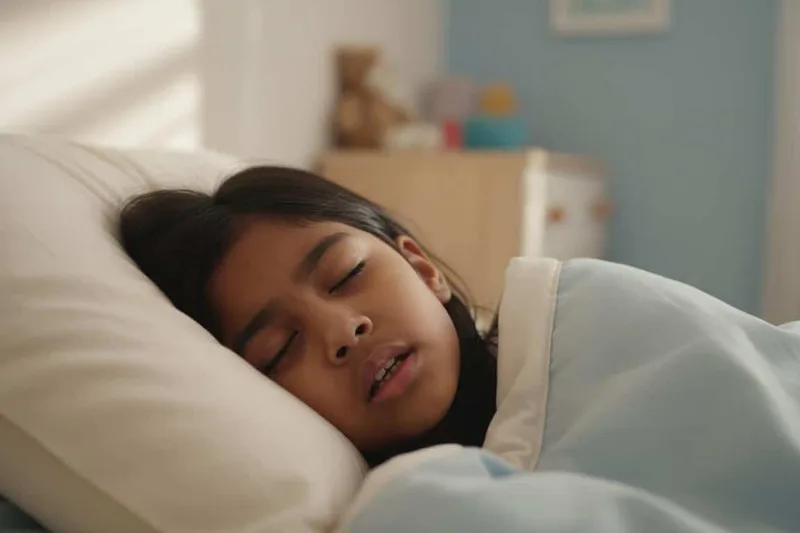
What is Obstructive Sleep Apnea?
Simply put, `(Obstructive Sleep Apnea)` is when a person stops breathing for a while while sleeping. The reason for this is that something in the airway, that is, in the throat, blocks the flow of air. "Obstructive" means that it is blocked. "Apnea" means that breathing stops temporarily. So when these two are combined, this condition is called `(Obstructive Sleep Apnea)` or `(OSA)`. When breathing stops like this during sleep, the oxygen level in the body can decrease and the carbon dioxide level can increase . This prevents the child from getting a good night's sleep. If not treated properly, this `(OSA)` condition can not only affect the child's learning, behavior, and physical development, but also cause heart problems. Therefore, it is very important to take care of this.Why does this happen to young children? What are the reasons?
When we sleep, all the muscles in our body relax. Similarly, the muscles at the back of our throat, which help keep the airway open, also relax. In someone with Obstructive Sleep Apnea, these muscles relax too much and can block the airway. This makes it difficult to breathe. Especially in children, if the tonsils in the throat or the adenoids behind the nose are large , there is a high chance that these can block the airway during sleep. The main reason why young children get OSA is because of these enlarged tonsils and adenoids. Apart from this, there are several other factors that can affect the development of OSA in a child:- If someone in the family has OSA: Sometimes this can be hereditary.
- Obesity : Excess fatty tissue around the neck of obese children can cause the airway to become narrow.
- Certain medical conditions: For example, children with conditions like `` Down syndrome '' or ``cerebral palsy'' are at higher risk.
- Certain problems with the mouth, jaw, or throat : It can also be caused by certain congenital differences in the way the airway narrows.
- Large tongue position: Some children have tongues that are larger than normal, which can cause them to fall backward during sleep and block the airway.
What are the symptoms of `(Obstructive Sleep Apnea)`? How is it diagnosed?
When breathing stops, the body's oxygen levels drop and carbon dioxide levels rise. When this happens, our brain sends a signal saying, "Oh, wake up and breathe." Most of the time, this happens very quickly, and we fall back asleep without even remembering waking up. But someone with Obstructive Sleep Apnea keeps stopping and waking up all night. Because of this, they never get a deep, restful sleep. Here are some signs that a young child with OSA may show:- Snoring in sleep: This is not just a snoring sound. Often, the person will snore loudly, then suddenly stop, make a "hhhh" sound or a nasal sound as if they are having difficulty breathing, and then start breathing again. Sometimes, they will make a wheezing sound when they breathe.
- It seems like you're having trouble breathing while you sleep.
- Having a very restless sleep: tossing and turning in bed, sleeping in strange positions.
- Bedwetting: This is especially important to consider if a child who previously did not wet the bed at night starts wetting again.
- Daytime sleepiness or behavioral/learning problems: Feeling tired during the day and having difficulty concentrating because of not getting enough sleep at night.
- Sleepwalking or night terrors.
- It's very difficult to wake up in the morning.
- I'm very tired during the day, and sometimes I fall asleep at school.
- Difficulty concentrating or becoming hyperactive.
Imagine, how does a child who struggles to breathe properly all night feel refreshed the next morning? How does he remember what he has learned? That's why it's important to be aware of this.
How do you diagnose this condition?
If your child has any of these symptoms, it's best to talk to a doctor:- If you often snore in your sleep.
- If your sleep is very restless, if you are tossing and turning.
- If you are always sleepy during the day.
- If you have other symptoms of sleep apnea.
- The way the eyes move
- Heart rate
- Breathing pattern (when you stop breathing and for how long)
- Brain waves (learn about the different stages of sleep)
- Blood oxygen level
- Carbon dioxide level in the blood
- Snoring and other sleep noises
- Body movement and sleeping positions
What is the treatment for this?
If the condition is not severe, that is, mild, doctors sometimes monitor the child's sleep for a while before starting treatment to see if the symptoms improve on their own. Some children can control mild OSA with nasal sprays or other medications. However, if enlarged tonsils are the cause of the difficulty breathing , your doctor will refer you to an ear, nose, and throat doctor (ENT doctor). The ENT doctor may recommend surgery such as:- Tonsillectomy (removal of the tonsils )
- Removal of enlarged adenoids (adenoidectomy)
- Removing both at once (adenotonsillectomy)
Finally, things to remember
So, we talked a lot about `(Obstructive Sleep Apnea)`. This is not as rare as you might think, and it is a condition that can be successfully treated if identified early.The most important thing is to see a doctor if your child is snoring at night, seems to be having difficulty breathing, or is sleepy during the day, and not just dismiss it as "just the way children are."It may not be serious. But, if it is ``(OSA)``, starting treatment early will be good for the child's whole life. It is everyone's responsibility to help your child have a healthy, restful sleep. Don't worry, doctors are there to help you.
Sleep apnea, children's sleep, snoring, tonsils, adenoids, CPAP, polysomnogram


💬 Comments (0)
No comments have been posted yet. Add your comment here for the first time.
Add your comment