
Explore Health Topics
Heart Health Diabetes Women's Health Pregnancy Digestive Health Mental Health
Medical Guides → • Calculators →
✓ Medically reviewed by Dr. Priya Sammani (MBBS, PG Dip. FM) | Age — · M/F · BMI —
88%
🩺 General and Preventive Health

Is your baby one month old? Let's learn about the monthly well-child visit!

MBBS

Medically reviewed by MBBS — Updated on Aug 20, 2026 · 3 min read

Is your baby one month old? Let's learn about the monthly well-child visit!
Table of Contents ▾

Your little one is now one month old, which is a very special time for both of you, isn't it? During this month, your baby is slowly getting used to the world and learning new things. So, a well-child visit during this first month is very important. Let's take a look at what happens during this visit and what you should expect.
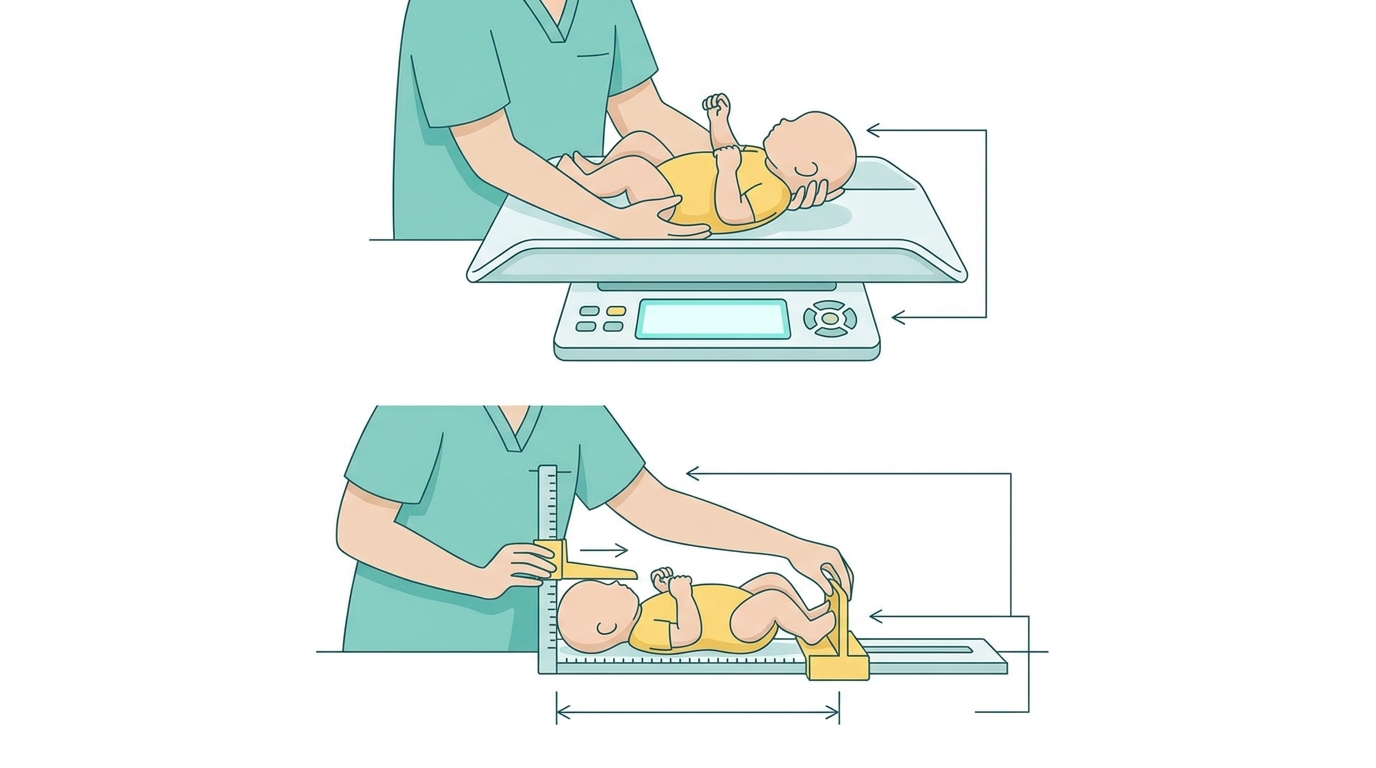
Is your baby one month old? Let's learn about the monthly well-child visit! Infographic
⚡ Interactive Clinical Tool
⚖️
BMI Calculator

Know your body mass index (BMI) and weight classification

Open Interactive Calculator →

What happens in this test?

When you go to the clinic with your baby, the doctor or nurse will meet you and do these things.

1. Measuring the baby's growth

The first thing to do is to measure the baby's weight, height, and head circumference . These measurements are then plotted on a growth chart. This helps you to see if the baby is growing properly.

2. Questions the doctor asks and advice he gives

Next, the doctor will ask you about your baby, answer any questions you may have, and give you valuable advice. He will mainly talk about these things:


❓ FAQ

FAQ

Evidence-based clinical answers to common patient questions

ukat juk’ampinaka ¿Kunas 1 phaxsi suma wawar visitt’añax nayrïr chequexa?

ukat juk’ampinaka Wawax pesaje ukat alturapax jilxattawaypachati janicha uk yatiñatakiw uñakipt’asi, nayra ukat jinchupan irnaqawip uñakipt’atarakiwa, ukat chuchuñ tuqit kuna jan walt’awinakas utjiti janicha uk yatiñataki.

ukat juk’ampinaka ¿Kunatsa mä wawax jiltañapatak tablax wali wakiskirixa?

ukat juk’ampinaka Ukax jaya pacha uñjañatakiwa, wawax mä suma k’umara jiltañapatakix yanapt’iwa, yaqha pachpa marani wawanakamp chikachasiñataki.

¿Kuna jach’a lurawinakas aka qullañ utan qullirir jiskt’añaxa?

ukat juk’ampinaka Awk taykanakax qullirirux jiskt’asipxaspawa, wawax kunjams ikiski, sapa kutiw intestino ukar mistu, ukat jutir 2 phaxsinx vacunas ukanakax churatäni.

📚

PubMed / WHO

✓ Peer-Reviewed Sources
  1. Feeding method: Feed your baby whenever he seems hungry. If you are breastfeeding at this age, he will feed about 8-12 times in 24 hours. If you are formula-fed , he will feed about 24 ounces a day. Don't forget to give him a goody bag during and after feeding.
  2. Number of wet diapers: You should wet about 6 diapers per day.
  3. Frequency of pooping: Breastfed babies may poop 3 or more times a day. However, by about 6 weeks of age, some breastfed babies may not poop for several days. Formula-fed babies should poop at least once a day. If you have any concerns about this, talk to your doctor.
  4. Sleep: Babies this age sleep about 14-17 hours a day. This includes short naps during the day. Breastfed babies may wake up frequently at night to feed. Formula-fed babies may sleep for a little longer.
  5. They look closely at faces and things moving around, turning their heads in that direction.
  6. When they hear a sound, they become silent, blink , turn their heads, flinch, or cry.
  7. Although the limbs are still slightly bent, the legs are slowly starting to open.
  8. Both arms and both legs shake in both directions.
  9. If you put your baby in the crawling position (Tummy Time), they will lift their head for a while.
  10. These age-specific reflexes (Newborn Reflexes) should be well-developed:
  11. Rooting Reflex and Sucking Reflex: When something is brought close to the lips, the baby turns its head in that direction and tries to suck.
  12. Grasp Reflex: If you put a finger on your hand, you will grasp it tightly.
  13. Tonic Neck Reflex / Fencer's Pose: When the head is turned to one side, the arm on that side is extended and the arm on the other side is bent. Like a swordsman.
  14. Moro Reflex / Startle Response: When suddenly startled, the arms and legs are spread out and then brought back in.
  15. Feed your puppy when he feels hungry. Also pay attention to signs of fullness (moving away from the milk, covering his mouth). Between 6 and 8 weeks, your puppy may experience a Growth Spurt'', which is when he is hungrier than usual.
  16. Do not give solid foods or fruit juice.
  17. Do not put things like cereal in your baby's milk bottle unless specifically instructed to do so by the doctor.
  18. Send goodies during and after breastfeeding.
  19. Wash your hands thoroughly before handling the baby. Ask other people who come into the house to do the same. Keep the baby away from people who are sick.
  20. Take care of the baby, take care of its needs. It doesn't hurt to pick up the little ones.
  21. Sing songs, talk, and read books to your baby. Babies learn best when they are around people.
  22. While your baby is awake, spend some time in the "crawling position" (Tummy Time) under your supervision. Keep an eye on your baby during this time, and help if he seems tired or struggling.
  23. It is normal for babies to cry for no reason at times (fussy periods). However, for some babies, this crying can be excessive, lasting for hours a day. If a baby with no other health problems develops colic, it usually starts around 3 weeks of age, peaks around 6 weeks, and subsides by about 3 months.
  24. If your baby's rectal temperature is 38 degrees Celsius (100.4 Fahrenheit) or higher, call your doctor immediately. If your baby seems sick, call your doctor. Do not give any medicine to a baby under 2 months of age without first talking to a doctor.
  25. It's normal to feel tired and stressed as a new mother. But if these feelings are too strong, or if you feel sad, anxious, or often irritable, talk to your doctor.
  26. If you have questions about your living situation (do you have the things you need to take care of your baby? Do you have enough food, a safe place to live, health insurance?), talk to your doctor. They can help you connect you with community resources or a social worker.
  27. Always put your baby to sleep face-up, on a flat, firm mattress, in a crib or bassinet. Do not put your baby to sleep on their stomach or on their side. Do not put crib bumpers, blankets, pillows, or soft toys in the crib.
  28. Breastfeed if possible.
  29. Until your baby's first birthday, at least 6 months (the risk of SIDS is highest during this time), sleep in a separate crib in your room, next to your bed. (Not in bed - no bed-sharing).
  30. Keep the room temperature comfortable and prevent the baby from overheating. Dress the baby appropriately for the room temperature, and do not overdress. Do not cover the head while sleeping. Check for sweating and body heat.
  31. Consider giving your baby a pacifier to suck on to help him sleep. If your baby doesn't like the pacifier, don't force it. If the pacifier leaves his mouth while he's sleeping, you don't need to put it back in. If you're breastfeeding, give him the pacifier after he's gotten used to breastfeeding.
  32. Do not let your baby sleep in inappropriate sleeping positions, such as in a sitting device (like a car seat), a nursing pillow (like a Boppy pillow), or some devices that allow babies to lie down (like Dock-a-Tot, Podster, Bummzie).
  33. Do not use any devices (such as sleep positioners, heart rate and breathing monitors) that claim to reduce the risk of SIDS. There is no product that actually does that.
  34. Make sure that everything you use for your baby's sleep, including bedding and mattresses, meets safety standards approved by a reputable agency, such as the US Consumer Product Safety Commission (CPSC).
  35. Do not smoke or use e-cigarettes. Do not allow anyone to smoke or vape in the area where your baby is.
  36. Always place your baby in the back seat of the car, in a rear-facing car seat. Never leave your baby alone in the car.
  37. Keep all toys with ropes, wires, and loops away from your baby.
  38. Do not leave your baby alone while he is awake, especially in high places or during bath time.
  39. Never shake your baby! Doing so can cause brain bleeding and even death. This is called Shaken Baby Syndrome. If you ever feel angry or worried that you might hurt your baby, put your baby safely in the crib and get away for a few minutes. Call a friend, relative, or your doctor for help.
  40. Minimize sun exposure. Keep your baby covered and in the shade as much as possible. Sunscreen is not recommended for babies under 6 months of age. However, if shade and clothing do not provide adequate protection, a baby under 6 months of age can use a small amount of sunscreen.
  41. NHS: Baby's Development Checkups
  42. Mayo Clinic: Infant growth milestones
  43. Cleveland Clinic: 1-Month Baby Care
  44. AAP: 1-Month Well-Child Visit
🔍 Search Keywords: parents checkup 1mo • parents checkup 1mo symptoms • parents checkup 1mo causes and treatment • parents checkup 1mo sri lanka • Is your baby one month old? Let's learn about the monthly well-child visit!
🩺 Articles For You
Mad Cow Disease and vCJD: Should we really be afraid?
How to protect yourself from meningitis? Let's be aware of this!
Do you also experience bowel incontinence? (Bowel Incontinence) - Don't be shy, let's talk about this
Are you really aware of this fine vellus hair on your body?
What are the complications of the flu? (Flu Complications) Let's find out exactly
Does your stomach look like an orange peel? Let's talk about cellulite!
💬 Patient Questions & Comments (0)

Have a question or experience to share? Post a comment or reply to other readers below.

🛡️ Plain Text Only • No Links
👤

No comments yet. Be the first to share your question or experience below.

⚠️ Important: Medical articles and information on Nirogi Lanka are strictly for educational and awareness purposes and do not substitute professional medical advice, diagnosis, or treatment. Always consult a qualified physician for any medical concerns.