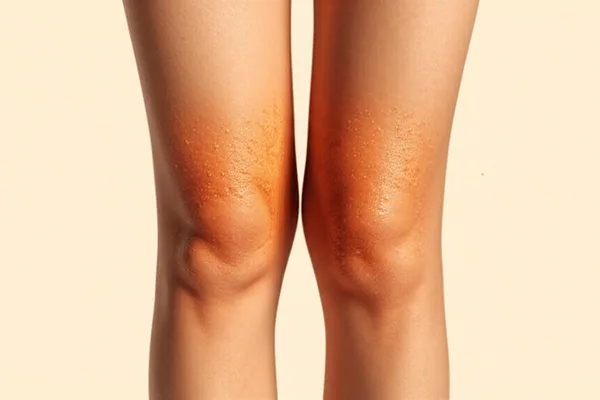
Are your legs swollen and the skin feels rough? Let's learn about this (Pretibial Myxedema)!

Are your legs swollen and the skin feels rough? Let's learn about this (Pretibial Myxedema)!
Have you ever noticed that the skin on your legs, especially below the knees, suddenly becomes swollen, thickened, and sometimes discolored? Or does it look like an orange peel in some places? If you have these symptoms, you may have a condition called Pretibial Myxedema, which we are going to talk about today.

What is this (Pretibial Myxedema)? Let's understand it simply!

Simply put, Pretibial Myxedema, sometimes called Graves' Dermopathy, is a form of Graves' Disease, a condition that affects our skin. It is caused by the accumulation of carbohydrates and sugars, or more precisely, glycosaminoglycans or mucopolysaccharides, in the deeper layers of our skin. These accumulate mainly in the lower legs, below the knees. This is when the legs swell, the skin becomes lumpy, and the skin becomes scaly (scaling plaques). What do the words "Pretibial" and "Myxedema" mean?
  • "Pretibial": This refers to the large bone on the side of our leg below the knee, the front of the `(tibia)`. If we say it in Sinhala, it's like "in front of the shinbone".
  • "Myxedema": This means swelling of the tissues under our skin.

Who is affected the most by this situation?

(Pretibial Myxedema) Although anyone can develop it, some people are more likely to develop it. They are:
  • People with Graves' Disease: This is the main concern.
  • People with thyroid problems: This means conditions like `(Hypothyroidism)` (low thyroid hormone ) or `( Hyperthyroidism )` (high thyroid hormone ).
  • People with severe eye disease: This is also often associated with Graves' Disease.
  • People between the ages of 40 and 60.
  • Women: This condition is more common in women than in men.
Imagine, your neighbor, Aunt Susila, has been having thyroid problems for a while. Suddenly, she noticed that the area below the knees of her legs was swollen, the skin was a little red, and it felt like small bumps when touched. At first, she thought it might be due to exertion. But it was only when she showed it to a doctor that she realized that it could be Pretibial Myxedema.

What are the main types of Pretibial Myxedema?

There are four main types of this condition. The symptoms may vary slightly accordingly: 1. Diffuse: This is the most common type. This is characterized by non-pitting edema that does not bulge when the skin is pressed against the skin. 2. Plaque:In addition to the swelling, there are thickened, raised, crusty plaques on the skin surface. 3. Nodular: In addition to the swelling, there are hard nodules under the skin. 4. Elephantiasis: This is the rarest type. In this type, lymphatic fluid accumulates under the skin, giving the skin a wart-like, rough appearance.

What are the symptoms of (Pretibial Myxedema)? Let's get to know them exactly!

If you have this condition, you may experience one or more of these symptoms:
  • Swelling: The skin on your leg looks bigger and puffier than the day before.
  • Hard lumps under the skin: These can be felt when you touch them with your hand.
  • Some areas of the skin become thick and become like plaques: like fish scales.
  • The skin and hair follicles take on a shiny, waxy texture: It may look like an orange peel .
  • The skin color changes: it can range from yellow and orange to brown, red, and purple.
  • There is increased sweating or excessive hair growth in the affected areas.
  • The skin hurts or itches.
Initially, the condition may start as a hard lump on the skin. This lump may grow larger over time, or may merge with other lumps.

Where on the body do these symptoms affect the most?

The most common symptoms of Pretibial Myxedema are:
  • On the legs below the knees.
  • On the soles of the feet.
  • The shins in the shin area.
Sometimes facial changes can be caused by Graves' Disease or a thyroid condition, but that's a separate issue.

Why do we get (Pretibial Myxedema)? What are the causes?

Although the exact cause of this is not yet fully understood, several factors have emerged from research. The main reason for this is the accumulation of the sugar compounds `(glycosaminoglycans or mucopolysaccharides)` that we mentioned earlier in the `(dermis)` and `(hypodermis)` layers of the skin. But why does it accumulate like that? 1. An immune system process `(Autoimmune response)`: Simply put, our body's own defense system starts working against us. In this, our defense system signals our cells to produce `(antibodies)` against thyroid hormones. These `(antibodies)` cause the cells to produce a substance called `(glycosaminoglycans)` in excess. 2. Activation of (T lymphocyte) cells: `(T lymphocytes)` is a special type of cell in our immune system. These cells go into the skin tissue and release messenger proteins called `(cytokines)`. These cytokines cause cells to produce excessive amounts of glycosaminoglycans. 3. Injury response:Imagine you have an injury to your lower leg, in the pretibial area. If you have hypothyroidism, immune cells and proteins can accumulate at the site of the injury. This is because thyroid hormones control the accumulation of these compounds in tissues. When hormones are lacking, that control is lost.

How does a doctor diagnose Pretibial Myxedema?

When you see a doctor, he or she will first ask you about your symptoms and any other medical conditions you may have (`(medical history)`). Then they will examine you (`(physical exam)`). To confirm whether this is (Pretibial Myxedema), a doctor may do the following tests:
  • Blood test: Check your thyroid hormone levels.
  • Skin biopsy: This can be used to determine whether the condition is present and to measure the levels of glycosaminoglycans in the skin.

Is there a treatment for this? What can be done?

Most of the time, the symptoms of Pretibial Myxedema are only cosmetic, so treatment is not always necessary. That is, they usually do not cause any significant harm . However, if you are uncomfortable with the appearance or have other symptoms (itching, pain), there are treatments available.
  • Wearing compression socks or stockings: This can reduce swelling.
  • Topical creams or ointments: Prevent itching and swelling.
  • Oral and topical medications and injections: To reduce lumps under the skin or minimize changes in appearance.
  • Treating Graves' Disease or Thyroid Condition: This is the most important thing . When the underlying cause is treated, the symptoms of Pretibial Myxedema often improve.
  • Plasmapheresis: This is a slightly more complicated treatment. It involves removing the liquid part of the blood (plasma), replacing the red and white blood cells and platelets in a new solution, and then reintroducing them back into the body. This is not something everyone can do.
Important: Although surgery can remove subcutaneous nodules, it is not usually recommended. This is because, as the skin heals after surgery, the nodules are more likely to recur at the site of the injury. This is because the body treats the surgical site as a "wound."

What are the medications given for Pretibial Myxedema?

Your doctor may give you medications such as these to help reduce the symptoms of this condition:
  • (Corticosteroids):These are topical medications that help reduce swelling, inflammation, and itching.
  • (Pentoxifylline): This is an oral medication that improves blood circulation in the legs.
  • (Octreotide): This is an injection. It can reduce the size of lumps under the skin.
  • (Rituximab): This is also an intravenous infusion. It helps our body's antibodies work properly.
  • Intravenous immunoglobulin (IVIG): This is also a drug given into a vein. It improves the functioning of the antibodies in the immune system.
Before starting a new medication, be sure to talk to your doctor about its side effects, how long you should take it, and whether it will cause problems with other medications you are currently taking.

How quickly will I recover after treatment?

The length of time you have symptoms of Pretibial Myxedema will vary depending on the severity of your condition. With treatment, symptoms may improve within a few weeks to a few months. Without treatment, it can sometimes take several years for the condition to resolve on its own. But remember, if you have an injury to your lower legs, the condition can recur.

Are there ways to prevent this (Pretibial Myxedema) from occurring?

There is no way to completely prevent this from happening, but you can do the following to reduce your risk:
  • Do not use tobacco products.
  • If you have conditions that affect your thyroid function, get them treated properly.
  • Wear compression socks or stockings on your legs.

What if I have this condition too? Is it something to be afraid of?

The prognosis for people with Pretibial Myxedema is generally good. If your symptoms only affect your appearance, you may not need treatment. If you have a mild case, it will usually go away on its own. If your case is more severe, the prognosis is good, but it can take several years to fully recover.

Do I need to see a doctor?

Pretibial Myxedema can recur even after it has healed, especially if you have an injury to your lower leg. So, if your symptoms have subsided and then recur, talk to your doctor. Also, if you have pain or severe itching, be sure to see a doctor.

What questions should I ask the doctor?

It's a good idea to have some questions like these ready when you go to the doctor:
  • Can I use compression socks to help with Pretibial Myxedema?
  • Do I need treatment for Pretibial Myxedema?
  • Is my symptoms caused by an underlying thyroid condition?
  • How do I take care of my skin affected by Pretibial Myxedema?

What is the difference between (Pretibial Myxedema) and (Erythema Nodosum)?

Both of these conditions affect our skin, especially the skin on our legs below the knees. However, there are differences in the symptoms:
  • (Pretibial Myxedema): This causes swelling and shiny, thickened, coral-like plaques.
  • (Erythema Nodosum): This causes swelling and small, painful bumps on the skin.

Finally, things to remember

Pretibial Myxedema is a condition that usually doesn't require treatment. In most cases, it goes away on its own. However, if the changes in appearance bother you, there are treatments available. Wearing compression socks can help reduce swelling and make you feel more comfortable. If you have pain or severe itching in your lower legs, be sure to talk to a doctor. Also, this condition is often associated with Graves' Disease and thyroid problems, so it's important to be aware of those as well.

⚠️ Important: The medical articles and information on Nirogi Lanka are for general awareness only, and are by no means a substitute for professional medical advice, diagnosis, or treatment. For any medical problem you have, consult a qualified physician immediately.

💬 Comments (0)

No comments have been posted yet. Add your comment here for the first time.

Add your comment

Please calculate: 2 + 4 =
Are your legs swollen and the skin feels rough? Let's learn about this (Pretibial Myxedema)!

Are your legs swollen and the skin feels rough? Let's learn about this (Pretibial Myxedema)!

Have you ever noticed that the skin on your legs, especially below the knees, suddenly becomes swollen, thickened, and sometimes discolored? Or does it look like an orange peel in some places? If you have these symptoms, you may have a condition called Pretibial Myxedema, which we are going to talk about today.

What is this (Pretibial Myxedema)? Let's understand it simply!

Simply put, Pretibial Myxedema, sometimes called Graves' Dermopathy, is a form of Graves' Disease, a condition that affects our skin. It is caused by the accumulation of carbohydrates and sugars, or more precisely, glycosaminoglycans or mucopolysaccharides, in the deeper layers of our skin. These accumulate mainly in the lower legs, below the knees. This is when the legs swell, the skin becomes lumpy, and the skin becomes scaly (scaling plaques). What do the words "Pretibial" and "Myxedema" mean?
  • "Pretibial": This refers to the large bone on the side of our leg below the knee, the front of the `(tibia)`. If we say it in Sinhala, it's like "in front of the shinbone".
  • "Myxedema": This means swelling of the tissues under our skin.

Who is affected the most by this situation?

(Pretibial Myxedema) Although anyone can develop it, some people are more likely to develop it. They are:
  • People with Graves' Disease: This is the main concern.
  • People with thyroid problems: This means conditions like `(Hypothyroidism)` (low thyroid hormone ) or `( Hyperthyroidism )` (high thyroid hormone ).
  • People with severe eye disease: This is also often associated with Graves' Disease.
  • People between the ages of 40 and 60.
  • Women: This condition is more common in women than in men.
Imagine, your neighbor, Aunt Susila, has been having thyroid problems for a while. Suddenly, she noticed that the area below the knees of her legs was swollen, the skin was a little red, and it felt like small bumps when touched. At first, she thought it might be due to exertion. But it was only when she showed it to a doctor that she realized that it could be Pretibial Myxedema.

What are the main types of Pretibial Myxedema?

There are four main types of this condition. The symptoms may vary slightly accordingly: 1. Diffuse: This is the most common type. This is characterized by non-pitting edema that does not bulge when the skin is pressed against the skin. 2. Plaque:In addition to the swelling, there are thickened, raised, crusty plaques on the skin surface. 3. Nodular: In addition to the swelling, there are hard nodules under the skin. 4. Elephantiasis: This is the rarest type. In this type, lymphatic fluid accumulates under the skin, giving the skin a wart-like, rough appearance.

What are the symptoms of (Pretibial Myxedema)? Let's get to know them exactly!

If you have this condition, you may experience one or more of these symptoms:
  • Swelling: The skin on your leg looks bigger and puffier than the day before.
  • Hard lumps under the skin: These can be felt when you touch them with your hand.
  • Some areas of the skin become thick and become like plaques: like fish scales.
  • The skin and hair follicles take on a shiny, waxy texture: It may look like an orange peel .
  • The skin color changes: it can range from yellow and orange to brown, red, and purple.
  • There is increased sweating or excessive hair growth in the affected areas.
  • The skin hurts or itches.
Initially, the condition may start as a hard lump on the skin. This lump may grow larger over time, or may merge with other lumps.

Where on the body do these symptoms affect the most?

The most common symptoms of Pretibial Myxedema are:
  • On the legs below the knees.
  • On the soles of the feet.
  • The shins in the shin area.
Sometimes facial changes can be caused by Graves' Disease or a thyroid condition, but that's a separate issue.

Why do we get (Pretibial Myxedema)? What are the causes?

Although the exact cause of this is not yet fully understood, several factors have emerged from research. The main reason for this is the accumulation of the sugar compounds `(glycosaminoglycans or mucopolysaccharides)` that we mentioned earlier in the `(dermis)` and `(hypodermis)` layers of the skin. But why does it accumulate like that? 1. An immune system process `(Autoimmune response)`: Simply put, our body's own defense system starts working against us. In this, our defense system signals our cells to produce `(antibodies)` against thyroid hormones. These `(antibodies)` cause the cells to produce a substance called `(glycosaminoglycans)` in excess. 2. Activation of (T lymphocyte) cells: `(T lymphocytes)` is a special type of cell in our immune system. These cells go into the skin tissue and release messenger proteins called `(cytokines)`. These cytokines cause cells to produce excessive amounts of glycosaminoglycans. 3. Injury response:Imagine you have an injury to your lower leg, in the pretibial area. If you have hypothyroidism, immune cells and proteins can accumulate at the site of the injury. This is because thyroid hormones control the accumulation of these compounds in tissues. When hormones are lacking, that control is lost.

How does a doctor diagnose Pretibial Myxedema?

When you see a doctor, he or she will first ask you about your symptoms and any other medical conditions you may have (`(medical history)`). Then they will examine you (`(physical exam)`). To confirm whether this is (Pretibial Myxedema), a doctor may do the following tests:
  • Blood test: Check your thyroid hormone levels.
  • Skin biopsy: This can be used to determine whether the condition is present and to measure the levels of glycosaminoglycans in the skin.

Is there a treatment for this? What can be done?

Most of the time, the symptoms of Pretibial Myxedema are only cosmetic, so treatment is not always necessary. That is, they usually do not cause any significant harm . However, if you are uncomfortable with the appearance or have other symptoms (itching, pain), there are treatments available.
  • Wearing compression socks or stockings: This can reduce swelling.
  • Topical creams or ointments: Prevent itching and swelling.
  • Oral and topical medications and injections: To reduce lumps under the skin or minimize changes in appearance.
  • Treating Graves' Disease or Thyroid Condition: This is the most important thing . When the underlying cause is treated, the symptoms of Pretibial Myxedema often improve.
  • Plasmapheresis: This is a slightly more complicated treatment. It involves removing the liquid part of the blood (plasma), replacing the red and white blood cells and platelets in a new solution, and then reintroducing them back into the body. This is not something everyone can do.
Important: Although surgery can remove subcutaneous nodules, it is not usually recommended. This is because, as the skin heals after surgery, the nodules are more likely to recur at the site of the injury. This is because the body treats the surgical site as a "wound."

What are the medications given for Pretibial Myxedema?

Your doctor may give you medications such as these to help reduce the symptoms of this condition:
  • (Corticosteroids):These are topical medications that help reduce swelling, inflammation, and itching.
  • (Pentoxifylline): This is an oral medication that improves blood circulation in the legs.
  • (Octreotide): This is an injection. It can reduce the size of lumps under the skin.
  • (Rituximab): This is also an intravenous infusion. It helps our body's antibodies work properly.
  • Intravenous immunoglobulin (IVIG): This is also a drug given into a vein. It improves the functioning of the antibodies in the immune system.
Before starting a new medication, be sure to talk to your doctor about its side effects, how long you should take it, and whether it will cause problems with other medications you are currently taking.

How quickly will I recover after treatment?

The length of time you have symptoms of Pretibial Myxedema will vary depending on the severity of your condition. With treatment, symptoms may improve within a few weeks to a few months. Without treatment, it can sometimes take several years for the condition to resolve on its own. But remember, if you have an injury to your lower legs, the condition can recur.

Are there ways to prevent this (Pretibial Myxedema) from occurring?

There is no way to completely prevent this from happening, but you can do the following to reduce your risk:
  • Do not use tobacco products.
  • If you have conditions that affect your thyroid function, get them treated properly.
  • Wear compression socks or stockings on your legs.

What if I have this condition too? Is it something to be afraid of?

The prognosis for people with Pretibial Myxedema is generally good. If your symptoms only affect your appearance, you may not need treatment. If you have a mild case, it will usually go away on its own. If your case is more severe, the prognosis is good, but it can take several years to fully recover.

Do I need to see a doctor?

Pretibial Myxedema can recur even after it has healed, especially if you have an injury to your lower leg. So, if your symptoms have subsided and then recur, talk to your doctor. Also, if you have pain or severe itching, be sure to see a doctor.

What questions should I ask the doctor?

It's a good idea to have some questions like these ready when you go to the doctor:
  • Can I use compression socks to help with Pretibial Myxedema?
  • Do I need treatment for Pretibial Myxedema?
  • Is my symptoms caused by an underlying thyroid condition?
  • How do I take care of my skin affected by Pretibial Myxedema?

What is the difference between (Pretibial Myxedema) and (Erythema Nodosum)?

Both of these conditions affect our skin, especially the skin on our legs below the knees. However, there are differences in the symptoms:
  • (Pretibial Myxedema): This causes swelling and shiny, thickened, coral-like plaques.
  • (Erythema Nodosum): This causes swelling and small, painful bumps on the skin.

Finally, things to remember

Pretibial Myxedema is a condition that usually doesn't require treatment. In most cases, it goes away on its own. However, if the changes in appearance bother you, there are treatments available. Wearing compression socks can help reduce swelling and make you feel more comfortable. If you have pain or severe itching in your lower legs, be sure to talk to a doctor. Also, this condition is often associated with Graves' Disease and thyroid problems, so it's important to be aware of those as well.
⚠️ Important: The medical articles and information on Nirogi Lanka are for general awareness only, and are by no means a substitute for professional medical advice, diagnosis, or treatment. For any medical problem you have, consult a qualified physician immediately.

💬 Comments (0)

No comments have been posted yet. Add your comment here for the first time.

Add your comment

Please calculate: 2 + 4 =