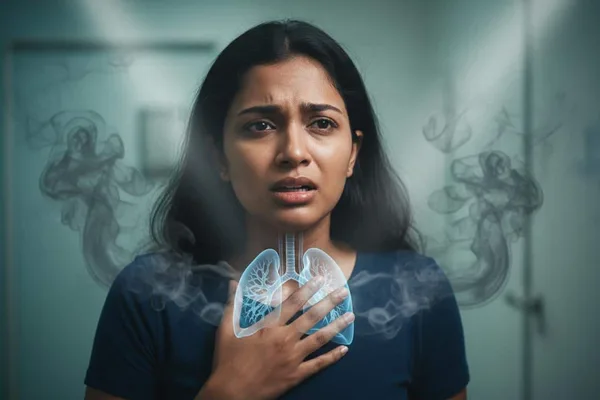
Smoking and Asthma: Let's find out exactly about this dangerous relationship.

Smoking and Asthma: Let's find out exactly about this dangerous relationship.
Do you have asthma? Or does someone you know suffer from this condition? Asthma is actually a bit of a nuisance, and it is a common condition among many people. So, today we are going to talk about how bad it is for someone with asthma to smoke, and whether it actually makes their asthma worse. This is a very important topic, because if you understand the relationship between the two, you can avoid a lot of harm.

Let's first remind ourselves what asthma is.

Now, when we say asthma, it simply means that our airways , that is, the small tubes that carry air to the lungs, become inflamed and narrow. Imagine it as if a water pipe is blocked from the inside. When the airways become narrow in this way, fluids like mucus start to accumulate in them. That's when it becomes difficult to breathe, you feel like your chest is constricted, you cough, and sometimes you make a whistling sound when you breathe. There can be many reasons for this. For some, things like dust, pollen, and animal dander are a problem. For others, asthma can be triggered by cold, exercise, or stress.

So how does smoking affect our lungs?

Okay, now let's look at the damage that smoking does to our lungs. When you smoke, thousands of harmful chemicals in a cigarette – not just nicotine , but also tar , carbon monoxide, and many other things – go straight into your lungs. These chemicals damage the fine, hair-like structures in your airways , called cilia . These cilia act like little brooms that sweep out dust and germs that enter your lungs. So, when these are damaged, the lungs don't clean properly. Not only that, smoking also causes inflammation, which means they swell. Over time, this can even lead to serious conditions like COPD (Chronic Obstructive Pulmonary Disease) .

Now let's see, what happens if someone with asthma smokes?

Now comes the important part. Imagine what would happen if these harsh chemicals from a cigarette entered an airway that was already sensitive, swollen, and narrowed due to asthma. It would be like pouring more kerosene on a fire.
  • Inflammation gets worse: Asthma is an inflammation of the airways . Smoking makes this inflammation worse. This means that the airways become more swollen and red.
  • Mucus production increases, accumulating:The body tries to get rid of these harmful substances because of the smoke. In response, mucus is produced. However, when a person with asthma smokes, this mucus is produced in much larger amounts than normal, and it becomes very thick and sticky. This further blocks the airways .
  • Bronchoconstriction : The chemicals in smoke can tighten the delicate muscles around the airways , making it harder to breathe.
In fact, for someone with asthma to smoke is like making their condition worse.

The chance of an asthma attack is high, and it is difficult to control!

An asthmatic who smokes is more likely to have asthma attacks than someone who just has asthma. Also, the attacks can be very severe. Sometimes they may even require hospitalization. The biggest problem is that smoking makes asthma medications less effective. You know, we usually use inhalers for asthma. There are two types of these:
  • Reliever inhalers : These are used to quickly open the airways during an asthma attack. For example, medicines like Salbutamol . If you smoke, the relief from these reliever inhalers may be reduced, or you may need to use them more often.
  • Preventer inhalers: These are used daily to prevent asthma attacks and control inflammation in the airways . These usually contain steroids . If you continue to smoke, these preventer inhalers will not be as effective at controlling inflammation in the airways .
So, one of the main challenges faced by asthmatics who smoke is that they find it difficult to control their disease even with medication . This is a bit obvious, isn't it?

The damage to asthma caused by secondhand smoke is not insignificant, right?

Yes, this is also a very important issue. Secondhand SmokeThis means that when someone smokes, the smoke is inhaled by others. This is also very harmful for people with asthma. Imagine, even if you don't smoke, if someone smokes where you are, that smoke goes into your lungs. For someone with asthma, this has the same effect as if they had smoked. This is especially dangerous for young children. If someone smokes at home, the child with asthma in that house may have more frequent asthma attacks, worse symptoms, and have to go to the hospital more often. Therefore, if there is an asthmatic, you should completely avoid smoking in that environment. It is very important to make your home, your car, and your workplace smoke-free zones .

"Thirdhand smoke is also a big problem!"

Now let's talk about 'Thirdhand Smoke' . This may be new to you. Simply put, this means that after you put out a cigarette, the chemicals in that smoke are deposited everywhere, such as on walls, clothes, sofas, toys, and carpets. These chemicals can remain in those places for a long time. So, when someone with asthma, especially a young child, is in a place that smells like smoke or has previously been smoked in, when the child touches those surfaces and puts his hand in his mouth again, those chemicals can be inhaled. This can also trigger asthma and increase symptoms. Therefore, it is important to keep smoking areas clean and create a smoke-free environment as much as possible.

What happens to children with asthma if their parents smoke?

This is a heartbreaking issue. If parents smoke, it is a great injustice to children with asthma.
  • Increased risk of developing asthma: If the mother smokes during pregnancy , or if the child is exposed to smoke from an early age, the child is more likely to develop asthma in the future.
  • Worsening asthma: If parents smoke in a home where a child already has asthma, that child may have more frequent asthma attacks , they may be more severe , and may not respond as well to medication .
  • Effects on lung development: Children exposed to smoke from an early age have impaired lung development, which can have lifelong effects.
  • Frequent hospitalizations: Children like this often have to be taken to and admitted to the hospital.
So, if you are a parent and your child has asthma, the best decision you can make for your child is to quit smoking.

Will my asthma get better if I quit smoking?

Absolutely yes! This is the best news. You will start to notice the difference almost as soon as you quit smoking.
  • Reduces inflammation in the airways :Once you stop smoking, the constant swelling and redness in your airways will decrease.
  • The frequency of asthma attacks decreases: The frequency of asthma attacks decreases, and the severity of an attack also decreases.
  • Medications are working better: Your inhaler and other asthma medications are starting to work better. This means you can get better control with less medication.
  • Lung function improves: Over time, damaged lungs begin to recover to some extent. Breathing becomes easier.
  • Quality of life improves: less fatigue, better exercise, better sleep, and happiness.
So, quitting smoking is one of the biggest things you can do for your asthma, as well as your overall health.

So, what can you do to quit smoking? (Take-Home Message)

Okay, so what's the most important message for you from what we've talked about? If you have asthma, smoking is a very dangerous enemy. It can not only worsen your asthma, but it can also be life-threatening. We know that quitting smoking is not easy. It's a challenge. But it's not impossible.
  • Seek medical advice: Talk to your doctor. He/she can advise you on methods and medications that can help you quit smoking. There are methods such as Nicotine Replacement Therapy (NRT) (e.g., nicotine patches, chewing gum).
  • Seek support: Ask for help from family and friends. If there are counseling services that help you quit smoking, you can also turn to them.
  • Identify triggers: Identify the times and reasons you feel like smoking. Try to avoid them.
  • Adopt a healthy lifestyle: drink plenty of water, eat a balanced diet, and exercise.
  • Never give up! You may not succeed right away. But don't stop trying.
Remember, every day you quit smoking is a day your lungs get better, your asthma gets better, and your life gets better. You can do it! Your health is in your hands.

Asthma, Smoking, Lungs, Respiratory Disease, Asthma Attack, Health, Quitting Smoking, Secondhand Smoke, Thirdhand Smoke, Inhaler
⚠️ Important: The medical articles and information on Nirogi Lanka are for general awareness only, and are by no means a substitute for professional medical advice, diagnosis, or treatment. For any medical problem you have, consult a qualified physician immediately.

💬 Comments (0)

No comments have been posted yet. Add your comment here for the first time.

Add your comment

Please calculate: 7 + 9 =
Smoking and Asthma: Let's find out exactly about this dangerous relationship.
Allergies and ImmunityFebruary 27, 2026

Smoking and Asthma: Let's find out exactly about this dangerous relationship.

Do you have asthma? Or does someone you know suffer from this condition? Asthma is actually a bit of a nuisance, and it is a common condition among many people. So, today we are going to talk about how bad it is for someone with asthma to smoke, and whether it actually makes their asthma worse. This is a very important topic, because if you understand the relationship between the two, you can avoid a lot of harm.

Let's first remind ourselves what asthma is.

Now, when we say asthma, it simply means that our airways , that is, the small tubes that carry air to the lungs, become inflamed and narrow. Imagine it as if a water pipe is blocked from the inside. When the airways become narrow in this way, fluids like mucus start to accumulate in them. That's when it becomes difficult to breathe, you feel like your chest is constricted, you cough, and sometimes you make a whistling sound when you breathe. There can be many reasons for this. For some, things like dust, pollen, and animal dander are a problem. For others, asthma can be triggered by cold, exercise, or stress.

So how does smoking affect our lungs?

Okay, now let's look at the damage that smoking does to our lungs. When you smoke, thousands of harmful chemicals in a cigarette – not just nicotine , but also tar , carbon monoxide, and many other things – go straight into your lungs. These chemicals damage the fine, hair-like structures in your airways , called cilia . These cilia act like little brooms that sweep out dust and germs that enter your lungs. So, when these are damaged, the lungs don't clean properly. Not only that, smoking also causes inflammation, which means they swell. Over time, this can even lead to serious conditions like COPD (Chronic Obstructive Pulmonary Disease) .

Now let's see, what happens if someone with asthma smokes?

Now comes the important part. Imagine what would happen if these harsh chemicals from a cigarette entered an airway that was already sensitive, swollen, and narrowed due to asthma. It would be like pouring more kerosene on a fire.
  • Inflammation gets worse: Asthma is an inflammation of the airways . Smoking makes this inflammation worse. This means that the airways become more swollen and red.
  • Mucus production increases, accumulating:The body tries to get rid of these harmful substances because of the smoke. In response, mucus is produced. However, when a person with asthma smokes, this mucus is produced in much larger amounts than normal, and it becomes very thick and sticky. This further blocks the airways .
  • Bronchoconstriction : The chemicals in smoke can tighten the delicate muscles around the airways , making it harder to breathe.
In fact, for someone with asthma to smoke is like making their condition worse.

The chance of an asthma attack is high, and it is difficult to control!

An asthmatic who smokes is more likely to have asthma attacks than someone who just has asthma. Also, the attacks can be very severe. Sometimes they may even require hospitalization. The biggest problem is that smoking makes asthma medications less effective. You know, we usually use inhalers for asthma. There are two types of these:
  • Reliever inhalers : These are used to quickly open the airways during an asthma attack. For example, medicines like Salbutamol . If you smoke, the relief from these reliever inhalers may be reduced, or you may need to use them more often.
  • Preventer inhalers: These are used daily to prevent asthma attacks and control inflammation in the airways . These usually contain steroids . If you continue to smoke, these preventer inhalers will not be as effective at controlling inflammation in the airways .
So, one of the main challenges faced by asthmatics who smoke is that they find it difficult to control their disease even with medication . This is a bit obvious, isn't it?

The damage to asthma caused by secondhand smoke is not insignificant, right?

Yes, this is also a very important issue. Secondhand SmokeThis means that when someone smokes, the smoke is inhaled by others. This is also very harmful for people with asthma. Imagine, even if you don't smoke, if someone smokes where you are, that smoke goes into your lungs. For someone with asthma, this has the same effect as if they had smoked. This is especially dangerous for young children. If someone smokes at home, the child with asthma in that house may have more frequent asthma attacks, worse symptoms, and have to go to the hospital more often. Therefore, if there is an asthmatic, you should completely avoid smoking in that environment. It is very important to make your home, your car, and your workplace smoke-free zones .

"Thirdhand smoke is also a big problem!"

Now let's talk about 'Thirdhand Smoke' . This may be new to you. Simply put, this means that after you put out a cigarette, the chemicals in that smoke are deposited everywhere, such as on walls, clothes, sofas, toys, and carpets. These chemicals can remain in those places for a long time. So, when someone with asthma, especially a young child, is in a place that smells like smoke or has previously been smoked in, when the child touches those surfaces and puts his hand in his mouth again, those chemicals can be inhaled. This can also trigger asthma and increase symptoms. Therefore, it is important to keep smoking areas clean and create a smoke-free environment as much as possible.

What happens to children with asthma if their parents smoke?

This is a heartbreaking issue. If parents smoke, it is a great injustice to children with asthma.
  • Increased risk of developing asthma: If the mother smokes during pregnancy , or if the child is exposed to smoke from an early age, the child is more likely to develop asthma in the future.
  • Worsening asthma: If parents smoke in a home where a child already has asthma, that child may have more frequent asthma attacks , they may be more severe , and may not respond as well to medication .
  • Effects on lung development: Children exposed to smoke from an early age have impaired lung development, which can have lifelong effects.
  • Frequent hospitalizations: Children like this often have to be taken to and admitted to the hospital.
So, if you are a parent and your child has asthma, the best decision you can make for your child is to quit smoking.

Will my asthma get better if I quit smoking?

Absolutely yes! This is the best news. You will start to notice the difference almost as soon as you quit smoking.
  • Reduces inflammation in the airways :Once you stop smoking, the constant swelling and redness in your airways will decrease.
  • The frequency of asthma attacks decreases: The frequency of asthma attacks decreases, and the severity of an attack also decreases.
  • Medications are working better: Your inhaler and other asthma medications are starting to work better. This means you can get better control with less medication.
  • Lung function improves: Over time, damaged lungs begin to recover to some extent. Breathing becomes easier.
  • Quality of life improves: less fatigue, better exercise, better sleep, and happiness.
So, quitting smoking is one of the biggest things you can do for your asthma, as well as your overall health.

So, what can you do to quit smoking? (Take-Home Message)

Okay, so what's the most important message for you from what we've talked about? If you have asthma, smoking is a very dangerous enemy. It can not only worsen your asthma, but it can also be life-threatening. We know that quitting smoking is not easy. It's a challenge. But it's not impossible.
  • Seek medical advice: Talk to your doctor. He/she can advise you on methods and medications that can help you quit smoking. There are methods such as Nicotine Replacement Therapy (NRT) (e.g., nicotine patches, chewing gum).
  • Seek support: Ask for help from family and friends. If there are counseling services that help you quit smoking, you can also turn to them.
  • Identify triggers: Identify the times and reasons you feel like smoking. Try to avoid them.
  • Adopt a healthy lifestyle: drink plenty of water, eat a balanced diet, and exercise.
  • Never give up! You may not succeed right away. But don't stop trying.
Remember, every day you quit smoking is a day your lungs get better, your asthma gets better, and your life gets better. You can do it! Your health is in your hands.

Asthma, Smoking, Lungs, Respiratory Disease, Asthma Attack, Health, Quitting Smoking, Secondhand Smoke, Thirdhand Smoke, Inhaler
⚠️ Important: The medical articles and information on Nirogi Lanka are for general awareness only, and are by no means a substitute for professional medical advice, diagnosis, or treatment. For any medical problem you have, consult a qualified physician immediately.

💬 Comments (0)

No comments have been posted yet. Add your comment here for the first time.

Add your comment

Please calculate: 7 + 9 =