
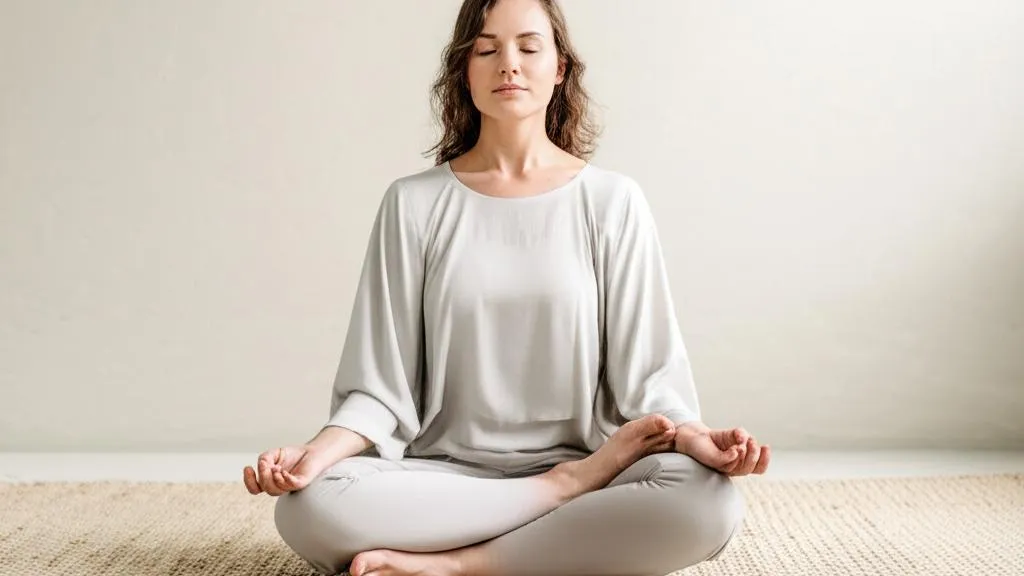
How busy is life these days? How many things come to mind? Sometimes the mind feels very pressured, heavy, and anxious, right? So today we are talking about a wonderful method that can help you free your mind , calm down, and understand who you really are at a time like this. That is Vipassana meditation. You may have heard of it. If not, that's okay, let's talk about it simply from the beginning.
What exactly is Vipassana meditation?
Simply put, the Pali word "vipassana" means "seeing things as they are, that is, as they really are." This is one of the oldest meditation techniques in India. In this, we observe our own body and mind without any judgment. As if we were an outsider looking at ourselves.
The special thing about this is that Vipassana meditation is not tied to any religion or belief system . That means whether you are Buddhist, Catholic, Hindu, Muslim, or someone who does not follow any religion, you can practice this meditation. This is not something mystical or mystical. This is an exploration of yourself.
The main goal of this meditation is to completely purify the mind, develop virtues such as kindness and non-judgement, and increase empathy for others. According to the Vipassana philosophy, the root of all suffering and defilements in our minds is ignorance about the true nature of reality. So, what Vipassana meditation does is to eliminate that ignorance and help us see reality.
What are the benefits of practicing Vipassana meditation?
Like many other meditation techniques, Vipassana meditation has many positive effects on our mind and body. Let's see what they are.
- The mind becomes clear and calm: How confused are our minds with the busyness of life? When you practice Vipassana meditation, your stress and anxiety will be greatly reduced. You will be able to look at your situation without worrying.
- Increases awareness of the present moment: Most of the time, we live either regretting what happened in the past or fearing what will happen in the future. But this meditation teaches us to live in the "present moment." We practice not chasing after thoughts and feelings that come to our mind, but observing them as they arise and pass away.
- Physical health improves:Studies have even found that those who participate in Vipassana programs also experience improved physical health. Experts believe that the main reason for this is reduced stress. We know that stress is directly linked to many diseases.
- Negative emotions are controlled: Imagine that you are feeling very angry or resentful towards someone. Normally, we just vent that anger. But this meditation technique teaches you to look at that anger. Observe that feeling, saying, "I am feeling angry right now." Then you will be able to control it instead of being a slave to that feeling.
- The ability to make the right decisions increases: When the mind is calm and awareness increases, we are able to understand reality and make the right decisions without succumbing to pressure.
Although these results can be achieved even with a ten-day program, to continue to achieve real results, it is very important to practice this meditation alone for a few minutes every day thereafter.
What is the history of this Vipassana meditation?
Listen to this as if it were just a story. Vipassana meditation is one of the oldest meditation techniques in India. It was introduced to the world by the Buddha. It is said that he used this meditation technique to attain enlightenment. He then taught this technique to his disciples. Over time, this meditation technique spread throughout India. Even kings practiced this meditation.
About 200 years after the Buddha's passing, Emperor Ashoka learned about this meditation. After a fierce war, King Ashoka, disheartened by the devastation, decided to follow the Buddha's path. With his patronage, this Vipassana meditation method spread throughout India and to countries like Egypt and Syria.
Although the practice faded over time, in the 1900s, Sayaji U Ba Khin, a civil servant in Myanmar (Burma), revived it and taught it to many people. It was his disciple, S. N. Goenka, who popularized the practice as we know it today, in the form of ten-day residential programs around the world.
How to do Vipassana meditation?
Vipassana meditation is usually learned by attending 10-day residential programs. These are often run on a donation basis, so you can attend for free . There are several such centers in Sri Lanka.
So let's get a rough idea of what's going to happen over these 10 days. While there are slight variations from center to center, the basic template is the same.
| Stages and time | A simple description of what is being done |
|---|---|
| Sila - Maintaining virtue (All the time) | To calm the mind for meditation, one must first establish good morals. For these 10 days, one must completely abstain from killing animals, stealing, lying, and drug use. |
| Samadhi - Concentration of the mind (First 3.5 days) | These days, what you do is watch your breath coming and going (anapanasati meditation). This will help you practice calming your scattered mind (samadhi). Only when you have learned to keep your mind in one place can you move on to the next step. |
| Vipassana - Developing Wisdom (Last 6.5 days) | Once you have settled your mind, you can now practice Vipassana. This involves observing with detachment any sensations (e.g., an itch, ache, a tingling sensation) that arise throughout your body from head to toe. Through this, you realize your true nature and purify your mind. |
During these 10 days, you should minimize talking (noble silence), eat at set times, and go to bed on a set schedule. All of this is done to free your mind from unnecessary things and focus on meditation. On the tenth day, you will begin to get used to normal life again.
💡 Take-Home Message
- Vipassana is a meditation method that is not related to any religion, teaches you to see reality as it is, and helps you purify your mind.
- This will greatly help you reduce negative emotions like stress, anxiety, and anger, and improve your mental and physical well-being.
- This is usually learned through 10-day residential programs, but after that, practicing for a short period of time every day can continue to produce good results.
- If you suffer from a serious mental illness, such as severe depression, it is very important to talk to your doctor before starting anything like this.




Janiw kuna arsuwinakas jichhakamax uñt’ayatäkiti. Aka chiqanx amuyt’awim jan ukax jiskt’awim yapxatañamawa.