

Is your little one acting a little strange these days? Is he crying all the time? Is he not drinking milk? Is there drooling? Maybe it's teething. Teething, also known as ``Teething Syndrome'', is a very normal part of their development. But it's a difficult time for both the little one and the mother. Let's find out more about it.
When do babies start teething?
Babies usually start to get their baby teeth between 6 and 12 months of age . However, some babies may get their teeth earlier and some later. This varies from baby to baby. The first to come in are usually the two front teeth on the bottom jaw. Then the four front teeth on the top jaw . Your baby's first big teeth, called molars, start to come in between 13 and 19 months of age. By the time your baby is about 3 years old, they will have a full set of 20 baby teeth, 10 on the top and 10 on the bottom.
How do teeth come in? Let's see in a little chart.
Now let's take a look at the order in which these baby teeth usually come in. Remember, this is just a general guideline, and your baby's teeth may be a little more spaced out than this.
- 6-10 months: Most often, the two lower central incisors are the first to appear.
- 8-12 months : Next come the two upper central incisors.
- 9-13 months: Upper lateral incisors.
- 10-16 months: Lower lateral incisors.
- 13-19 months: First molars - top and bottom. These are the slightly larger teeth.
- 16-22 months: Canines - top and bottom.
- 25-33 months: Second molars - top and bottom.
Simply put, a baby's baby teeth erupt about every 6 months of their life. Most of the time, the bottom teeth come in before the top teeth. They also come in pairs, meaning they come in one at a time, either on the top or bottom, or on the right or left side of the jaw. These baby teeth are smaller and whiter than the permanent teeth that come in later.
Imagine, when your child turns 4 years old, his jawbone and facial bones start to grow . Then, gaps form between these baby teeth. This is very natural. Because, this is how the space needed for the big permanent teeth that will come next is created. Between the ages of 6 and 12, a child has both baby teeth and permanent teeth in their mouth.
If baby teeth fall out after a while, why should we care about them?
Yes, it's true that baby teeth, or what we call ``primary teeth'' or ``deciduous teeth,'' are only in a child's mouth for a short time. But during that short time, these teeth play a very important role.
- Space is reserved for permanent teeth: it's like reserving a seat on a bus.
- Gives the child's face a normal shape.
- Helps develop clear speech: It's hard to say some letters without teeth, right?
- Helps with good nutrition: When teeth are decayed or missing, it can be difficult to chew food. Children may not eat certain foods.
- Gives a healthy start to permanent teeth: Just think, if baby teeth have decay and infection, the permanent teeth that come in underneath can also develop unsightly stains. That's why it's so important to take good care of baby teeth.
When do permanent teeth start to appear?
Let's take a look at the timeline for permanent teeth to appear. For some children, the first permanent molars come in first; for others, the incisors come in first. By the age of 13, about 28 permanent teeth have appeared. Then, between the ages of 17 and 21, wisdom teeth, or third molars, can appear, from one to four. Then, the total number of permanent teeth will be 32. However, for some people, a permanent tooth does not grow under every baby tooth. In medicine, this condition is called ``Hypodontia''.
What symptoms does a baby show when teething?
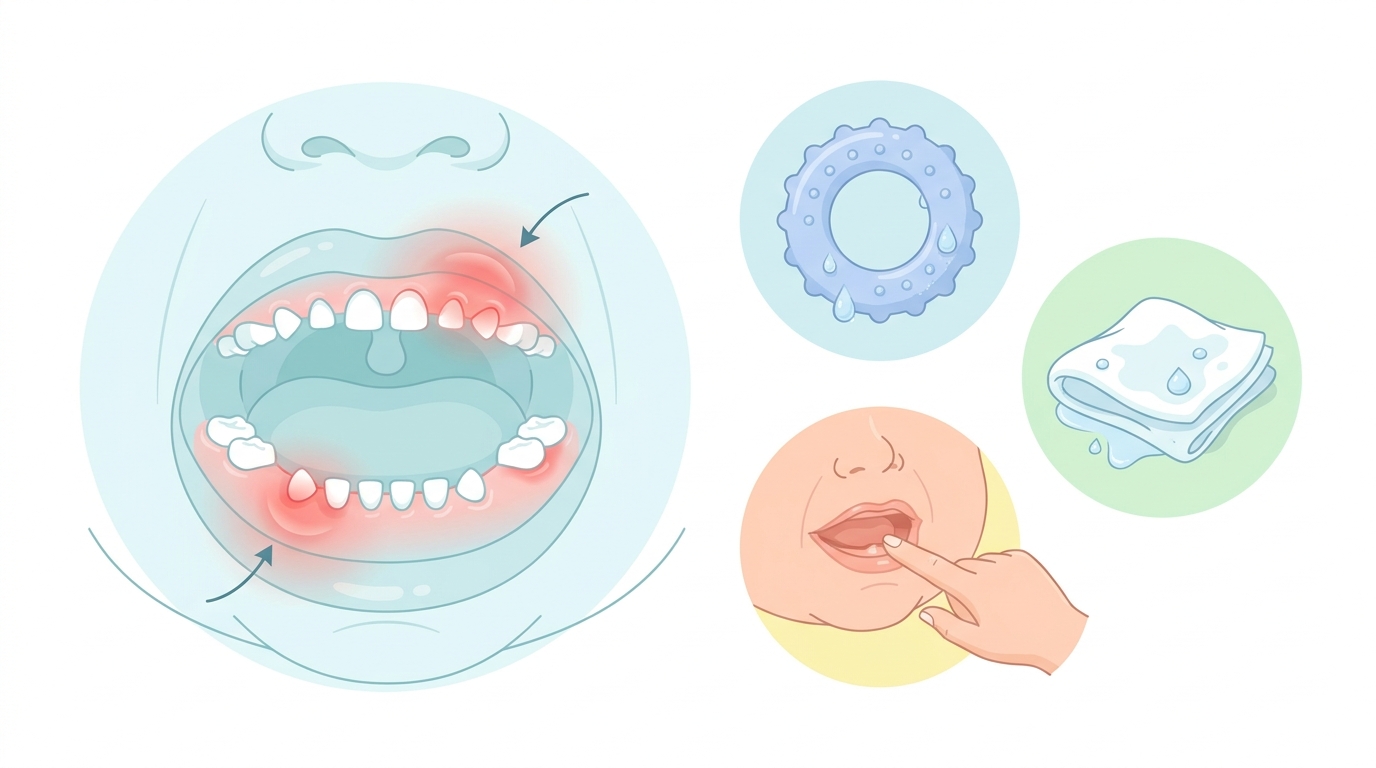
The first signs that your baby is teething are more saliva than usual and sore gums . The gums near the teething area may become red, swollen, and tender to the touch. In addition to these, there are other symptoms:
- Constant crying, restlessness.
- Irritability, irritability.
- Difficulty sleeping.
- Food is tasteless .
- Chewing on things you can get your hands on, putting them in your mouth.
Importantly, a baby's temperature may rise slightly when teething. However, if the fever is over 100.4 degrees F (38 degrees C), it is not due to teething. If your baby has a fever, or if they have any of the following symptoms , you should see a doctor right away :
* Diarrhea (stomach upset).
* Vomiting .
* A skin rash.
Symptoms like these are not related to teething, so it is essential to seek medical advice.
What can I do to reduce my baby's discomfort when teething?
It's heartbreaking when your baby cries from teething pain. But there are things you can do to ease his pain. The best thing to do is to gently massage his sore gums . Here's what you can do:
- Use your well-cleaned finger .
- A chilled spoon (not one that has been frozen! Just one that has been chilled).
- A wet gauze pad or a clean piece of cloth is fine.
- A clean teether that your baby can chew on. When choosing this , it should be made of thick rubber . For your baby's safety, avoid plastic toys that can break, liquid-filled teething rings , and frozen teething rings . They are too harsh for your baby's mouth and can damage their gums.
Definitely avoid these items: The US Food and Drug Administration warns against using teething necklaces or bracelets made of amber, silicone, marble, or wood. These pose a serious choking hazard . Also, avoid using gels and creams that contain Benzocaine, which numbs the gums. Homeopathic remedies are also not suitable at this time, as there is no guarantee of their ingredients and safety.
If your baby is unable to swallow, ask your doctor about giving him an appropriate dose of acetaminophen (such as Tylenol®) or ibuprofen (such as Advil®). Never give him medication without first consulting a doctor. Always know the exact dose and give it exactly as your doctor tells you.
When should you start brushing your baby's teeth?
Even before your baby's teeth come in, you can clean his gums with a gauze pad or a clean, damp cloth after he's finished eating. This will remove any food particles from his mouth and help your baby get used to brushing his teeth.
As soon as the first tooth appears, you should start brushing your child's teeth twice a day. To do this, you will need a small, soft-bristled toothbrush and a small amount of fluoride toothpaste . The amount of fluoride is very important, which is why it is called a small amount. This is the amount of fluoride you should use until your child is 3 years old. When your child has two teeth that touch each other, start cleaning between the teeth with dental floss. If you need help with this, you can ask your dentist.
For a while, you'll be the one brushing and flossing your baby's teeth. When your child is between 3 and 6 years old, you should start teaching them how to brush and floss on their own. But, you should watch to see if they do it properly. At this age, you can start using a ``pea-sized amount`` of toothpaste with each brushing.
So, what are the things we should remember from this story?
Teething is a normal, but somewhat uncomfortable, part of baby development. It's natural to feel sad when your little one is in pain. But remember, these teething symptoms will go away in a few days. After that, your baby will have healthy, beautiful teeth.
The most important thing is, if you have any concerns or doubts about your baby's teething, definitely consult your family doctor or pediatrician for advice. They will give you the right guidance. So, be patient and loving with your baby during this difficult time. Everything will be fine!
` Teething, baby teething, baby teeth, Teething Syndrome, baby teeth, gum pain, how to brush teeth
Doctor's Note
Although teething is a normal developmental stage for babies, it can be quite a stressful time for both the baby and the parents. Teething can cause swollen gums (gingivitis), drooling, anxiety, and a mild fever. To avoid these difficulties, you can give a clean cooled rubber tooth ring (Teething ring) or gently rub the gums with a clean finger. Avoid using pain reliever gels without medical advice.
❓ Some more questions you may encounter (FAQ)
At what age do children get their first teeth?▼
Generally, between 6 and 10 months, the lower central incisors appear first.
Is diarrhea or high fever normal when teething?▼
no Teething causes only a very mild fever or gingivitis. If diarrhea or high fever persists, it may be due to another bacterial infection and should be seen by a doctor immediately.
How to relieve gum pain in a teething baby?▼
A chilled teething ring or a clean wet cloth can be used to bite.




💬 Comments (0)
No comments yet. Be the first to share your thoughts here.
Add Your Comment