

You must have heard of marijuana, right? Some people call it hemp , ganja, weed, and pot. It is actually something that can cause some changes in our minds when used. So, today we will talk about marijuana in a little more detail and simply.
Are Marijuana and Cannabis the same thing?
Although people often use the words "marijuana" and "cannabis" interchangeably, there are some subtle differences between the two. Let's take a look at what they are.
- Cannabis: Simply put, this refers to any product derived from the plant Cannabis sativa. That means the dried flowers, leaves, stems, and seeds of the plant. This plant contains over 500 different chemicals . You may have heard of cannabidiol (CBD). That is one of the chemicals found in this plant.
- Marijuana: This refers to any part of the Cannabis sativa plant or products made from it, but especially those that contain significant amounts of the chemical tetrahydrocannabinol (THC) . It is this THC that primarily affects the mind and causes the feeling of being "high."
Do you understand then? Marijuana is also a type of cannabis. However, not all types of cannabis are marijuana. Because not all types of cannabis contain the psychoactive chemical THC .
In countries like the United States, marijuana use is common, especially among young people. However, scientifically speaking, there is still a lot we don't know about marijuana. Researchers are still studying its short-term and long-term effects.
Is marijuana a psychoactive drug?
In the past, scientists classified the compound in marijuana, THC, as a hallucinogen. However, not all marijuana uses produce these effects.
Some people may experience hallucinations after using marijuana. However, these are different from the experiences caused by other hallucinogens such as LSD, psilocybin (found in magic mushrooms), or ecstasy. This suggests that marijuana's hallucinogenic effects may work differently than other drugs.
What is Medical Marijuana?
You may have heard the term "medical marijuana." Some states in the United States have laws that allow the use of marijuana for medical purposes. These are mainly used to help control symptoms, not to cure a disease. Here are some of the uses of medical marijuana:
- To reduce long-term pain , especially neuropathic pain. This may also help reduce the use of opioids , a type of pain medication used to control pain.
- To reduce nausea and vomiting (as an antiemetic).
- To control the symptoms of diseases such as ` Multiple Sclerosis (MS),` for example, things like muscle stiffness (Spasticity).
- To increase appetite .
The U.S. Food and Drug Administration ( FDA ) has classified marijuana as a Schedule I drug, meaning it has no currently accepted medical use and is highly addictive . As a result, doctors cannot prescribe marijuana. However, in states where it is legal, doctors can certify the use of marijuana as a treatment for certain medical conditions.
The FDA has not approved marijuana to treat any medical condition. However, it has approved some purified compounds (analogs) derived from marijuana. Here are some examples:
- Cannabidiol (Epidiolex®): This helps prevent and control seizures in people with two rare forms of epilepsy called Lennox-Gastaut syndrome and Dravet syndrome. This is a prescription medication, unlike CBD products that you can buy at a pharmacy.
- Dronabinol (Marinol®) and Nabilone (Cesamet®): These compounds help prevent and treat nausea and vomiting caused by chemotherapy in cancer patients. Dronabinol is also used to treat conditions such as anorexia and weight loss in people with HIV or AIDS.
However, because there is still a lack of detailed research and clinical trials on the medical use of marijuana, not all hospitals and doctors certify medical marijuana, even where it is legally permitted.
What are the effects of using marijuana?
Marijuana affects everyone differently. There are several reasons for this. Think about it this way:
- Your genetics .
- your age.
- Your gender.
- The amount and potency of marijuana you use.
- How you ingest marijuana/THC (smoke, vape, or eat it).
- How long you have been using marijuana and how often you use it.
- Whether you use other medications or drugs.
Therefore, what you feel from marijuana may be different from what someone else feels. Not only that, but the effects of using marijuana on different occasions, even for the same person, can be different.
Studies show that marijuana use has several short-term and long-term effects. However, researchers are still learning about this, especially the long-term effects.
Short-term effects
When you smoke marijuana, the chemical THC is quickly absorbed into the bloodstream through the lungs. The blood then carries THC to the brain and other organs. But when you eat or drink marijuana, the THC is absorbed more slowly. It usually takes half an hour or an hour for the effects to kick in.
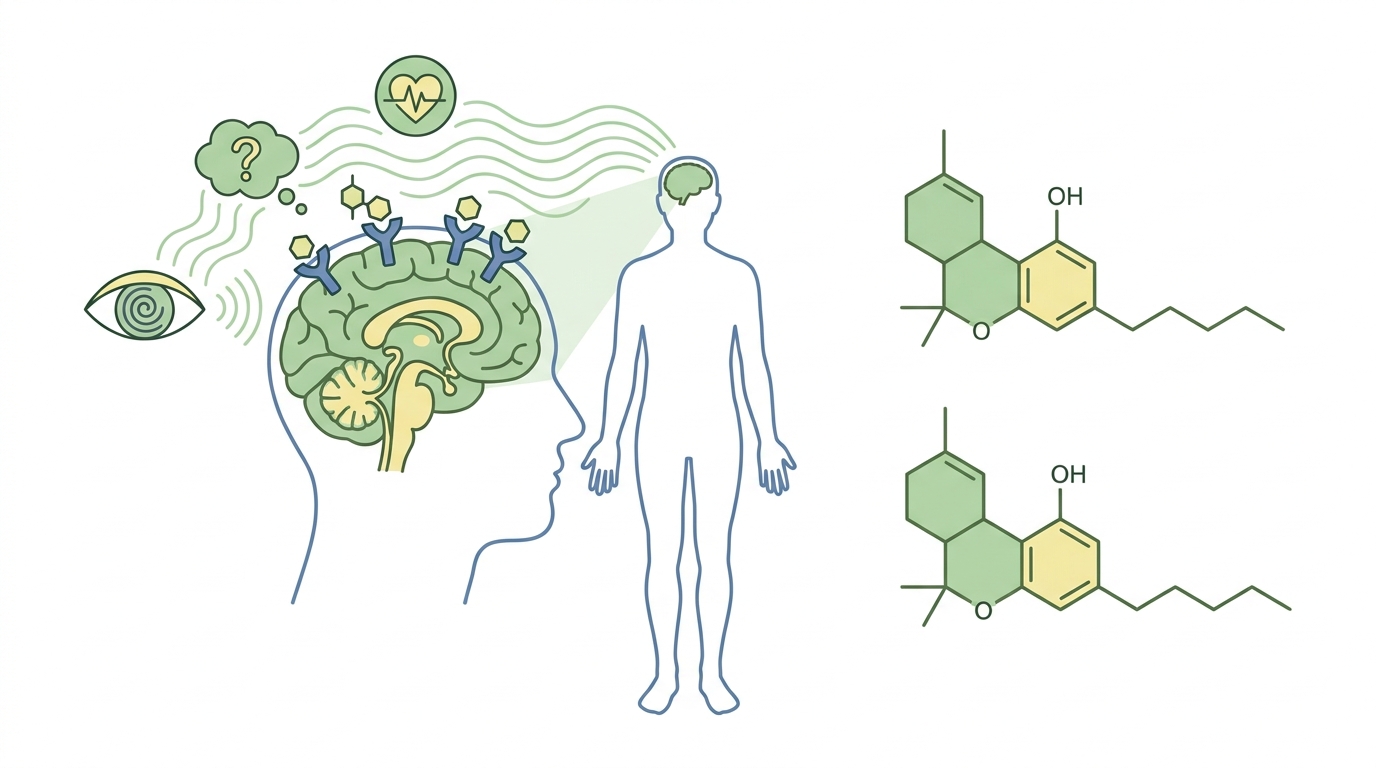
The chemical `THC` is similar to the chemical `Anandamide` that is naturally produced in our bodies. So, `THC` can act like `Anandamide` and attach to `Anandamide` receptors in certain parts of the brain. In this way, the `THC` in marijuana activates the parts of the brain that have the most of these receptors, causing various effects.
Here are some short-term effects related to brain function:
- Changes in sensory perception. This means that colors may appear brighter than usual, and smells may be more intense.
- Altered perception of time and space.
- Unusual happiness (Euphoria) and mood changes.
- Difficulty thinking and solving problems.
- Memory impairment.
- Confusion and disorientation.
- Feeling light-headed and/or drowsy (sedation).
- Dizziness.
- Problems with body balance (Coordination).
- Slow response speed.
- Sometimes, a state of anxiety can occur, like a panic attack .
If you take high doses of marijuana, the following things can happen:
- Hallucinations are the feeling of seeing or hearing things that are not really there.
- Strong belief in things that are not true (Delusions).
- Psychosis. This risk is higher if you are a regular marijuana user.
Other common short-term effects:
- Dry mouth.
- Nausea.
- Increased heart rate (up to three hours after smoking).
- Increased appetite.
Long-term effects
Researchers are still learning about the long-term effects of marijuana use. Here are some of the findings so far:
- Marijuana, especially when used at a young age, before the brain is fully developed , can affect the way certain connections are made in the brain. It can affect things like attention, memory, and learning. These effects can be long-lasting and even permanent .
- Smoking anything, including marijuana, can damage the lungs, increase the risk of bronchitis, and cause scarring of small blood vessels.
- Smoking marijuana can increase the risk of stroke, heart disease, and other vascular diseases .
- Vaping products containing THC has been linked to lung problems, and possibly even death.
- People who use marijuana frequently and have a genetic predisposition to developing psychoses, such as schizophrenia , are at increased risk of developing these diseases.
- People who use high doses of THC for a long time are at risk of developing a condition called Cannabis hyperemesis syndrome, which causes frequent and severe vomiting.
Studies show that long-term marijuana use is associated with:
- Periodontal disease.
- People with sickle cell disease often experience painful conditions.
- Disruption of the sperm production process (spermatogenesis) can affect fertility.
Are there any benefits to using marijuana?
To be honest, scientists and doctors can't say for sure that marijuana has these general benefits. That's because there hasn't been enough research on the drug's medical benefits, especially its long-term effects. And the way marijuana affects each person is very different.
Although each person may claim to have received some personal benefits, it is difficult to come to firm conclusions due to all these factors.
What are the risks of using marijuana?
In addition to the immediate and long-term health effects of marijuana use, there are several other risks:
- Marijuana use is associated with an increased risk of car accidents.
- Among adults over the age of 65, marijuana use is associated with an increased risk of accidents.
- Some cannabis/marijuana products may be contaminated with germs, pesticides, or other harmful substances.
- Some cannabis/marijuana products may contain significantly different amounts of cannabinoids than what is stated on the label.
What is Cannabis Use Disorder?
About one in 10 adults who use marijuana develop a condition called Cannabis Use Disorder . This is also a type of substance use disorder (SUD) . Simply put, it is a mental health condition. This condition occurs when a person's pattern of using a drug becomes problematic and causes distress or disruption to their life. When this becomes severe, we call it addiction .
Importantly, young children who use cannabis are four to seven times more likely than adults to develop cannabis use disorder.
This condition can have a significant impact on your health, relationships, and overall quality of life. Therefore, it is very important to seek help as soon as symptoms of this condition begin to appear.
Marijuana and pregnancy
This is a matter of great concern. Medical institutions such as the FDA strongly advise against using anything containing `CBD` or `THC`, including marijuana, during pregnancy or while breastfeeding.
Marijuana use during pregnancy can cause the following:
- It can affect the development of a baby's brain in the womb. THC can enter the fetus's brain from the mother's bloodstream. Studies show that this exposure can affect a child's attention, memory, and problem-solving abilities.
- The risk of having a low birth weight baby may increase.
- The risk of premature birth and possibly stillbirth may increase.
Breast milk can contain THC for up to six days after using marijuana. Therefore, you should avoid using marijuana while breastfeeding . THC can affect your baby's brain development.
Marijuana smoke contains many of the same harmful components as tobacco smoke. Therefore, you should avoid smoking marijuana in the presence of babies or young children.
Finally, things to remember
As you can see, marijuana has a number of short-term and long-term effects. Many of these are still being studied by scientists. Therefore, it is important to be very careful when using marijuana and other cannabis products.
If you want to learn more about the medical uses of marijuana, or if you think you may have a marijuana use disorder, be sure to talk to your doctor . They are there to help you.
Remember, your health is the most valuable thing. Therefore, it is very important to research everything thoroughly before using anything, especially seeking medical advice.
` Marijuana, hemp, THC, CBD, drugs, health effects, addiction
Doctor's Note
Marijuana (Marijuana) or Cannabis (Cannabis) is a medicinal plant that changes mental function. The chemical THC (Tetrahydrocannabinol) contained in it affects brain function and causes stimulation (High), while the chemical CBD (Cannabidiol) is widely used for medical treatment. Long-term and misuse of marijuana can cause memory loss, lung problems, and addiction. So it is dangerous to use this without medical advice.
❓ Some more questions you may encounter (FAQ)
For what diseases is medical cannabis used?▼
Administered under medical supervision to relieve severe cancer pain, control epilepsy, and control vomiting after cancer chemotherapy.
How does marijuana affect the brain?▼
It changes the brain's messaging pattern and can temporarily or permanently impair decision-making, memory, and coordination.
Is marijuana use addictive?▼
It changes the brain's messaging pattern and can temporarily or permanently impair decision-making, memory, and coordination.





💬 Comments (0)
No comments yet. Be the first to share your thoughts here.
Add Your Comment