
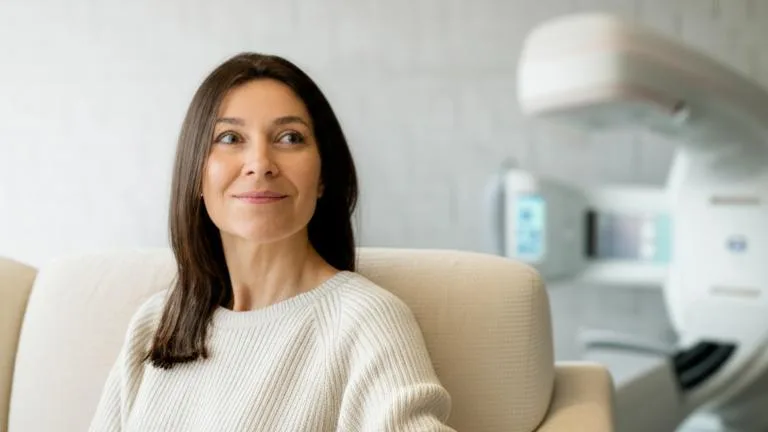
" Radiation " or "radiation" may sound a little scary to you when you hear the word. But it is actually a very successful, advanced, and widely used treatment for breast cancer. Today, we are going to talk about this treatment in a simple way, eliminating all your questions, concerns, and fears.
Simply put, what is radiation therapy?
Think of cancer cells in our bodies as weeds. Radiation therapy is like using a special drug to kill these weeds. Here, high-energy rays (similar to X-rays, but much more powerful) are used to kill cancer cells, or stop them from growing, dividing, and spreading to other parts of the body.
The most important thing is that this treatment is very precisely targeted to the cancer , so there is very little damage to the surrounding healthy cells.
Main types of radiation therapy used for breast cancer
There are several main types of radiation therapy used for breast cancer. Your doctor will decide which method is best for you.
| Treatment method | Simply explained |
|---|---|
| External Beam Radiation Therapy | This is the most commonly used method. A large machine outside your body directs a beam of radiation aimed only at the area where the cancer is. |
| Internal radiation therapy (Brachytherapy) | Here, very small radioactive seeds (about the size of a grain of rice) are surgically placed inside your breast, near where the cancer was. These destroy the cancer cells from within. |
| Proton Therapy | This is also a type of external beam radiation therapy. However, a special proton beam is used here. The special thing about this is that these rays only go to the breast tissue and stop, and the risk of damage to the heart or lungs underneath is very low. |
In what situations is this treatment given?
There are several situations in which your doctor may recommend this treatment:
- After Lumpectomy: After the lump has been removed, this treatment is given to reduce the risk of cancer coming back in the same breast.
- After mastectomy : In some cases, this is given to prevent cancer from coming back in the chest wall or nearby lymph nodes, even after a mastectomy.
- Sometimes during surgery: Very rarely, radiation is given to the same area at the same time as the surgery to remove the tumor.
- In cases of advanced cancer: This treatment is also used to control symptoms such as pain caused by the spread of cancer.
Radiation therapy usually begins a few weeks after surgery. This is to give your body time to heal. If you have also been prescribed chemotherapy , you may start that first and then start radiation therapy.
Side effects that may occur during treatment
As with any treatment, radiation therapy can cause some side effects. But these are not the same for everyone. They vary depending on things like the dose received and the area treated. Don't worry, most of these are temporary.
| Type of side effect | Possible symptoms |
|---|---|
| Things that may occur during and shortly after treatment (short-term) | |
| Skin changes | The skin becomes red, swollen, and feels warm. It feels like a sunburn. The skin may become dry and flaky or moist and painful. |
| Fatigue | It's something that many people feel. It can even affect daily activities. |
| Other | Breast swelling, changes in skin texture, loss of armpit hair, and decreased sweating. |
| Things that may last long after treatment (long-term) | |
| Skin and breast changes | Slight skin discoloration, enlarged skin pores, thickening of the skin or tissue of the breast, slight change in breast size. |
| Very rare complications | |
| Rare complications | Damage to the ribs, effects on the heart or lungs, swelling of the arm (Lymphedema), pain in the chest wall. |
Important: If you notice any changes to your skin outside the treatment area, let your doctor or nurse know immediately.
What can be done about skin reactions?
It's very important to take care of your skin during treatment. These tips will help you.
- Keep the skin clean: Gently wash the treatment area with lukewarm water and a mild, unscented soap. Do not rub vigorously. Gently pat dry with a soft towel.
- Do not scratch: Do not scratch or pick at the treatment area. If you need to remove hair from the area, use only an electric razor.
- Don't apply anything: Don't apply anything (perfume, deodorant, powder) to the area except a cream or lotion prescribed by your doctor.
- Take care of your clothes: Wear soft, loose-fitting clothes like cotton instead of tight clothes or clothes made from rough fabrics like wool.
- Avoid heat: Do not place hot water bottles or ice packs on the treatment area.
- Protect yourself from the sun: Even after treatment, treated skin is very sensitive to sunlight. Avoid direct exposure to the sun. If you are going outside, apply a sun-screen with an SPF of 30 or higher. Wear long-sleeved clothing and a wide-brimmed hat.
How do you maintain your energy during treatment?
It's normal to feel tired during radiation treatment, so it's important to take good care of yourself.
- Get enough rest: Rest when you feel tired. Get enough sleep at night.
- Eat a nutritious diet: Eating a well-balanced diet will give your body energy and help it recover from side effects. If you have an appetite, talk to your doctor and seek advice from a dietitian if necessary.
- Do what you can: Reduce your daily activities and plan to take regular breaks. Your doctor will tell you if you need to limit your activities.
After treatment, your doctor will call you for follow-up appointments at regular intervals. Be sure to attend those appointments.
Take-Home Message
- Radiation therapy is a very advanced and effective treatment for breast cancer. Don't be unnecessarily afraid of it.
- This treatment is very precisely targeted to cancer cells, so damage to healthy tissue is minimal.
- Skin changes and fatigue are normal during treatment. These are manageable and often temporary.
- It is very important to take good care of the treated skin and protect it from the sun.
- Talk openly with your doctor about any questions, concerns, or fears you have. They are always ready to help you.


💬 Comments (0)
No comments yet. Be the first to share your thoughts here.
Add Your Comment