
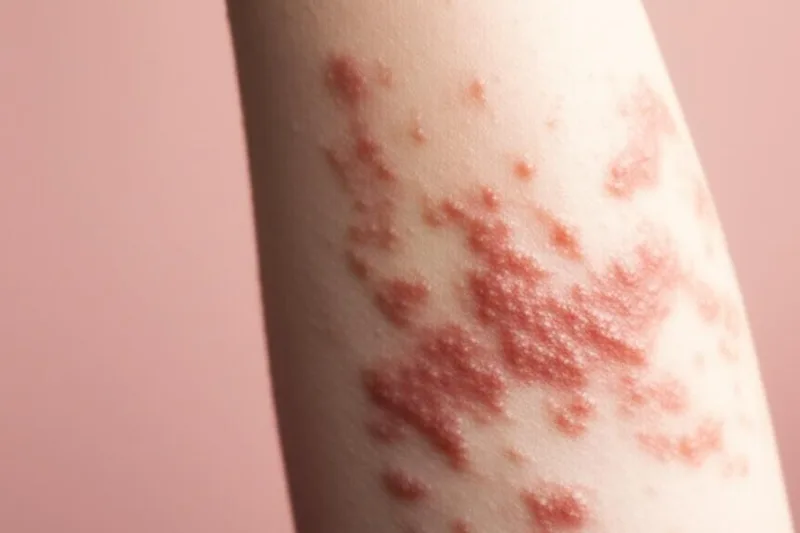
Have you ever suddenly developed red, itchy welts on your body that you have to scratch a lot? After a while, they disappear in one place and reappear in another. While this is normal for most people, sometimes it can be a bit serious. Today we are talking about this welt , or as doctors call it, Urticaria.
What are Urticaria and Angioedema?
Simply put, Urticaria is a type of raised, red (sometimes skin-colored) welts or spots that suddenly appear on the surface of the skin. We usually call these "hives." These welts are very itchy , and sometimes they can feel like a burning or stinging pain.
Just think, these spots can appear anywhere on the body. They can appear on the face, lips, tongue, throat, and even ears. The special thing about this is that these spots are not permanently located in one place. They can disappear completely from one place within a few hours and reappear in another place on the body. For some people, they may only appear once in their life and never come back. But for some, they occur repeatedly.
These lesions can range in size from the size of a pencil eraser to the size of a dinner plate , and can coalesce to form large plaques.
Now let's look at what Angioedema is. This is a little different from hives. Here, the swelling does not occur on the surface of the skin, but deep beneath the skin . It is most often seen around the eyes and lips . Sometimes this deep swelling can also occur in the hands, feet, and genitals. This swelling usually goes down within 24 hours, but sometimes it can last longer.
Although very rare, angioedema of the throat, tongue, or lungs can cause airway obstruction and difficulty breathing. This is a very serious and urgent condition.
Why is this happening to us? What are the reasons?
Allergies , chemicals in some foods, insect bites, sunlight, and some medications cause our body cells to release a chemical called histamine . This histamine causes blood plasma to leak out of the tiny blood vessels in the skin. That's what we see as Urticaria (hives) or Angioedema (swelling).
But to be honest, in many cases, even doctors cannot find a specific cause for this. We call it Idiopathic Urticaria.
| Main type | Description and main reasons |
|---|---|
| Acute Urticaria (sudden onset) | This lasts less than 6 weeks. The most common causes are foods (cashews, peanuts, fish, tomatoes, eggs, milk), medications (NSAIDs such as aspirin, ibuprofen), latex allergies, and various infections. |
| Chronic Urticaria (a condition that lasts for a long time) | This lasts for more than 6 weeks. Finding the cause is more difficult than Acute Urticaria. Sometimes it can be caused by a problem with the body's immune system, a long-standing infection, or hormonal problems. |
| Physical Urticaria (due to physical stimuli) | It is caused by direct physical stimulation to the skin. Examples: extreme cold, heat, sunlight, shock, pressure (such as a tight belt), sweating, and exercise. |
| Dermatographism (drawing on the skin) | This is a very strange type. When the skin is scratched with force, as if with a fingernail, it forms a scar along the scratched area. The meaning of this name is "writing on the skin." |
| Hereditary Angioedema | This is a painful, subcutaneous swelling. This is a rare condition that can be passed down through families from generation to generation. |
How does a doctor find this?
When you go to see a doctor, he will ask you a lot of questions. He will try to get an idea of the cause by asking you a lot of details, such as whether you ate anything strange before the symptoms appeared, whether you took any medicine, how long you have had them, and what time of day they are worse.
In addition, a physical examination will be performed. Skin tests or blood tests may also be done to see if you have any allergies.
What are the treatments for this?
The best and first step is to find the cause and avoid it . For example, if you are sure that a certain food is causing your symptoms, the best thing to do is to avoid that food. But as we mentioned earlier, finding the cause is not always easy.
Your doctor will usually give you a pill called an antihistamine . This works by controlling the action of histamine and reducing itching and swelling.
For a chronic condition, your doctor may prescribe a combination of antihistamines or other medications, such as steroids, on a daily basis.
In an emergency and serious situation, such as angioedema with difficulty breathing, an injection of epinephrine (adrenaline) or a steroid injection may need to be given in a hospital.
7 simple things you can do at home to relieve pain
You can try these things until the bruising and swelling subside:
- Don't bathe in hot water. Use lukewarm water. Hot water can make itching worse.
- Use a mild soap that does not have a strong scent.
- Place a cloth soaked in cold water or an ice pack (wrapped in a cloth) on the affected area.
- Try to sleep in a room as cold as possible.
- Wear loose, lightweight cotton clothing that is not tight.
- Apply an ointment recommended by your doctor or something like ``Calamine lotion`` to control itching.
- Apply a fragrance-free moisturizer several times a day to prevent skin dryness.
When should I see a doctor immediately?
This is the most important part of this article. If you have any of the following symptoms in addition to bruising or swelling, it is an emergency . Go to the nearest hospital Emergency Treatment Unit (ETU) without delay.
- If you feel dizzy
- If you make a whistling sound when breathing (Wheezing)
- If you have difficulty breathing
- If you feel chest tightness
- If your tongue, lips, or face suddenly swells
These symptoms indicate a risk of airway obstruction. Therefore, do not stay at home at a time like this, go to a hospital immediately.
Take-Home Message
- Urticaria (hives) is a common condition, but sometimes it can be serious.
- Angioedema is a deep swelling that occurs under the skin. Be especially careful of this swelling that occurs around the lips and eyes.
- If you can find the cause, avoid it. Don't worry if you can't find it, that's often the case.
- Use the antihistamines your doctor prescribes to relieve itching and swelling.
- Most importantly: If you have symptoms such as difficulty breathing, chest tightness, swelling of the tongue or face, it is an emergency. Go to a hospital's Emergency Department (ETU) immediately.


💬 Comments (0)
No comments yet. Be the first to share your thoughts here.
Add Your Comment