
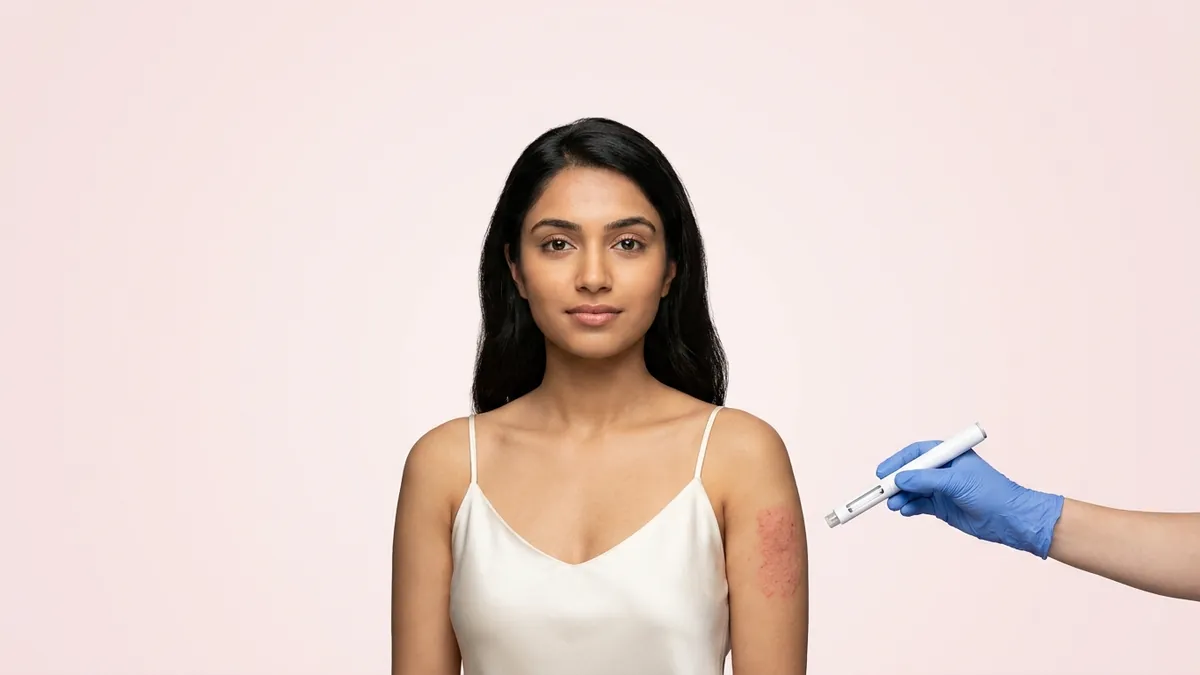
If you have been searching for Lebrikizumab (Ebglyss) for Moderate-to-Severe Eczema, chances are you are tired of waking up at 3 a.m. scratching raw, burning skin. Be honest, you have probably tried layering thick prescription steroid creams, soothing lotions, and cool compresses night after night, only for the angry red patches to roar right back, haven't you? We doctors see that exhaustion every single week in clinic.
That is why we want to sit down with you and talk plainly about lebrikizumab, known by its brand name Ebglyss. It is a modern targeted biologic medicine (a lab-made antibody treatment) designed specifically for moderate-to-severe eczema (atopic dermatitis). Instead of damping down your entire immune system like older tablets used to do, Ebglyss zeroes in on one specific chemical troublemaker under your skin—and after the first few months, many people only need a single home injection once every four weeks. Pretty encouraging, right?
📌 Key Takeaways at a Glance
- Targeted IL-13 Action: Lebrikizumab (Ebglyss) selectively blocks interleukin-13 (IL-13), a major immune signal behind eczema redness, skin barrier breakdown, and deep itch.
- Who Qualifies: Approved for adults and teens aged 12 years and older weighing at least 40 kg (88 lbs) whose eczema is not controlled by prescription creams or ointments.
- Monthly Maintenance Option: After a 16-week starter schedule (loading doses at Weeks 0 and 2, then every 2 weeks), responders drop down to one 250 mg injection every 4 weeks.
- No Routine Blood Tests: Unlike older systemic eczema drugs or oral JAK inhibitors, Ebglyss does not require regular liver, kidney, or blood-count lab monitoring.
- Watch Your Eyes: Mild pink eye (conjunctivitis) and injection-site redness are the most common side effects, so tell your doctor early if your eyes feel gritty or sore.
What Is Lebrikizumab (Ebglyss) for Moderate-to-Severe Eczema and How Does It Work?
Lebrikizumab (Ebglyss) is a targeted prescription biologic injection for adults and adolescents aged 12 and older with moderate-to-severe eczema (atopic dermatitis). It works by selectively blocking interleukin-13 (IL-13), a key immune protein driving skin inflammation and intense itch, offering a convenient once-monthly maintenance schedule after an initial 16-week loading phase.
Have you ever wondered why moderate-to-severe eczema keeps flaring up even when you moisturize faithfully? Think about it for a second. Eczema is not just dry skin on the surface—it is driven by an overactive immune signal deep beneath the skin barrier. In most people with moderate-to-severe eczema, one specific messenger protein called interleukin-13 (IL-13) is working overtime. IL-13 weakens the protective "mortar" between your skin cells, lets moisture escape, invites irritating bacteria in, and fires up the nerve endings that scream "scratch me!" all night long.
Look at what happens when lebrikizumab enters the picture. Lebrikizumab is a monoclonal antibody (monoclonal IgG4 biologic) that binds tightly to free-floating IL-13 and holds onto it tightly, preventing it from switching on the inflammation receptors on your skin cells. Makes sense, right? Because it leaves the rest of your immune defenses largely alone, it is not a broad immunosuppressant. We doctors typically discuss Ebglyss when standard prescription topical corticosteroids (steroid creams) or non-steroid creams are no longer enough, or when using strong creams across large areas of your body is no longer practical. Your Primary Care Physician (PCP) or family GP clinic can review your treatment history, examine your skin, rule out mimicking rashes, and refer you to a dermatologist who starts and supervises biologic therapy.
What Is the Exact Dosing Schedule for Ebglyss Injections?
One of the first questions patients ask us is, "How often do I actually have to poke myself with a needle?" We rarely stop to think about how much injection fatigue matters over a year, do we? With Ebglyss, the dosing schedule is split into two clear stages: a starter phase to calm the immune storm, followed by a lighter maintenance phase to keep your skin steady.
Phase 1: The 16-Week Starter (Induction) Schedule
Every dose is given as a shallow under-the-skin shot (subcutaneous injection) using a pre-filled auto-injector pen or pre-filled syringe containing 250 mg of medicine. Here is how the calendar unfolds:
- Week 0 (First Dose): 500 mg total, given as two separate 250 mg injections on the same day at two different body spots.
- Week 2: Another 500 mg loading dose (two 250 mg injections) to bring medicine levels up steadily.
- Weeks 4 through 14: One single 250 mg injection every 2 weeks until you reach your Week 16 check-in.
Phase 2: Once-Monthly Maintenance (Week 16 Onward)
At Week 16, your dermatologist evaluates how well your skin and itch have cleared. Once you achieve a solid clinical response, you transition to just one 250 mg injection every 4 weeks. Depending on local specialist guidance in the US, UK, Canada, or Australia, a small group of people who are improving slowly at Week 16 may stay on every-2-week shots for a few extra weeks before stepping down to monthly dosing. See? That's why we always personalize your follow-up.
For home injections, store Ebglyss in your fridge between 36°F and 46°F (2°C to 8°C)—never freeze it. Take your pen out about 45 minutes beforehand so it warms naturally to room temperature, which makes the shot sting far less. Inject into your belly (staying at least 2 inches or 5 cm away from your belly button), the front of your thighs, or the back of your upper arm if a partner or caregiver helps you. Always rotate spots and avoid bruised, scarred, or actively oozing eczema patches.
What Do the Clinical Trial Results Actually Show for Eczema Relief?
Before we doctors recommend a newer biologic, we look closely at hard numbers from large randomized clinical trials. For lebrikizumab, the three cornerstone Phase 3 studies are ADvocate 1, ADvocate 2 (testing Ebglyss on its own), and ADhere (testing Ebglyss alongside standard topical steroid creams). What do you think stood out most to dermatologists? Two things: steady itch relief early on, and impressive staying power once patients switched to monthly shots.
In the ADvocate 1 and ADvocate 2 trials, adults and teens with moderate-to-severe eczema received either Ebglyss alone or a placebo (dummy shot). By Week 16, roughly 52% to 59% of patients taking Ebglyss achieved at least a 75% reduction in overall eczema extent and severity (known medically as EASI-75), compared with only 16% to 18% on placebo. Furthermore, 33% to 43% reached completely clear or almost clear skin (an Investigator's Global Assessment score of 0 or 1), compared with just 11% to 13% on placebo.
What about combining Ebglyss with prescription steroid creams during flares? In the ADhere study, nearly 70% of participants using Ebglyss plus topical steroids hit EASI-75 by Week 16, versus about 42% using placebo plus topical steroids. Even better, noticeable itch relief often started around Weeks 2 to 4, helping sleep improve well before the 4-month mark. And remember how we talked about that once-monthly maintenance schedule earlier? When Week 16 responders stepped down to one injection every 4 weeks, roughly 77% to 82% kept their clear or nearly clear skin all the way to Week 52. Pretty surprising, right?
How Does Ebglyss Compare on Side Effects, Monitoring, and Everyday Practicalities?
No prescription medicine is completely free of side effects, so we doctors believe in laying out the full picture honestly. Overall, clinical trials showed lebrikizumab is well tolerated, and unlike oral Janus kinase inhibitors (JAK inhibitors) or traditional tablets like methotrexate, it carries no requirement for routine blood work. Still, a few specific reactions deserve your attention—especially eye irritation.
Below is a practical side-by-side guide showing the most common situations, side effects, and treatment comparisons we discuss with patients, along with the exact steps to take if they come up for you:
| Side Effect, Situation, or Comparison | What It Means & What You Should Do |
|---|---|
| Pink eye or gritty, dry eyes (Conjunctivitis / Keratitis) | Seen in roughly 7% to 10% of people on Ebglyss. Blocking IL-13 can temporarily reduce protective mucus cells on the eye surface, causing redness, watering, or a sandy feeling. What you should do: Use preservative-free lubricating eye drops for mild dryness and contact your Primary Care Physician (PCP), family GP clinic, or eye doctor promptly. Seek same-day care if you develop eye pain, light sensitivity, or blurry vision. |
| Injection-site redness, swelling, or mild itch | A localized skin reaction right where the needle entered is common during the first few doses and usually fades within a few days. What you should do: Let the pen warm to room temperature for 45 minutes before injecting, apply a cool damp cloth afterward, and rotate injection spots every dose. Tell your clinic if swelling spreads or looks infected. |
| Shingles (Herpes zoster) or cold sores | A small number of trial patients (around 1%) developed shingles, a painful blistering rash along one side of the body. What you should do: Ask your doctor about getting the non-live shingles vaccine before starting therapy if you are eligible. If you notice burning tingling followed by clustered blisters, visit your family doctor or local Urgent Care center within 48 hours for antiviral pills. |
| Missed Ebglyss dose | Life gets busy and people occasionally forget their injection day—that happens to the best of us. What you should do: Take the missed injection as soon as you remember, then resume your regular dosing calendar from that new date. Never double up two doses close together to "catch up," and call your pharmacist or dermatology nurse if you are unsure. |
| Vaccinations & parasitic infections | Live vaccines (like MMR, chickenpox, yellow fever, or nasal flu spray) should be avoided during treatment, and IL-13 also plays a role in fighting intestinal worms (helminths). What you should do: Review your vaccination record with your family GP clinic before starting Ebglyss so you can safely get inactivated shots (like the annual flu shot or COVID-19 booster). Let your doctor know about recent tropical travel or unexplained gut symptoms. |
| Ebglyss vs. Dupilumab (Dupixent) & Oral JAK Inhibitors | Dupixent blocks both IL-4 and IL-13 and is typically injected every 2 weeks long-term; Ebglyss selectively targets IL-13 with once-monthly maintenance after Week 16. Oral JAK inhibitors work fast as daily pills but carry stricter blood-test monitoring and heart/clot warnings. What you should do: Talk with your dermatologist about your needle comfort, travel habits, asthma or allergy history, and insurance or public health coverage (such as NHS, PBS, or provincial drug plans) before choosing. |
How Can You Support Your Skin Daily While Taking Lebrikizumab?
Just like we mentioned a moment ago, Ebglyss calms the immune fire from the inside, but rebuilding your outer skin barrier still needs gentle daily care. Think of the injection as turning down the thermostat, while your daily routine repairs the insulation in your walls. Makes sense, right?
Stick to short, lukewarm showers—5 to 10 minutes is plenty—using a soap-free, fragrance-free cleanser rather than bubbly scented body washes. Within three minutes of patting your skin gently with a soft towel, seal in moisture using a thick, plain cream or ointment (familiar local pharmacy staples like CeraVe, Cetaphil, Aveeno, QV, or Epaderm work wonderfully). If you live in a chilly northern US, Canadian, or UK winter with cranked-up indoor radiators, or spend long Australian summers in dry air conditioning, running a clean bedroom humidifier can noticeably cut overnight dryness.
Wash your sheets and breathable cotton clothing in dye-free, fragrance-free laundry detergent and skip scented fabric softeners. Also remember: never stop oral steroid tablets (like prednisone) cold turkey when starting Ebglyss—your doctor will guide a safe, gradual taper. And if you are pregnant, planning a baby, or breastfeeding, chat with your family doctor and dermatologist first so you can weigh the limited pregnancy safety data together.
✔️ What You Should Do & ❌ What to Avoid
- ✔️ Do keep a simple skin and itch diary: Jotting down weekly itch scores (0 to 10) and taking quick phone photos helps your dermatologist judge your Week 16 response accurately.
- ✔️ Do let the pen warm naturally: Leave your Ebglyss pen at room temperature for 45 minutes before injecting so the shot feels noticeably gentler.
- ✔️ Do continue daily moisturizing: Even when your skin looks smooth, daily fragrance-free ointment keeps your barrier resilient between monthly doses.
- ✔️ Do dispose of used pens safely: Drop every used auto-injector straight into an approved sharps container—never toss loose needles into household trash or recycling.
- ❌ Don't receive live vaccines without checking first: Avoid live attenuated shots (such as yellow fever, MMR, or nasal flu mist) while taking lebrikizumab.
- ❌ Don't shake, freeze, or microwave your pen: Extreme heat, freezing, or vigorous shaking damages the delicate biologic protein so it will not work properly.
- ❌ Don't stop other prescribed asthma or steroid medicines suddenly: Always taper existing prescription treatments under your doctor's direct supervision.
🚨 When to Seek Immediate Emergency Care (Red-Flag Symptoms)
If you or someone near you develops any of these red-flag symptoms, do not wait — call 911 (US & Canada), 999 or 111 (UK), or 000 (Australia) immediately or go straight to the nearest hospital Emergency Room (ER / A&E):
- Signs of a severe allergic reaction (anaphylaxis): Sudden swelling of your face, lips, tongue, or throat, trouble breathing, wheezing, chest tightness, widespread raised hives, or feeling faint and dizzy after an injection.
- Sudden vision changes or severe eye pain: Sharp eye pain, sudden blurriness, sensitivity to bright light, or thick yellow-green eye discharge that could signal a serious corneal infection.
- Rapidly spreading painful skin infection (eczema herpeticum or cellulitis): Sudden clusters of punched-out painful blisters, spreading hot red skin, pus, or a high fever with chills.
💡 Key Take-Home Message
- Lebrikizumab (Ebglyss) selectively targets IL-13 to calm moderate-to-severe eczema from within without broad immune suppression or routine blood tests.
- Most patients start with loading doses at Weeks 0 and 2, inject every 2 weeks through Week 14, and step down to a convenient once-monthly maintenance shot from Week 16 onward.
- Clinical trials show meaningful itch relief often begins within 2 to 4 weeks, and roughly four out of five Week 16 responders maintain clear or nearly clear skin at one year on monthly dosing.
- Partner closely with your Primary Care Physician (PCP) or family GP clinic and dermatologist—and speak up early if you notice red, gritty eyes or new skin blisters.


No comments yet. Be the first to share your question or experience below.