
Exploring the MILD Procedure (Minimally Invasive Lumbar Decompression) for Neurogenic Claudication: Standing Longer Without Back Fusion opens up a practical middle ground for older adults whose legs cramp, ache, or go heavy after just a few minutes on their feet. When you have a narrowed lower spinal canal (lumbar spinal stenosis), everyday chores like standing at the kitchen counter making scrambled eggs, queuing at the pharmacy, or strolling down a supermarket aisle can feel exhausting. Have you ever noticed how leaning forward over a shopping cart or sitting down on a park bench makes that heavy leg ache melt away within minutes? That classic pattern is what we doctors call nerve-related walking pain (neurogenic claudication).
For decades, patients fell into a frustrating treatment gap. Once physical therapy, anti-inflammatory tablets, and back injections stopped holding the pain at bay, the next step often jumped straight to open bone-trimming surgery or hardware-based spinal fusion. Many older adults living with heart conditions, diabetes, or brittle bones understandably hesitate before undergoing general anesthesia and months of surgical recovery. Makes sense, right?
Today, we doctors can refer eligible patients from your Primary Care Physician (PCP) or family GP clinic to an interventional spine or pain specialist for a tiny, image-guided outpatient option. By removing only the excess thickened ligament pressing on your spinal nerves—without cutting bone, placing screws, or fusing vertebrae—this percutaneous approach aims to restore standing endurance and walking distance while preserving your spine's natural stability.
📌 Key Takeaways at a Glance
- Targets the exact pinch point: The MILD procedure shaves away small slivers of overgrown spinal ligament (ligamentum flavum hypertrophy) that crowd up to 85% of narrowed lower spinal canals.
- Tiny opening, zero implants: Performed through a 5.1-millimeter skin portal—roughly the width of a baby aspirin—using live X-ray guidance, local numbing, and light twilight sedation.
- Preserves future options: No bone is fused and no metal spacers or screws are left behind, meaning your natural spinal mechanics remain intact.
- Clear MRI qualification cutoff: Best suited for patients with confirmed neurogenic claudication and a ligamentum flavum thickness greater than 2.5 millimeters on an MRI or CT scan.
- Fast outpatient recovery: Most patients walk out the same day and resume light household routines within 24 to 48 hours, with clinical studies showing standing time jumping from roughly 8 minutes to nearly an hour.
What Is the MILD Procedure (Minimally Invasive Lumbar Decompression) for Neurogenic Claudication, and How Does It Help You Stand Longer Without Back Fusion?
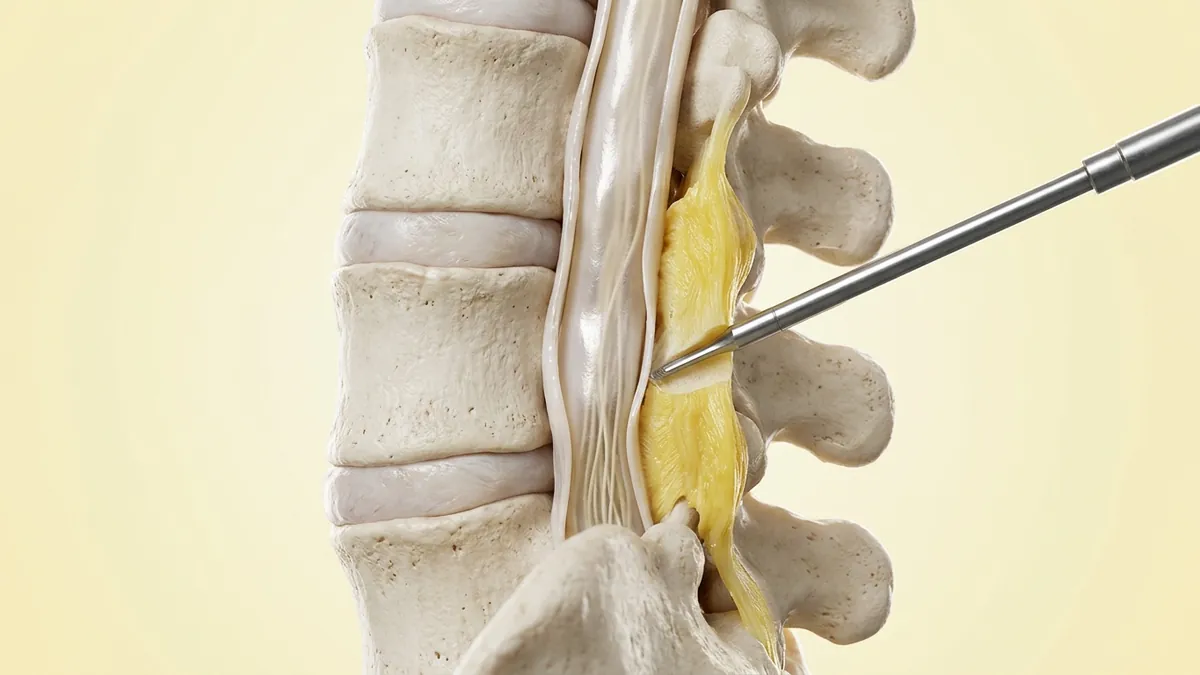
The MILD procedure (Minimally Invasive Lumbar Decompression) is an outpatient, X-ray-guided micro-treatment that relieves neurogenic claudication from lumbar spinal stenosis by trimming away tiny strips of overgrown spinal ligament through a five-millimeter skin opening, helping you stand longer and walk further without general anesthesia, stitches, implants, or back fusion.
Think about your lower spinal canal like a protective tunnel carrying delicate nerve roots down to your buttocks, thighs, and calves. As we age, wear-and-tear arthritis causes a supportive elastic band along the back of that tunnel—called the yellow ligament (ligamentum flavum)—to buckle inward and thicken like tough scar tissue. When you stand upright, that thickened band folds further into the tunnel and squeezes the nerves. Pretty surprising how a single thickened band can stop you in your tracks, right?
Instead of opening the back widely or bolting vertebrae together with rods and bone grafts, an interventional spine specialist slips specialized micro-instruments through a pencil-tip cannula to debulk just enough of the outer ligament layer. Look at what happens inside your spine here: removing even a few tiny fragments lowers fluid pressure inside the spinal canal and gives compressed nerves breathing room to receive fresh blood flow when you stand tall. Because the structural bones and joints stay untouched, there is no destabilization that would require spinal fusion.
How Does a Thickened Spinal Ligament Cause Neurogenic Claudication vs. Vascular Leg Pain?
Before we doctors ever recommend a spine procedure, we start at your Primary Care Physician (PCP) or family GP clinic with a careful history and physical exam to be certain your leg symptoms truly come from your lower back. Have you ever wondered why two neighbors can complain of the exact same calf cramping while walking the dog, yet need completely different treatments?
In central lumbar spinal stenosis, standing upright extends your lower back and narrows the cross-sectional area of your spinal canal by an extra 15% to 20%. When an overgrown ligamentum flavum—accounting for up to 85% of canal narrowing—presses against the bundle of lower spinal nerves (cauda equina), tiny veins around those nerves become congested. Starved of oxygen during standing, the nerves fire off heavy, cramping, tingling, or weak sensations down one or both legs. Leaning forward over a grocery cart or kitchen counter flexes the spine, stretches that buckled ligament flat, and eases the ache. Be honest, you have leaned on a shopping cart or trolley just like that to catch a break, haven't you?
By contrast, circulation-related leg cramping (vascular claudication) comes from narrowed leg arteries (peripheral artery disease). With blocked arteries, your calf muscles cramp whenever you walk because working muscles demand more blood—and simply standing still upright relieves the pain without needing to sit or bend forward. Hip joint arthritis (coxarthrosis) can also mimic back trouble, though it usually causes groin stiffness when putting on socks or getting out of a car. Checking your foot pulses, testing reflexes, and ordering an ankle-brachial blood pressure index alongside spinal imaging helps us separate these look-alikes cleanly.
Who Qualifies for the MILD Procedure, and What Are the Exact MRI Cutoffs and Contraindications?
Remember how we talked about that thickened yellow ligament earlier? Because MILD specifically trims soft ligament tissue rather than bone spurs or slipped discs, matching the right anatomy to the procedure is everything. We doctors follow a stepwise clinical evaluation before referring you to an interventional pain specialist or spine surgeon.
Evidence-Based Qualification Criteria
- Classic posture-dependent symptoms: You experience buttock, thigh, or calf heaviness, aching, or numbness triggered by standing or walking that consistently improves when sitting or bending forward.
- Confirmed imaging cutoff (>2.5 mm): A lower-back magnetic resonance scan (MRI) or computed tomography scan (CT) confirms central lumbar spinal stenosis with a ligamentum flavum thickness measuring greater than 2.5 millimeters (normal thickness is typically 2.0 mm or less, while symptomatic patients often measure 4.0 to 6.0 mm).
- Conservative care trial first: You have already tried reasonable first-line measures—such as flexion-based physical therapy, walking aids, acetaminophen or paracetamol, nonsteroidal anti-inflammatory drugs if safe for your kidneys and stomach, or an epidural steroid injection—without lasting functional relief.
Key Contraindications & Healthcare Access
You should not undergo MILD at a spinal level if you have unstable forward slippage of the vertebra (Grade III or higher spondylolisthesis), severe motor paralysis, active skin or systemic infection, uncorrected bleeding disorders, or prior open laminectomy surgery at that exact vertebral level (since scar tissue alters protective landmarks). In the United States, Medicare covers MILD nationwide under Percutaneous Image-Guided Lumbar Decompression (PILD) rules, while access across private US insurers, Canada, the UK private sector, and Australia depends on local interventional spine centers and regional coverage guidelines.
How Do You Prepare, and What Happens Step by Step During the Outpatient Procedure?
Walking into an ambulatory surgery center or hospital day-unit feels much less daunting when you know the exact routine ahead of time. Because no general breathing tube is required, older adults with mild cardiopulmonary conditions often tolerate the preparation far more smoothly than open surgery. What do you think—doesn't avoiding heavy general anesthesia take a huge weight off your mind?
- Medication and blood-thinner check (5–10 days prior): Your specialist coordinates directly with your family doctor or cardiologist before pausing blood thinners (anticoagulants or antiplatelets like apixaban, warfarin, or clopidogrel). Never stop heart or stroke tablets on your own without written medical clearance!
- Fasting and ride home (night before): Because light intravenous twilight sedation is typically paired with local skin numbing, you will usually stop solid food 6 to 8 hours beforehand and arrange for a trusted friend or family member to drive you home.
- Safety dye map (epidurogram): Lying comfortably face-down over a supportive pillow that gently flexes your lower back, your doctor injects a tiny droplet of X-ray contrast dye into the epidural space. This dye creates a visible safety barrier protecting the fluid sac around your spinal nerves (dura mater).
- Precision ligament sculpting (30–45 minutes): Through a single 5.1-millimeter nick in the skin, the physician uses a specialized bone rongeur and tissue sculptor under continuous fluoroscopic X-ray views to shave tiny chips off the dorsal side of the thickened ligament until the contrast line visibly relaxes and widens.
- Bandage closure: Once decompression at one or two levels (even on both left and right sides) is complete, the tiny tube slips out and a simple sterile adhesive strip covers the opening—zero stitches or staples needed.
How Does MILD Compare With Epidural Injections, Interspinous Spacers, Laminectomy, and Back Fusion?
Just like we mentioned at the beginning, spinal stenosis care works best as a ladder rather than an all-or-nothing leap. Look at the two-column guide below to compare where percutaneous ligament decompression sits alongside injections, spacer implants, and open surgical options when discussing next steps with your doctor.
| Treatment Option / Clinical Finding | How It Works & Action Step |
|---|---|
| Epidural Steroid Injections (ESIs) | Calms nerve-root inflammation temporarily with corticosteroid medicine, but cannot physically shrink a 4-millimeter thickened ligament. Relief often fades after weeks or a few months, and repeated steroid doses can thin bones or raise blood sugar. What you should do: Use one or two targeted injections to calm acute flare-ups or confirm your pain source, then ask about structural micro-decompression if relief wears off quickly. |
| MILD Procedure (Ligament >2.5 mm) | Physically removes excess overgrown ligament tissue through a 5.1-millimeter portal without implants or bone fusion. Clinical trials show over 80% complication-free safety equivalence to steroid shots, with multi-year durability in standing and walking gains. What you should do: Ask your PCP or pain specialist to measure your ligamentum flavum thickness on a recent lumbar MRI to check if it exceeds 2.5 millimeters. |
| Interspinous Spacer Implants | Places a small titanium or medical-grade device between the bony spinous processes at the back of your spine to prop the canal open as an "internal shopping cart." Leaves permanent hardware behind and carries a minor risk of bone spinous fracture. What you should do: Discuss spacers if bony narrowing (facet hypertrophy) dominates over soft ligament thickening and you want an implant-based alternative to open surgery. |
| Open Laminectomy (Without Fusion) | Surgically removes a wider window of vertebral bone, bone spurs, and ligament under general anesthesia. Delivers robust space creation for severe bony stenosis or large disc bulges, but requires muscle dissection and 4 to 8 weeks of recovery. What you should do: Consult a neurosurgeon or orthopedic spine surgeon when severe bony overgrowth, nerve weakness, or multi-tissue compression cannot be cleared percutaneously. |
| Decompression With Spinal Fusion | Permanently joins two or more vertebrae using screws, rods, and bone graft to stabilize a slipping or collapsing spine. Involves hospital admission, higher blood loss, longer rehab, and extra mechanical stress on neighboring spinal joints over time. What you should do: Reserve fusion strictly for true mechanical spinal instability, high-grade spondylolisthesis, or progressive spinal deformity confirmed on standing flexion-extension X-rays. |
What Does Real-World Recovery Look Like, and How Quickly Can You Walk Further?
We rarely stop to think about how quickly calf stamina drops after months of sitting to avoid nerve pain, do we? Setting realistic expectations helps you celebrate steady progress rather than expecting overnight magic. After an hour or two in the recovery bay sipping water or tea and taking a short supervised hallway walk, virtually all patients head home the same afternoon.
Mild soreness or bruising around the tiny lower-back Steri-Strip site is completely normal for two to four days—applying a wrapped ice pack for 15 minutes at a time and taking plain acetaminophen (paracetamol) if approved by your doctor usually settles it easily. Unlike open back surgery, we doctors encourage gentle daily walking starting the very next day! Reconditioning deconditioned hip and leg muscles is half the victory.
In landmark randomized clinical trials—including the Medicare-backed MiDAS ENCORE and MOTION studies—patients treated with MILD increased their average pain-free standing time from roughly 8 minutes at baseline to 56 minutes, while average walking distance more than tripled (jumping from roughly 295 feet to over 3,900 feet at one-year follow-up). Even better, fewer than 6% to 12% eventually needed open spine surgery over two to five years. Pair your newfound standing comfort with bone-friendly meals—like salmon, leafy greens, Greek yogurt, oatmeal, and plenty of water—plus low-impact stationary cycling or warm pool walking at your local recreation center.
✔️ What You Should Do & ❌ What to Avoid
- ✔️ Do keep the tiny dressing clean and dry: Leave the sterile adhesive strip in place for 3 to 5 days, taking brief sponge baths or careful showers only when cleared by your discharge instructions, and wait until the skin fully seals before soaking in a bathtub, hot tub, or swimming pool.
- ✔️ Do start short, frequent daily walks: Begin walking indoors or along a flat neighborhood sidewalk within 24 hours, gradually adding 3 to 5 minutes every few days to rebuild leg endurance.
- ✔️ Do bring your actual MRI images to your consult: Radiology reports sometimes mention "moderate central stenosis" without typing the exact millimeter thickness of the ligamentum flavum—having the digital images lets your specialist measure it directly.
- ❌ Don't lift heavy groceries, pets, or garden pots right away: Avoid lifting anything heavier than 5 to 10 pounds (about a gallon jug of milk or a full kettle) and skip heavy twisting, vacuuming, or snow shoveling for the first week.
- ❌ Don't restart blood thinners without checking your discharge sheet: Follow the exact hour and day given by your prescribing doctor to prevent deep spinal bruising (epidural hematoma).
- ❌ Don't expect arthritis stiffness in your back joints to vanish completely: Remember that MILD targets leg heaviness and standing endurance caused by pinched nerves—mild morning back stiffness from facet joint arthritis may still benefit from gentle stretching and heat.
🚨 When to Seek Immediate Emergency Care (Red-Flag Symptoms)
If you or someone near you develops any of these red-flag symptoms—either while living with spinal stenosis or after a spinal procedure—do not wait: call 911 (US & Canada), 999 or 111 (UK), or 000 (Australia) immediately or go straight to the nearest hospital Emergency Room (ER / A&E):
- Saddle numbness: Sudden numbness, tingling, or loss of sensation around your groin, inner thighs, buttocks, or rectal area (the areas that would touch a bicycle saddle).
- Bladder or bowel changes: New inability to pass urine (urinary retention), sudden unexplained incontinence of urine or stool, or inability to feel when your bladder is full—classic warning signs of cauda equina syndrome.
- Sudden foot drop or leg collapse: New or rapidly worsening weakness where your foot slaps the floor, you cannot lift your toes, or your knees buckle beneath you.
- Severe escalating back pain after a procedure: Intense, throbbing midline back pain accompanied by progressive leg numbness—especially if you take blood thinners—which requires urgent evaluation to rule out an epidural blood clot.
- Signs of spinal infection: A fever above 100.4°F (38.0°C), shaking chills, worsening redness, pus, foul drainage, or a clear watery fluid leak at the puncture site, or a severe headache that worsens sharply when sitting upright.
💡 Key Take-Home Message
- You do not have to choose between living in an armchair and undergoing major spinal fusion if thickened ligament tissue (>2.5 mm) is the main culprit squeezing your lower back nerves.
- Start with your Primary Care Physician (PCP) or family GP clinic to confirm neurogenic claudication, rule out leg artery blockages, and review a lumbar MRI with an interventional spine specialist.
- Even if you undergo MILD today, none of your spinal bones are fused or altered—keeping every future conservative or surgical option completely open.





No comments yet. Be the first to share your question or experience below.