
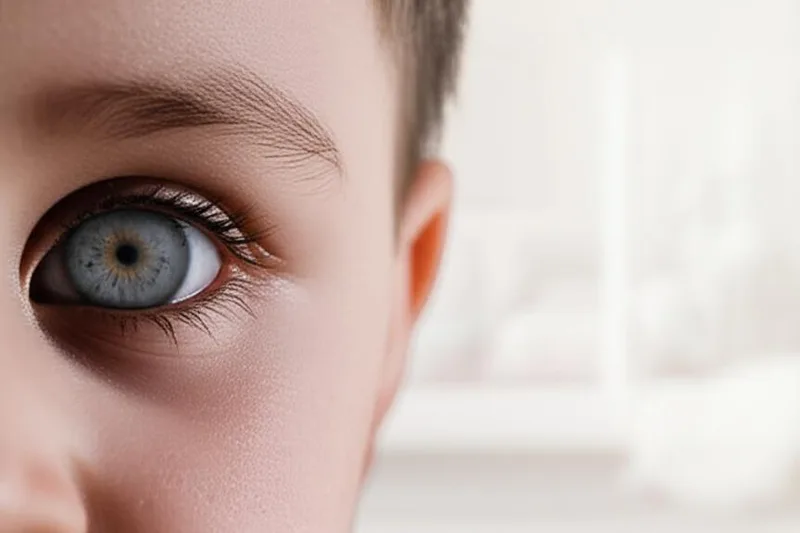
When you look at your little one's eyes, have you ever noticed that there's something different about one eye? Maybe the inside of the eye looks a little strange, or the baby's head is turned to one side, or one eye is bulging. It's normal for a parent to feel a little scared when they see things like this. Today we're going to talk about a condition that can affect the eyes, which is a bit rare but very important to know about. That's a condition called 'Morning Glory Syndrome '.
What is this 'Morning Glory Syndrome'?
Simply put, 'Morning Glory Syndrome' is a condition that occurs when the part of your eye that is inside your eye, the back, does not develop properly. Imagine, the main nerve that is related to vision is inside our eye, the place where it connects to the eye, that is, the part called the optic nerve root, which is in this condition, is in the shape of a funnel. It is like there is a flower called 'Morning Glory', and when a doctor looks into your eye's `(Retina)', it looks like he is looking into that flower. That is why it has been named 'Morning Glory Syndrome'.
This is caused by a problem with the development of the eye while the baby is still in the womb . It is often diagnosed very early, sometimes before the child is two years old. This 'Morning Glory Syndrome' (MGS) causes structural changes inside the eye that can affect your vision. It also increases the risk of developing various eye problems throughout life. It usually affects only one eye, but very rarely it can affect both eyes.
Another thing is, sometimes there may be only a difference in the appearance of this eye, that is, without any symptoms. In that case, specialists call it 'Morning Glory Disk Anomaly'. However, if this difference in appearance is accompanied by symptoms, then it is called 'Morning Glory Syndrome'.
How common is this situation?
Morning Glory Syndrome is a very rare condition . Worldwide, it is estimated to affect just over 63,000 children under the age of 20. Another interesting fact is that it is twice as common in girls as in boys. It is also said to be less common in black people.
What are the symptoms of this?
Not everyone with Morning Glory Syndrome (MGS) will experience the same symptoms. However, there are some common symptoms. The condition is twice as likely to affect the left eye than the right.
Eye-related symptoms:
- Myopia : This means that even though close objects can be seen clearly, distant objects appear blurry.
- Obvious vision problems: You may develop gaps or blind spots (scotomas) in your visual field. While it is normal for everyone to have a small natural blind spot in each eye, this blind spot may be larger than normal in the affected eye of someone with MGS.
- Strabismus: One or both eyes turn in different directions. We say "crossed eyes."
- White, silver, yellow, or grayish- white cornea (Leukocoria): The center of the eye, which normally appears black, may appear a different color. If you see this, you should definitely see a doctor immediately.
Symptoms that occur with other related conditions:
In addition to these eye-related symptoms, there are other health conditions that can occur along with Morning Glory Syndrome (MGS). These conditions include:
- Encephalocele (part of the brain protruding from the skull)
- Moyamoya disease (thinning of the blood vessels that supply blood to the brain)
- `PHACE syndrome`
- ``Neurofibromatosis type 2 (NF2)''
- ` Aicardi Syndrome `
- `Chiari malformation type I`
- `Duane syndrome` (sometimes called `Okihiro syndrome`)
These names may sound a bit complicated to you, but if a doctor suspects MGS, they will also look for other conditions like this.
What is the reason for this?
In fact, experts still don't have a clear idea of how Morning Glory Syndrome (MGS) develops. This is largely because it is a very rare condition and was first described as recently as 1969.
However, what experts do know is that the cause of MGS is related to some disruption in the development of the eye while the baby is still in the womb . This is thought to be related to the blood vessels that supply blood to the eye not developing properly, or to disruptions in the development of the eye and optic nerve.
One of the main pieces of evidence that suggests that blood vessel problems are involved is that MGS is twice as likely to affect the left eye. Normally, a developing fetus in the womb has small openings between the left and right sides of the heart. These usually close shortly before or a few days after birth.
However, if the embryo is prone to developing small blood clots (microemboli), those openings can allow a blood clot to travel from the left side of the heart to the right side. From there, it can travel to the brain. If there are any disruptions in the development of blood vessels, the clot can get stuck there, blocking the blood supply and preventing the tissue from growing properly. It is these kinds of events that have suggested that disruptions in blood vessel development contribute to MGS.
Although MGS can occur with genetic and hereditary conditions, research has not shown that these conditions directly cause MGS. Although there have been reports of several members of the same family developing MGS, it is not that common.
What complications can occur?
The most common complication of Morning Glory Syndrome (MGS) is retinal detachment . This condition can occur in up to 40% of people with MGS. This is a medical emergency .
Other complications may include:
- Low vision: Significantly reduced vision.
- Lazy eye (Amblyopia): Because the vision in one eye does not develop properly, the brain begins to ignore the signals from that eye.
- Neovascularization of the eye: This can affect vision.
- Retinal detachment (Retinoschisis) .
How do you recognize this?
An eye doctor, especially a retina specialist, can diagnose Morning Glory Syndrome (MGS) using a combination of methods, including asking about the symptoms you or your child are experiencing and the effects you are experiencing.
The doctor will also examine your (or your child's) vision, look directly into the affected eye, and possibly take pictures of the retina. Some specialized retinal imaging scans can also be very helpful.
Tests that can help in diagnosis are:
- An eye exam: This includes things like a visual acuity test, visual field test, and slit lamp exam.
- Optical Coherence Tomography (OCT): This can take cross-sectional images of the inside of the eye.
- Fluorescein Angiography: This examines the condition of the blood vessels inside the eye.
- Magnetic Resonance Imaging (MRI): This helps to see the structures around the brain and eyes.
Can this be cured? What are the treatments?
Morning Glory Syndrome (MGS) is a condition that occurs when the inside of your eye doesn't develop properly. The developmental changes can't be repaired or treated, and there's no cure . That means there's no direct treatment for Morning Glory Syndrome.
But don't worry. While there is no direct cure for MGS, the symptoms and complications it causes can be treated .
The main goals of treatment are as follows:
- Reversing a problem: For example, if the retina is detached, it can be repaired surgically.
- Limiting the impact of a problem: Wearing an eye patch to stop lazy eye from getting worse.
- Preventing further problems: If a retinal detachment occurs, it is important to fix it quickly to prevent permanent damage and vision loss.
Treatment options depend on your specific problem(s) and many other factors. Your doctor is best able to tell you which treatments are right for your situation and what they recommend.
What kind of future can someone with this condition expect?
Morning Glory Syndrome (MGS) is often diagnosed in childhood. It is a permanent, lifelong condition . It cannot be cured, reversed, or repaired. It is not life-threatening, but it can severely affect vision. More than a third of people with MGS experience retinal detachment.
Some people with MGS may have "normal" vision (20/20) or near-normal vision (between 20/20 and 20/70). However, many do not . The majority of people with MGS fall into the category of "partially sighted" (20/70 to 20/200) or "legally blind" (20/200 with corrections such as glasses).
On the other hand, people with MGS on one side should have their unaffected eye monitored closely, as that eye is also at higher risk of developing certain problems. Because MGS causes nearsightedness (myopia), there is a risk of retinal detachment, and myopia is a major risk factor for retinal detachment, whether or not MGS is present. The unaffected eye may also be at higher risk of developing cataracts.
Because MGS is diagnosed at an early age, treatment decisions are often made by parents or guardians. They also have a key role in being alert to signs or behaviors that may indicate a child has a vision problem related to MGS.
Can this be prevented?
Morning Glory Syndrome (MGS) is not preventable , and there is no way to reduce the risk of it occurring.
How do I take care of myself/my child?
If you or your child has MGS, the best thing you can do is to maintain your vision as best you can . Your eye specialist will guide you on how to do this. It is very important to follow your treatment instructions carefully, use your prescribed glasses or other treatments as recommended, and see your specialist for regular checkups.
When do you need to see a doctor soon?
If you have MGS, you are at high risk of developing retinal detachment. This is a medical emergency . Therefore, it is important to seek immediate treatment if you have any of the following symptoms. Prompt treatment can often prevent permanent damage and restore vision in the affected eye.
Symptoms of retinal detachment are:
- Sudden flashes of light (Photopsia): Like lightning.
- Black spots that appear to be floating or floaters that appear more than once: (It is normal to see some floating objects in front of the eyes, but if they suddenly increase, you need to pay attention).
- Blurred vision: This may feel like a black wave or curtain is coming and blocking your field of vision.
- Sudden blurred vision.
If you see any of these symptoms, go to a hospital without delay .
What questions should you ask the doctor?
You may want to ask your eye specialist these questions:
- How severe is my (or my child's) MGS?
- How will it affect my (or my child's) vision?
- What things should I look for if I think my child has a vision problem related to his MGS?
- Are there other medical conditions that could contribute to MGS in me (or my child)? Do I need a referral to another specialist?
Finally, things to remember
When you find out that your child or someone you care for has Morning Glory Syndrome (MGS), a rare condition in which the retina at the back of the eye doesn't develop properly, you may feel sad and disappointed. There is no direct treatment for this condition.
However, while MGS cannot be cured, many of the problems it causes can be treated . If your child has MGS, talk to their eye doctor. There are things you can do to limit the effects of this condition and prevent it from getting worse. Preserving your vision is the most important thing . With advances in eye surgery and other treatments today, it is more possible than ever before. So, don't give up hope. With the right medical advice and care, this condition can be managed.
` Morning Glory Syndrome, MGS, Eye Diseases, Retina, Pediatric Eye Diseases, Visual Impairment, Retinal Detachment


💬 Comments (0)
No comments yet. Be the first to share your thoughts here.
Add Your Comment