
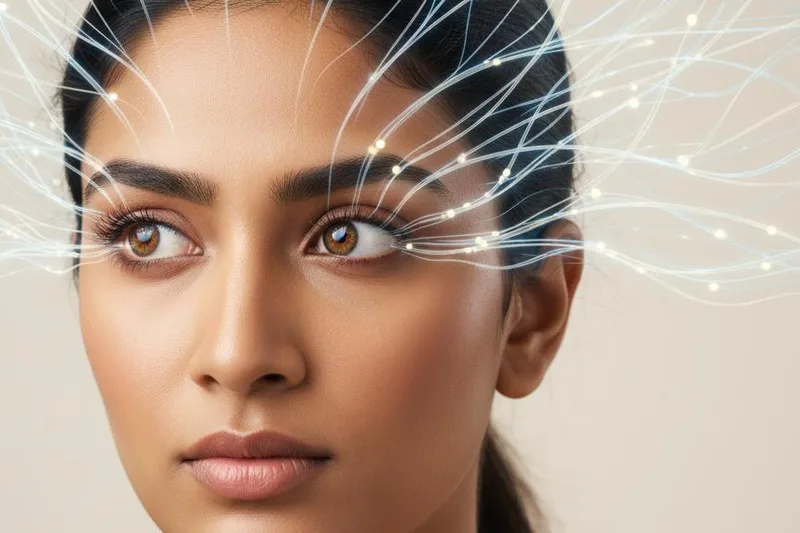
Have you ever wondered how quickly and precisely our eyes move when we read a book, look at a car on the road, or talk to someone? All of this happens almost like magic, without us even realizing it. So the main hero behind this amazing process is the oculomotor nerve, or what we medically call the `(Oculomotor Nerve)`. This is the third of the 12 main pairs of nerves that are directly connected to our brain. That is why we also call it `(CN III)`.
So what is the function of the oculomotor nerve?
Simply put, this nerve controls about seven muscles around your eyes. Although there are three main nerves involved in eye movement, this one does the most work. It's like the head manager in an office.
Imagine, your eyes are the two cameras in your body. These two cameras need to be turned, zoomed, and adjusted according to the light. All the buttons related to that task are located near this nerve.
Let's take a look at the table below to see what exactly happens with this nerve.
| Main function | A simple explanation |
|---|---|
| Eyelid lift | You open your eyes in the morning and keep them open all day because of signals from this nerve. |
| Rolling eyes up and down | This is what helps you look at a plane in the sky and at something that has fallen to the ground. |
| Rolling eyes towards the nose | If a fly lands on your nose, this nerve turns your eyes inward. |
| Pupil control | It is this same cilia that shrinks when exposed to bright sunlight to reduce the amount of light reaching the eye, and enlarges in the dark to absorb more light. |
| Focusing by controlling the lens of the eye | When you look at something far away and then suddenly try to read a book that's close up, this nerve changes the shape of the eye's lens to see clearly at both distances. |
But remember, this nerve is not the only one that controls all eye movements. Two other nerves help with two other minor tasks. They are the `(Trochlear nerve / CN IV)`, which helps the eye turn inward and look down, and the `(Abducens nerve / CN VI)`, which helps the eye turn outward (inward) .
Special abilities besides eye movement
This nerve, along with several other systems, helps us do many things properly.
- Accommodation: Imagine someone is throwing a ball at you. It is because of the activity of this nerve that you are able to continue to see the ball clearly, without it becoming blurry as it approaches.
- Scanning eye movements (Saccades): These are the rapid movements that move your eyes from word to word, line to line, when you read a newspaper or a book. They are also the same as when you look at people in a room from time to time.
- Smooth pursuit: This ability helps you smoothly pursue a vehicle on the road or a bird in the sky without taking your eyes off it.
- Vestibulo-ocular reflex: This helps you keep your gaze steady even when you turn your head quickly left or right. It works in conjunction with the system that controls your balance.
- Pupillary light reflex: This nerve controls the process by which the pupil of the eye contracts when a sudden bright light hits the eye, and enlarges when the light decreases.
What medical conditions can affect this nerve?
Like any other nerve in our body, the oculomotor nerve can be damaged by various diseases and accidents. The condition in which this nerve does not work properly is called ``Oculomotor nerve palsy.`` Here are some of the possible causes.
| Possible cause | What is happening? |
|---|---|
| Circulatory system problems | Especially poorly controlled diabetes mellitus and high blood pressure can reduce the blood supply to the nerve. This condition is called ``ischemia.'' This can damage the nerve and cause loss of function of the muscles it controls. |
| Injuries to the head and face | Injuries to the head or the area around the eye from an accident can directly damage this nerve. |
| Infections | Some bacterial and viral infections, such as Lyme disease, can disrupt nerve function. |
| Brain and nervous system diseases | This nerve can also be affected by diseases that affect brain function, such as stroke , migraine, and seizures. |
| Inflammation | Certain autoimmune conditions can cause the tissues around the nerves to swell, such as multiple sclerosis (MS). This swelling can damage the nerves and impair their function. |
| Tumors | This nerve can be compressed and damaged by tumors or common tumors in the brain. |
| Congenital conditions | Very rarely, problems can occur at birth due to the nerve or surrounding structures not developing properly. |
How do you know if there is a problem with this nerve? (Symptoms)
If there is weakness or damage to the oculomotor nerve, you may experience one or more of the following symptoms. These may start suddenly.
- Drooping eyelid (ptosis): A condition in which one eyelid appears to droop downward, unable to open normally.
- Strabismus: A condition in which one eye is turned in a different direction, with the eyes unable to point in the same direction .
- Double vision (diplopia): Seeing one thing as two.
- Blurred vision: Seeing things blurry, not being able to see clearly.
- Eye strain and headaches: Headaches can occur due to the extra strain on the eyes.
- Mydriasis: The iris of one eye is larger than the other and does not respond to light or responds very slowly.
If you suddenly experience symptoms like this, especially if you have a severe headache along with double vision, drooping eyelids, etc., it could be an emergency. In such a case, you should go to an ETU (Emergency Treatment Unit) as soon as possible.
What can we do to prevent these types of neurological disorders?
Just as we take care of our entire body, we should also think about the health of this nerve. It is very important to follow these things.
- Get annual medical checkups and eye exams. This can help detect many problems before symptoms appear.
- Avoid smoking, chewing tobacco, etc. completely. If you already use them, ask your doctor for help to stop.
- Avoid head injuries. Wear a helmet when riding bicycles and motorbikes. Wear a seat belt when riding in vehicles.
- If you have chronic diseases like diabetes or high blood pressure, control them well. Take the medicine prescribed by your doctor on time. Follow the instructions exactly as given.
Ultimately, this oculomotor nerve is a very important part that silently helps with almost everything we do on a daily basis. If you notice any changes in its functioning, the best thing to do is not to panic or panic, but to seek medical advice.
Take-Home Message
- The oculomotor nerve is the main nerve that controls most eye movements, eyelid lifting, and the size of the black eye.
- Common medical conditions such as poorly controlled diabetes and high blood pressure can damage this nerve.
- If you experience symptoms such as drooping eyelids, double vision (seeing two things), or difficulty turning one eye, it is important to see a doctor immediately.
- By following a healthy lifestyle and properly managing chronic diseases, we can protect our entire nervous system, including this nerve.




💬 Comments (0)
No comments yet. Be the first to share your thoughts here.
Add Your Comment