

Does your little one seem to have a cold? Does he feel like he's running a fever? The first thing we do in such cases is take his temperature. So, one way to check a young child's temperature is to take his temperature from the armpit. This is often easy, but today we'll talk about how to do it exactly and what to be careful of.
Why do we check for fever in the armpit? How accurate is it?
Now you might be wondering why we're asking you to take a temperature in your armpit. Simply put, this method is very easy for small babies who can't or don't like to hold a thermometer in their mouth, as well as for slightly older children. They can do it quickly without much hassle.
But here's a little something you should know. Axillary temperature is not 100 percent accurate as a rectal temperature or an oral temperature for an older child. The reason is that the armpit is an exposed area of the body, so this value can fluctuate a bit depending on the surrounding temperature and whether the child is sweating. But don't worry, this is a good way to get a basic idea of whether your child has a fever or not.
What do we need for this? What kind of bamboo skewer is good?
For this task, you mainly need a good thermometer. Nowadays, a digital thermometer is the most suitable and safest . Do you remember the glass thermometers that used to be filled with mercury? Oh, don't use them at all now, right? The reason is that if that glass thermometer breaks by mistake, the chemical substance called mercury can come out. This mercury is very harmful to our bodies as well as the environment. If something like that happens in a house with small children, it would be very dangerous, right? So definitely use a digital thermometer. These are easy to use, the value is clear, and they are safe. You can easily find one at a pharmacy or a baby shop.
How to prepare your child? What are some things to consider about the environment?
Okay, now you have a digital thermometer. The next important thing is to prepare the child for it.
- Don't check the temperature right after bathing: If you bathe your baby, or if he is well-dressed and has a lot of clothes on, or if he is a small baby , he should wait about 20 to 30 minutes before checking the temperature . Do you know why? At that time, the temperature on the surface of the baby's body may be different from the actual temperature inside the body. Because the body may be a little cold after bathing, and a little warm after being well-dressed. We want the baby's actual body temperature.
- Keep the child calm:It's hard to treat a fever when your child is crying and struggling. If possible, try to calm them down by talking to them, giving them a toy, or playing a cartoon they like.
- The armpit should be dry: If the child is sweating, wipe the armpit a little to dry it. If it is damp, the temperature will not be accurate.
- Clothing: When checking for fever, the child's outer clothing should be removed, as the fever needle should be placed directly on the skin.
The correct way to check your armpit temperature, step by step
Okay, now let's see how to do this exactly. Follow these steps.
1. Turn on the thermometer: Turn on your digital thermometer . Some have a small button. When you press it, it will either beep or turn on with a light.
2. Remove the child's top clothing: As mentioned earlier, remove the child's top clothing and expose the armpit.
3. Raise the arm: Slowly raise one of the child's arms so that the armpit is clearly visible.
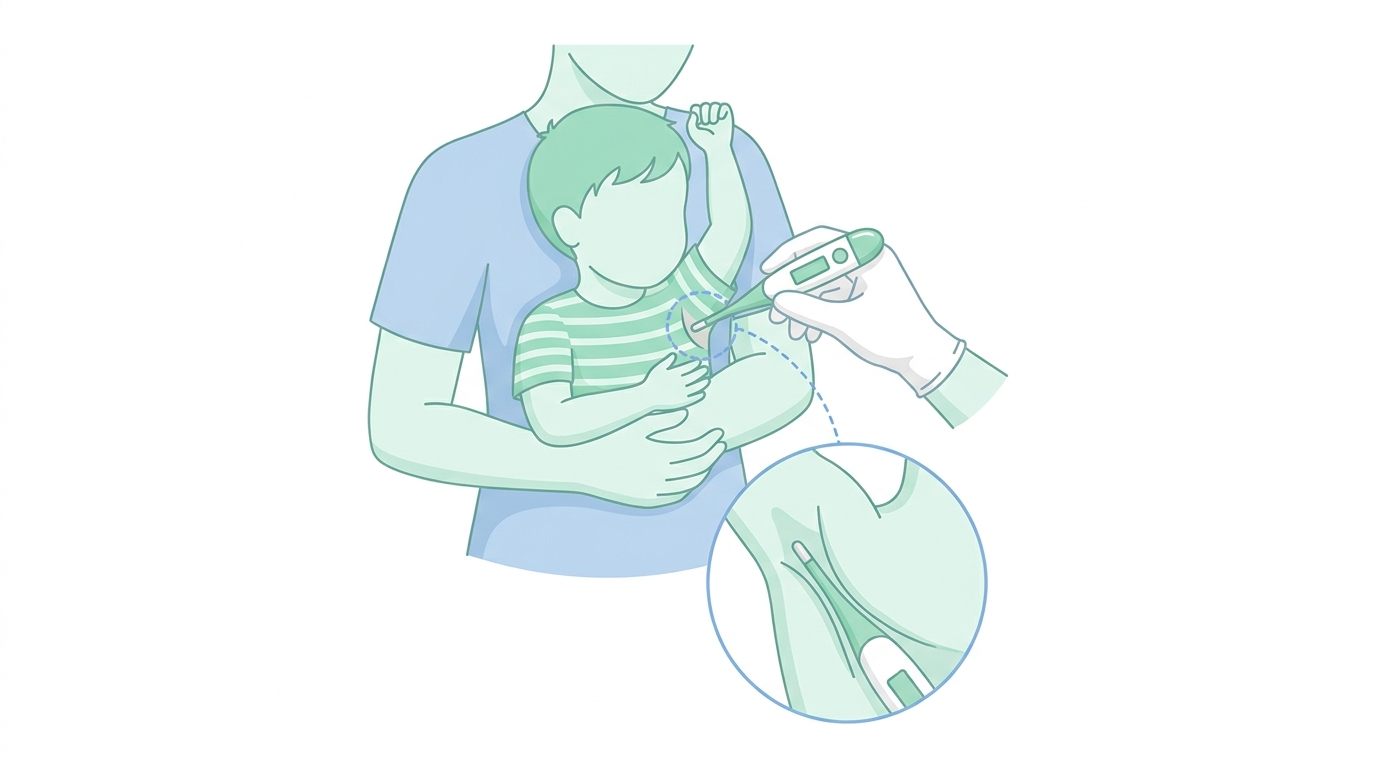
4. Place the tip of the thermometer inside the armpit: Now place the tip of the thermometer (where the sensor is) in the deepest part of the armpit, that is, in the middle of the armpit. This should touch the skin, it won't work if you put it over clothing, right?
5. Cross the arm across the chest: After placing the bamboo skewer in the armpit, cross the child's arm across the chest again. As if he were holding his own shoulder on the other side. This will keep the bamboo skewer stuck inside the armpit and not coming out. Hold the arm gently, but a little firmly.
6. Wait for the 'beep' sound: Most digital thermometers will beep when they are finished measuring the temperature. Leave the thermometer in place until you hear the beep. Some thermometers also recommend leaving it in place for about a minute. Check the instructions for your thermometer.
7. Read the temperature: After the 'beep' sound, slowly take the thermometer and read the value displayed on the screen. That is your child's armpit temperature.
How do you understand a fever? When should you see a doctor?
Now you've checked your temperature. There's a value. What should you understand by that?
Axillary temperature should generally be between 36.4°C (97.5°F) and 37.4°C (99.3°F) . This can vary slightly. Remember, armpit temperatures are usually 0.5°C to 1°C lower than oral temperatures.
When should we be concerned?
- For a baby under 3 months: An armpit temperature of 37.5°C (99.5°F) or higher is considered a fever . If a baby of this age develops a fever , they should be taken to a doctor immediately . Fever can be serious for very young babies.
- If your baby is between 3 and 6 months old: Axillary temperature of 38°C (100.4°F) or higherIf the child seems uncomfortable and refuses to eat or drink, see a doctor.
- If your child is over 6 months old: If the fever is 39°C (102.2°F) or higher , or if the fever has subsided but the child is very lethargic, lethargic, refuses to eat or drink, shows symptoms such as seizures, has difficulty breathing , or shows signs of dehydration (dry mouth, sunken eyes, decreased urine output), you should definitely see a doctor.
The most important thing is to pay attention not only to the temperature, but also to the child's behavior and other symptoms . Sometimes, even if the child has a slight fever, he or she may be playing and doing well. In such cases, do not worry. However, if the child is acting abnormally, seek medical advice, even if the fever is low.
Do these things to get a more accurate reading when taking a temperature from the armpit
To further increase the accuracy of taking a temperature from the armpit, remember these little things.
- The armpit should be dry , wipe it if there is sweat.
- Make the tip of the bamboo stick hit the deepest part of the armpit.
- Hold the child's hand tightly to his chest, and don't let the fever blister move around.
- Don't check your child's temperature right after they've been running around or playing, or after they've been crying a lot. Wait a while and check when they've calmed down.
- Hold the thermometer patiently until it beeps, or until the time it says is up.
Is it always better to check your temperature from the armpit?
Although it is convenient to check your temperature from the armpit, sometimes this is not the best method.
- If you need a very accurate temperature: For example, for a newborn baby, or when a doctor needs a very accurate value, taking a rectal temperature is the most accurate. But it is a bit difficult to do at home, and it is also difficult for the child.
- If your child is older and can hold the thermometer in their mouth: Taking their temperature through their mouth (oral temperature) may give them a more accurate reading than taking their temperature through their armpit.
- There are also new thermometers that are placed on the forehead (temporal artery thermometer) and ear (tympanic thermometer) . They are also convenient, but they can also have some issues with accuracy, if not used correctly.
So, taking a temperature from the armpit is a good initial test . But if there is any doubt, or if the child is very uncomfortable, it is wise to take the temperature in another way or seek medical advice.
What to do if your child doesn't want to see a fever? Let's also learn how to clean a fever blister.
Some children don't like having the bamboo skewer in their armpits. In such cases, don't scare them or try to hold them too tightly.
- If possible, explain why you are doing this in a simple way that they can understand. For example, "The baby is not feeling well, so I'm going to tell the doctor, Uncle/Auntie, that I have a fever."
- TheirsDivert attention. Sing a favorite song, tell a story, or show a cartoon.
- Do this calmly and lovingly . If you get nervous, the child will be even more scared.
Finally, don't forget to clean your bamboo skewer after using it. Wipe the tip of the bamboo skewer well with soapy water or a cotton ball soaked in alcohol . That way, it will be clean when you use it again.
So, here are some things to remember from what we've talked about:
I hope you now have a better understanding of taking axillary temperature.
- This is an easy method , especially for young children.
- However, keep in mind that it's not 100 percent accurate like other methods. It's best to get a basic idea.
- Use a digital thermometer . No more glass mercury thermometers!
- If the child has been bathed and well-wrapped before checking the temperature, wait 20-30 minutes before checking the temperature.
- The bamboo skewer should hit the skin , placing it in the deepest part of the armpit.
- Hold the child's arm across his chest.
- Along with the fever, pay attention to your child's behavior and other symptoms .
- If a baby under 3 months old has a fever (over 37.5°C in the armpit), see a doctor immediately.
- If you have any doubts, or if your child is in a lot of discomfort, don't delay seeking medical advice.
If you follow these steps correctly, you will be aware of your little one's body temperature and be able to take quick action when necessary.
` Taking a fever, Taking a fever from the armpit , Axillary temperature, Fever in children, Digital thermometer, Fever symptoms, Axillary Temperature
Doctor's Note
Axillary temperature is a simple and safe method that can be easily used at home to measure the temperature of young children. In this method, first make sure the baby's armpit is dry (wipe if sweaty). Place the metal tip of the digital thermometer in the middle of the armpit, and keep the child's hand folded down so that it is pressed against the body. Ignore the hand until the thermometer beeps. Keep in mind that the axillary reading can usually be about 0.5 degrees Celsius (1 Fahrenheit) lower than the rectal reading.
❓ Some more questions you may encounter (FAQ)
What is the main thing to pay attention to when looking at fever from the armpit (Axillary temperature)?▼
Since the temperature will not be accurate if the armpit is sweaty, the armpit should be thoroughly wiped and kept dry before placing the thermometer.
Is there a difference between the armpit value and the rectal value?▼
yes Armpit temperature is usually about 0.5 degrees Celsius (1 Fahrenheit) lower than the actual internal body temperature.
Why is it inappropriate to use mercury thermometers?▼
Since mercury thermometers are made of glass, there is a risk of breakage, and mercury is a heavy metal that is extremely toxic to the body. So always use only digital thermometers.


💬 Comments (0)
No comments yet. Be the first to share your thoughts here.
Add Your Comment