

Your little one is now one month old, which is a very special time for both of you, isn't it? During this month, your baby is slowly getting used to the world and learning new things. So, a well-child visit during this first month is very important. Let's take a look at what happens during this visit and what you should expect.
What happens in this test?
When you go to the clinic with your baby, the doctor or nurse will meet you and do these things.
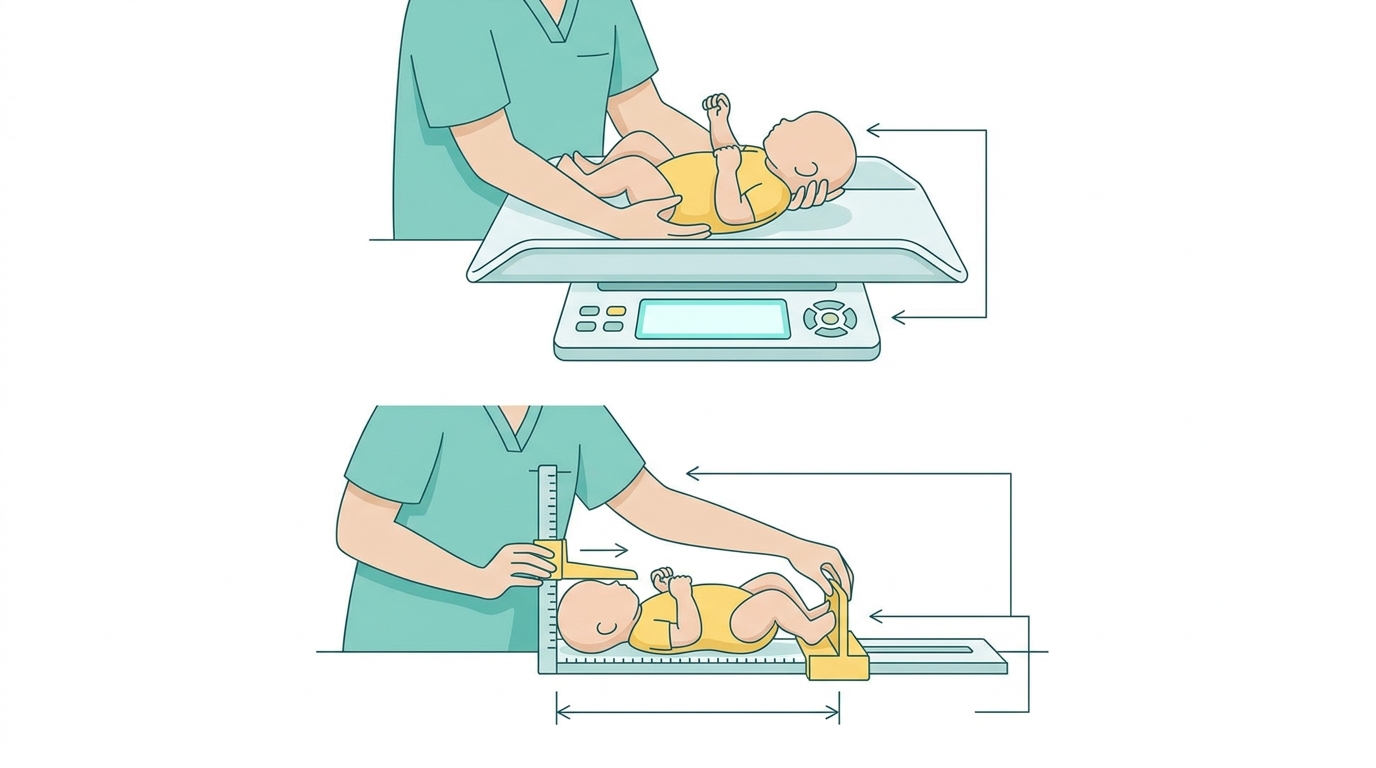
1. Measuring the baby's growth
The first thing to do is to measure the baby's weight, height, and head circumference . These measurements are then plotted on a growth chart. This helps you to see if the baby is growing properly.
2. Questions the doctor asks and advice he gives
Next, the doctor will ask you about your baby, answer any questions you may have, and give you valuable advice. He will mainly talk about these things:
About food and drink
- Feeding method: Feed your baby whenever he seems hungry. If you are breastfeeding at this age, he will feed about 8-12 times in 24 hours. If you are formula-fed , he will feed about 24 ounces a day. Don't forget to give him a goody bag during and after feeding.
About how to urinate and defecate
- Number of wet diapers: You should wet about 6 diapers per day.
- Frequency of pooping: Breastfed babies may poop 3 or more times a day. However, by about 6 weeks of age, some breastfed babies may not poop for several days. Formula-fed babies should poop at least once a day. If you have any concerns about this, talk to your doctor.
About sleep
- Sleep: Babies this age sleep about 14-17 hours a day. This includes short naps during the day. Breastfed babies may wake up frequently at night to feed. Formula-fed babies may sleep for a little longer.
Developmental Milestones
By one month, your baby should be doing things like this:
- They look closely at faces and things moving around, turning their heads in that direction.
- When they hear a sound, they become silent, blink , turn their heads, flinch, or cry.
- Even though the limbs are still slightly bent, the legs are slowly starting to open.
- Both arms and both legs shake in both directions.
- If you put your baby in the crawling position (Tummy Time), they will lift their head for a while.
- These age-specific reflexes (Newborn Reflexes) should be well-developed:
- Rooting Reflex and Sucking Reflex: When something is brought close to the lips, the baby turns its head in that direction and tries to suck.
- Grasp Reflex: If you put a finger on your hand, you will grasp it tightly.
- Tonic Neck Reflex / Fencer's Pose: When the head is turned to one side, the arm on that side is extended and the arm on the other side is bent. Like a swordsman.
- Moro Reflex / Startle Response: When suddenly startled, the arms and legs are spread out and then brought back in.
3. Complete body examination
You will first undress your baby and perform a complete physical exam. This will include checking the baby's eyes, listening to the heart, checking the pulse, examining the abdomen, and examining the hips.
4. Special tests (Screening Tests)
The doctor will review the results of the newborn screening tests done at the hospital. If necessary, some tests will be repeated. If the hearing test was not done at that time, it will be done this time.
5. Giving Vaccines
Vaccines are very important to protect your baby from serious diseases. Therefore, it is important to give them the vaccines on time. Vaccine schedules may vary slightly from one medical center to another. So, talk to your doctor about it.
6. Pay attention to the mother's mental health
Postpartum depression is a common condition among mothers after having a baby, so your doctor may ask you some questions about your mental health and may have you fill out a short questionnaire. This is for your own good.
Keep these things in mind until your next monthly checkup.
Okay, now let's see what things you need to take care of your baby until the two-month checkup.
Let's take care of food and drink.
- Feed your puppy when he feels hungry . Also pay attention to signs of fullness (moving away from the milk, covering his mouth). Between 6 and 8 weeks, your puppy may experience a Growth Spurt'', which is when he is hungrier than usual.
- Do not give solid foods or fruit juice.
- Do not put things like cereal in your baby's milk bottle unless specifically instructed to do so by the doctor.
- Send goodies during and after breastfeeding.
If breastfeeding:
- If you haven't started yet, you can pump and save your breast milk for future use.
-If breastfeeding is going well, there is nothing wrong with giving a bottle or a pacifier. However, if your baby refuses the bottle when you give it, try having someone else give the bottle.
- Take a multivitamin for mothers daily.
- Ask the doctor if you need to give your baby Vitamin D drops.
If you are giving powdered milk:
- Give the baby formula containing iron.
- Follow the instructions on the powdered milk package exactly (when making and storing). Do not add water in addition to the milk.
- Do not feed the baby by leaving the bottle somewhere, or put the baby to sleep with the bottle in his mouth.
- If you are switching to a different type of formula, talk to your doctor first.
Daily care and health
- Wash your hands thoroughly before handling the baby. Ask other people who come into the house to do the same. Keep the baby away from people who are sick.
- Take care of the baby, take care of its needs . It doesn't hurt to pick up the little ones.
- Sing songs, talk, and read books to your baby. Babies learn best when they are around people.
- While your baby is awake, spend some time in the "crawling position" (Tummy Time) under your supervision. Keep an eye on your baby during this time, and help if he seems tired or struggling.
- It is normal for babies to cry for no reason at times (fussy periods). However, for some babies, this crying can be excessive, lasting for hours a day. If a baby with no other health problems develops colic, it usually starts around 3 weeks of age, peaks around 6 weeks, and subsides by about 3 months.
- If your baby's rectal temperature is 38 degrees Celsius (100.4 Fahrenheit) or higher, call your doctor immediately . If your baby seems sick, call your doctor. Do not give any medicine to a baby under 2 months of age without first talking to a doctor.
- It's normal to feel tired and stressed as a new mother. But if these feelings are too strong, or if you feel sad, anxious, or often irritable, talk to your doctor.
- If you have questions about your living situation (do you have the things you need to take care of your baby? Do you have enough food, a safe place to live, health insurance?), talk to your doctor. They can help you connect you with community resources or a social worker.
Baby's safety (Safety First!)
You have to be very careful about these things.
How to reduce the risk of Sudden Infant Death Syndrome (SIDS)?
SIDS is the sudden death of a healthy baby while sleeping. Here are some things you can do to prevent it:
- Always put your baby to sleep face-up, on a flat, firm mattress, in a crib or bassinet. Do not put your baby to sleep on their stomach or on their side. Do not put crib bumpers, blankets, pillows, or soft toys in the crib.
- Breastfeed if possible.
- Until your baby's first birthday, at least 6 months (the risk of SIDS is highest during this time), sleep in a separate crib in your room, next to your bed . (Not in bed - no bed-sharing).
- Keep the room temperature comfortable and prevent the baby from overheating . Dress the baby appropriately for the room temperature, and do not overdress. Do not cover the head while sleeping. Check for sweating and body heat.
- Consider giving your baby a pacifier to suck on to help him sleep . If your baby doesn't like the pacifier, don't force it. If the pacifier leaves his mouth while he's sleeping, you don't need to put it back in. If you're breastfeeding, give him the pacifier after he's gotten used to breastfeeding.
- Do not let your baby sleep in inappropriate sleeping positions, such as in a sitting device (like a car seat), a nursing pillow (like a Boppy pillow), or some devices that allow babies to lie down (like Dock-a-Tot, Podster, Bummzie).
- Do not use any devices (such as sleep positioners, heart rate and breathing monitors) that claim to reduce the risk of SIDS. There is no product that actually does that.
- Make sure that everything you use for your baby's sleep, including bedding and mattresses, meets safety standards approved by a reputable agency, such as the US Consumer Product Safety Commission (CPSC).
Other important safety tips
- Do not smoke or use e-cigarettes . Do not allow anyone to smoke or vape in the area where your baby is.
- Always place your baby in the back seat of the car, in a rear-facing car seat . Never leave your baby alone in the car.
- Keep all toys with ropes, wires, and loops away from your baby.
- Do not leave your baby alone while he is awake, especially in high places or during bath time.
- Never shake your baby! Doing so can cause brain bleeding and even death. This is called Shaken Baby Syndrome. If you ever feel angry or worried that you might hurt your baby, put your baby safely in the crib and get away for a few minutes. Call a friend, relative, or your doctor for help.
- Minimize sun exposure . Keep your baby covered and in the shade as much as possible. Sunscreen is not recommended for babies under 6 months of age. However, if shade and clothing do not provide adequate protection, a baby under 6 months of age can use a small amount of sunscreen.
Take-Home Message
So, simply put, this monthly well-baby checkup is the best opportunity to talk to your doctor about your baby's development, health, and safety.
Don't hesitate to ask your doctor about any concerns or fears you may have. Also, as a mother, it's important to take care of your own health. Only if you are healthy can you take good care of your baby.
I hope you find these tips helpful. I wish you and your little one good health!
Doctor's Note
The 1-Month Well-Child Visit (1-Month Well-Child Visit) is very important to assess the baby's early growth and nutrition. Here the doctor measures the baby's weight, height and head circumference and marks it in a growth chart. Baby's basic skills (Milestones) such as seeing, hearing and smiling are discussed here as well as the breastfeeding pattern. Also, the doctor will check if the scar has formed properly at the site where the BCG vaccine, which prevents tuberculosis, has been given.


💬 Comments (0)
No comments yet. Be the first to share your thoughts here.
Add Your Comment